This is very early electronic music, from White Noise’s first album from 1969. They were among the first to use synthesizers in a rock context and their music became very influential later on. This particular track seems indeed way ahead of its contemporaries, and it is pretty wild.
I didn’t know that at all. I had problems listening through it, it is almost disturbing. From today’s point of view it maybe is not that overtly experimental anymore, but setting it into the time of its production, it is very cool.
There certainly was not much comparable music back then.
The sound is very good. They already had synthesizers? There is a lot of space in the production. If you would not have told me, I would never have guessed that it is so old. The arrangement and the noisy parts reminded me of destructed Amen breaks, totally distorted. Very interesting.
Quartz – Chaos
The next one is by Quartz from France . Also early synthesizer music, but within a disco context.
I was not into that at all. My calendar does not really start before 1990 or so. Even stuff like early Model 500, Cybotron, it is ok, but it’s not mine. I also can’t get into Kraftwerk. What has been called techno from 1990 on was what got me to listen to music consciously for the first time. I was never the one to check the influences on music that I like. I know Disco only from TV, Saturday Night Fever and such. I was never really interested in it.
Is that based on a basic antipathy towards the sounds of disco music?
There was a short period I found it exciting, around the time the filter and cut-up disco house arrived with DJ Sneak, all the sample stuff. But that was over pretty soon when all the records started to sound the same. So yes, it is based on principle that I don’t like the sounds too much.
So you were more interested in how a track was built on samples than where they came from?
Exactly. It was fascinating to me how all could be said in a loop that went for three minutes, if it was a cool one. Longer than that it could get boring. Of course you can’t compare that to what happens in the original disco track, there was more happening there than in house tracks, which only used bits. It was interesting that many people used the same samples and you became aware that there must some source for it. But sample based productions are not my philosophy. I never wanted to just use bits of other people’s music.
Those disco house records also did not always pay tribute to disco, they deconstructed it, and often in a not very respectful manner.
Not at all. It’s strange how American producers often deal with each other, all that stealing amongst themselves. But in the end we all benefited from that (laughs). Read the rest of this entry »
This is from an old French movie soundtrack, „Le Casse“. I picked this for the string arrangement, because it puts a lot of emphasis on build-up, thus linking to the way Disco producers arranged strings for climactic dancefloor moments.
To be honest, I muss confess I don’t know Morricone’s works so well. I don’t think I have been a really big fan, partially because I don’t know it so well. My first impression of this track, which I didn’t know, was that it’s a formal composition. In my head I make a distinction between pop music, which has almost very definite rules, and people following it like Abba. It’s not formulaic, but there are very basic chord progressions that are based on Blues and Jazz that you can do in pop music and that have their own logic and their own progression. Many pop songs are actually the same song. “Good Times” by Chic is one kind of groove and twenty other songs sound exactly like it. It could be “Rapture” by Blondie or something. That’s pop music writing. And then you have soundtrack music writing and it has a different logic. It doesn’t have to follow a certain progression like in pop music, which has a reason and an impulse that keeps on pushing the song forward. When I heard this I thought it is a very good example of soundtrack music writing where you don’t really have to explain the logic of the chord progression, it just sets a mood. It makes an ambience. I think this is probably from 1967 to 71.
Good guess, it’s from 1971.
Because from 1972 on you start getting the big multi-track stuff, like Philly Disco and the more sophisticated pop, and this still sounds relatively simple. My first impression was it’s like a slightly cheaper copy of Burt Bacharach’s “Raindrops Keep Fallin’ On My Head”, but with more drama. It has some very formal devices, like it’s basically a minor key. But at some points he plays the same theme but he opens it up with a major key.
Lately all this beautifully orchestrated obscure library music back is popping up again and people scan back catalogues for songs groovy enough to suit a Disco context.
Yeah, that’s interesting, and I think there is a good reason for that. There is such a thing as real music, in the sense that there were people who did music for films, like Ennio Morricone, or Giorgio Moroder, with a more naïve use of the rules, or the very sophisticated Henry Mancini, or Alec Constandinos, or Vangelis, or Jean-Michel Jarre. All these people were obviously classically trained and they followed the rules. It doesn’t really matter if it’s a Bossa Nova, 60’s GoGo or a Disco beat, the rules of the music don’t change. I think that is why everybody is going back now to find real music. When people like Masters At Work appeared in the 90’s, people who didn’t know anything about the basic rules of music started making music. That’s why it sounds so awful, haha. A lot of the DJ produced music doesn’t have its own intrinsic logic and sense. And chords, progression and melodies have that intrinsic logic. That’s what’s been missing. So everyone of this generation who wants to find out what is really musical has to go back to the 60’s and 70’s, and there you find it everywhere actually.
> Carter Burwell – Blood Simple
This is from the soundtrack of the Coen Brothers debut film “Blood Simple”.
It’s from the 80’s I suppose.
Yes, it’s from 1987. It’s a mood piece with a synthetic feel to it.
I found the orchestration is simpler, but it’s similar to the previous song. Again, it’s not a pop song with intrinsic deep logic. Like Bach’s “Air On The G-String”, that is also some kind of pop music because it has a very definite logic. This one has a formal piano theme that sounds a bit like Erik Satie. Simple chord, simple melody, a little bit like Mozart’s “Eine kleine Nachtmusik”. It is not original, it is a formal piece, it follows a form that other people have created.
You could maybe alter its logic by just putting a beat under it, and by not adding much you would have a really moody dance track.
Yeah, actually this is the thing. To be honest, and many people are going to hate me for saying this, I’m not a big fan of Portishead. It’s very easy to make a mood piece. Anybody can do it. All you have to do is take a minor key and play some stuff over it, doesn’t really matter what. I think Portishead never even use a major key (laughs).
They don’t have to, really.
Yes. I think anybody writing good music should move between major and minor keys, that’s part of the magic. Since we now accept that some people make mood music, you can have a whole album of just melancholy. Personally, that doesn’t move me at all and I don’t find it very interesting. I think a lot of people in this generation think that this is a valid way to do music, for me it’s not enough. Salsoul records only have two or three keys but they do it so well, there are so many nuances.
I think the problem is that many people think they can only sound deep by using minor keys.
Yes, you’re right. That’s very true. If it’s not melancholy and it’s not moody then it’s not deep. Which is not true. That’s very profound what you just said. Read the rest of this entry »
And yet another guest spot at Hamburg’s cherished Betalounge location. Well I told you before how much I loved playing there. If, as usual, I was playing records there that I selected for a gig in town later, that gig was probably a good one, as it contains a lot of records I always loved to play. I remember people hanging out during my set there asking me about Minako’s “Town”, a Japanese disco gem. Hamburg clubbers are often very knowledgeable about music so that surprised me. Result!
Mr. Fingers – What About This Love (Even Deeper Mix) Code 718 – Equinox (Heavenly Club Mix) Was (Not Was) – Listen Like Thieves (Giant Club Mix) De La Soul – A Rollerskating Jam Named Saturdays (Mo Mo Dub) De La Soul – A Rollerskating Jam Named Saturdays (6:00 A.M. Mix) ABC – The Greatest Love Of All (Mayday Mix) Thompson Twins – Groove On (Extended Groove Mix) Aurra – A Little Love (Just A Little Silky Mix) Johnny Dynell – Love Find A Way (Club Mix) Electribe 101 – Talking With Myself (Frankie Knuckles Mix) Wamdue Kids – That’s The Feeling Richard Rogers – Can’t Stop The Feeling (Morales Sleaze Mix) Swing Out Sister – Notgonnachange (Classic Club Mix) Tafuri – What Am I Gonna Do About Your Love? (Silk On Steel Extended Mix) Joanna Law – Love Is Not Enough (Mix D’Ambience)
And yet another guest spot at Hamburg’s cherished Betalounge location. Well I told you before how much I loved playing there. If, as usual, I was playing records there that I selected for a gig in town later, that gig was probably a good one, as it contains a lot of records I always loved to play. I remember people hanging out during my set there asking me about Minako’s “Town”, a Japanese disco gem. Hamburg clubbers are often very knowledgeable about music so that surprised me. Result!
Heaven 17 – …(And That’s No Lie) (Remix to Enhance Its Danceability) Dr. Buzzard’s Original Savannah Band – Call Me Antena – Mummy’s Not At Home Tonight 400 Blows – Groove Jumping Clock DVA – Breakdown Medium Medium – So Hungry, So Angry Ian Dury & The Blockheads – Reasons To Be Cheerful, Part 3 (Long Version) Thompson Twins – In The Name Of Love Konk – Machine Spandau Ballet – Chant No. 1 (I Don’t Need This Pressure On) Quando Quango – Rebel The Members – Going West (Dance Mix) Modern Romance – Can You Move Haircut 100 – Ski Club Of Great Britain Dislocation Dance – Show Me (Extended Mix) Johnny Bristol – Love No Longer Has A Hold On Me Minako – Town Venus – Twilight Zone Syncbeat – More Music Adonis – Lost In The Sound (Lost Mix) Hanson & Davis – Can’t Stop (Piano Dub) Will Downing – A Love Supreme (Psycho Supreme Remix) Fred Fowler – Times Are Changin’ (5:00 AM Mix) Queen Latifah – Come Into My House (Zanzibar Mix) Jomanda – Don’t You Want My Love (Bizzy Ass Breakdown) Project 122 – Kiss Me Baby (Club Vocal Mix) C-Bank – Nightmare Of A Broken Heart (Dub Version) Fox The Fox – Precious Little Diamond (Special Remix) Les Rita Mitsouko – Singing In The Shower Adele Bertei – Take It To The Bridge (Instrumental) Atlantic Starr – Does It Matter Womack & Womack – Baby I’m Scared Of You
Passend zur Mark Stewart-Retrospektive auf Soul Jazz gibt es jetzt diese Werkschau von LeBlanc, ebenfalls Mitglied der Maffia, Tackhead, On-U-Sound und vormals Sugar Hill Gang. Zudem war er als Schlagzeuger, Programmierer oder Produzent an beeindruckend zahlreichen Veröffentlichungen beteiligt, das reicht von Mick Jagger bis Miles Davis. Entsprechend sind auf diesem Album kein Groove der nicht zupackt und kein Beat der nicht knallt. Alles ist supertight. Diese ganze monolithische Wucht zwischen Industrial, Dub, No Wave und Hip Hop ist wirklich einnehmend, auch die menschliche Stimme in Form von Agitprop-Schnipseln, Melle Mel und vor allem Bim Sherman fügt sich ansatzlos in die Gesamtfunktionalität. Gelegentlich ist das fast schon zu bolzig und in den Wummerfunk schleichen sich ein paar Rockismen zuviel ein, aber insgesamt kann das immer noch sehr gut dem standhalten, was man aktuell unter der Verbindung von knalligen Breakbeats, urbaner Funkiness und einer Botschaft versteht. Sample-Musik dieser Bauart wirkt natürlich nicht mehr so futuristisch wie in den 80ern, hat aber auch über den Prototypen-Status hinaus genug Relevanz.
Dies ist der dritte Teil der EP-Serie zum anstehenden Remix-Album im Frühjahr 2006 und er klingt formidabel. Für die Drum And Bass-Gemeinde bauen Marky & XRS exakt den Vocal-Clubhit, den man von ihnen erwarten konnte. Auf diesen sonnendurchfluteten Flow haben sie quasi ein Abo, dass geht ihnen flugs von der Hand, ist aber auch immer noch sehr schön anzuhören. Etwas gewagter sind die restlichen Adaptionen. Jeremy Newall gelingt ein 1A spaciger Boogie, der an die guten Tage von Clubsoul erinnert, steht wohl wieder unmittelbar vor der Tür. Mr V macht aus “In Your Mind Part II” zwei schöne TechHouse-Versionen, die sich rechtmäßig im Umfeld der guten Seite von San Francisco Deep House und Londoner Boompty niederlassen können. Pepe Bradock geht auch in die Tiefe, aber wesentlich weiter, bis er schon dunkel-psychedelische Gefilde vorstößt, in denen der Groove mit allen Bauteilen reduziert und seziert wird, um als kühner Entwurf wieder an die Oberfläche zu kommen. Beeindruckender House-Dub, in großen Buchstaben. Lobenswert bei allen Beiträgen ist zudem die fehlende Scheu vor den originalen Vocals, das wird nach Bedarf auf Ayers selber oder auf die Gastsängerinnen konzentriert, aber immer smart.
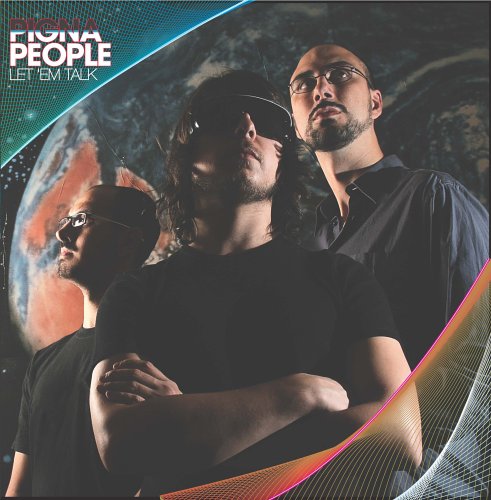
Album von den Labelverantwortlichen Marco Passarani, Francesco De Bellis und Mario Pierro, das ein paar bereits veröffentlichte und neue Produktionen versammelt, inklusive Bonus Mix CD mit den Perlen des Backkataloges. Die Tracks holen sich wie gehabt die besten Klänge aus einem Referenzsystem irgendwo zwischen Vince Clarke, Tony Carrasco, Steve Poindexter und Carl Craig und setzen diese in ein Modell, das in seiner klatschenden Stromlinienförmigkeit durch die Bank nach vorne geht und fast lässig den Mangel an Verständnis und Können bei anderen Leuten mit den gleichen Vorbildern unterstreicht. Wo bei so mancher oldschooligen Neu-Produktion nur noch Stereotypen verwaltet werden, gehen Pigna People vor allem erstmal von sehr zeitgemäßen Rhythmen aus, auf die dann in entspannter Vorsortierung die Sounds montiert werden, die du an den älteren Platten in deiner Sammlung immer so geliebt hast. Dass das so gut hinhaut kann daran liegen, dass bei den Stücken nicht Epochenausschnitte für sich selbst bleiben, sondern frei kombiniert werden. Der grundlegende Groove ist keine Reminiszenz, sondern ein eigener Entwurf und darauf tummelt sich, was gerade passt. Acid trifft Electric Funk, Italo trift Detroit und Virgo trifft Yazoo. Das ist alles offen genug dargelegt, um ansteckend zu wirken, ist aber auch clever genug arrangiert um dem vordergründigen Nummernrevue-Charakter aus dem Weg zu gehen, der bei anderen Retro-Produktionen neueren Datums schon ab Werk geliefert wird. Die Naivität und die schlampige Funkiness mancher Vorbilder findet man nun nicht mehr, aber trotzdem, dieses Album zeigt den nötigen Respekt und hat gleichermaßen ausreichend Auslage in der eigenen Frischetheke.
The sad truth about going out in the 80s in a small coastal town: Even if you read all the right magazines, had knowledgeable and smilarly enthusiastic friends, and kept on digging all the time. It just did not mean that you could actually dance in a club to what you just discovered. That does not mean the DJs were bad, but a lot of them were a bit lazy. If a sequence of songs worked, it was repeated for quite a while. And music was played in topical blocks. You had an italo disco round, then maybe a goth round, new wave, 2 tone, synthpop. If you came in and you just missed your preference you had to wait. Thankfully a lot of music at the time was good and interesting enough to make that bearable. But there was so much incredible music coming out, it was just frustrating that you could only hear a fraction of it in the clubs you had most frequent access to. I must admit I compensated that for many years, playing as much different music on the same occasion as I could, and often it did not make much sense. In any case a lot of mixes I did were some kind of ideal party that rarely happened, for a particular style of music or several at once. This mix is a good example, even if at the time I recorded it my situation in those aspects had already changed quite a bit. But it seems I could still remember…
Pere Ubu – The Modern Dance The Flying Lizards – Her Story Hot Gossip – Geisha Boys And Temple Girls Telex – Raised By Snakes The Bollock Brothers – The President And The Showgirl New Order – The Perfect Kiss Strawberry Switchblade – Since Yesterday Holger Czukay/Jah Wobble/Jaki Liebezeit – How Much Are They? The Fun Boy Three – Life In General Visage – Anvil (Night Club School) The Residents – Diskomo The Stickmen – Do Get Down Devo – Freedom Of Choice Yello – Base For Alec Human League – The Sound Of The Crowd Heaven 17 – (We Don’t Need This) Fascist Groove Thang Matia Bazar – Elettrochoc Cabaret Voltaire – Nag Nag Nag Tuxedomoon – No Tears Suicide – Dream Baby Dream John Cale – I Keep A Close Watch


Recent Comments