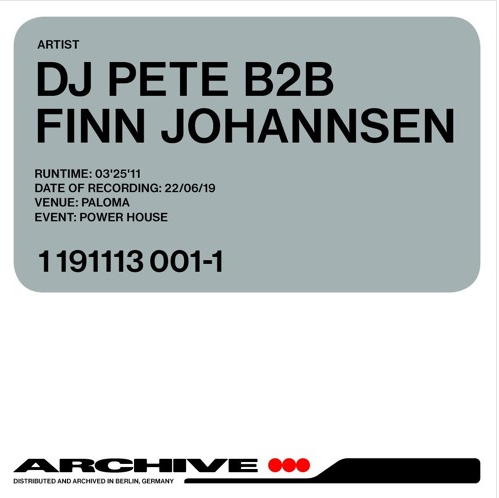
“The idea behind the Power House nights at Paloma was to react to trends that we felt neglected the vibe of the house nights we grew up with. We wanted to offer an alternative to what we call shoegaze house music, and we wanted to bring back the focus to the party. There is no strict musical old school policy, but the feeling is. Even if we do not try to reproduce experiences from the past too nostalgically and too authentically, we like to achieve a collective enthusiasm on the floor that in our opinion is sometimes missing nowadays. To achieve that we play a direct, pumping kind of house music that goes back and forth between anthems and obscure gems from our extensive vinyl collections. DJ Pete and me are the core personnel of the events, and when we team up we like to play topically, shining a light on certain sounds, styles and local scenes that we think should be represented more entirely. We play the records like we have heard them being played when they originally came out (and played by ourselves too) and we often accompany the sets with live beats programming by Pete on a 909, and a special effects unit. For these recordings the topic was acid house. Obviously.”
There was this moment in the 90s when the sound of house music changed, with lasting consequences. I would say it began in 1993. Of course technical progress in terms of production techniques and equipment played a role, but it was also very important that the music itself became more popular, and attracted bigger crowds, which led to bigger clubs, and a house sound that pumped crowds and clubs of that size sufficiently. In the following years the superclubs emerged with corresponding budgets, and they needed DJs that played accessible enough to please and unite as many people as possible. This created a divide between denonimators, as simultaneously a lot of DJs and producers defined quality in a different way, and played different styles, to smaller crowds, in smaller clubs. There were DJs and artists that lived in both worlds, or crossed over, and both worlds had different levels of credibility, and success. But increasingly the circuits frowned upon each other, and disrespect was mutual. The big room house music examined here was produced at a time when it had a really bad reputation, being accused of being commercial, devoid of original ideas, or milking once original ideas for far too long. Indeed the sound templates for the music in this playlist had been established years before, and it seemed as if they were only developed further if really necessary. Some of the big room artists were once renowned for different music, and many were quick to maintain that at some point they were selling out and adapting to lesser creative requirements to do so. And some smaller room artists were maybe just envious and could not produce a tune that sold as well, and just claimed they did no want to. And of course for a lot of people it does not matter what size the room has, they just go for music based on their individual preferences, and find that in different contexts. But meanwhile in the early 00s, big room house had its apex of booming beats, dramatic breakdowns and disco samples, and here are some prime examples of the sound.
Victor
Simonelli – Ease Into The Dance (Stellar, 2000)
Victor
Simonelli has many great moments in his back catalogue, and in my
opinion this on par with his most cherished productions. For me the
combination of the bodiless vocal sample and the pumping yet and
elegant deep groove is as immersive as Love Inc.’s “Life’s A
Gas”. I’m serious.
Lenny
Fontana & DJ Shorty – Chocolate Sensation (Original Force Mix)
(FFRR, 2000)
Johnny
Hammond’s early disco staple “Los Conquistadores Chocolates”
was sampled countless times, but not as sweeping as on this belter.
Extra props for the extended filter break which then erupts into
Loleatta Holloway on the top of her lungs. This track pushes all the
right buttons, and works although you can predict any move, only that
every move sounds even more striking than the one before. If you have
never been on a dancefloor exploding to this, you really missed out.
Groove
Assassins – Everything I Knew (Black Vinyl, 2000)
If
some of the orchestral disco maestros would have still been active in
the 90s their music could have sounded like this. Even if this is
just a reconstructed original from their heyday, with a heavily
beefed up groove. Nick Moss and Will Hague understood the craft of
their forebearers on this track, and they made it their own.
Rhythm
Section Feat. Donald O – Do You Know (Main Mix) (MAW Records, 2000)
Every
disco DJ should bring at least one Chic Organization production to
their party, and every disco loving house producer should sample at
least one as well. Henry Maldonado went for “My Forbidden Lover”
and then he turned it into a glorious garage opus, co-written and
performed by the great Donald O. This should have been much bigger
than it actually was, but it is never too late.
David
Bendeth – Feel The Real (Jazz-N-Groove Ultra Classic Mix) (Audio
Deluxe, 2000)
“Feel
The Real”was indeed an ultra classic, albeit on the jazz
funk/disco circuit of the 80s. By the time this was released
Jazz-N-Groove had perfected their slick but heavy groove template so
impressively that they basically could have applied it to any tune
they were given and come up trumps. Judging by their vast output,
some say they did just that.
LoveRush
– Luv 2 See Ya (Joey Negro’s Vocal Mix) (Azuli, 2000)
Joey
Negro always knew how euphoria works, and here he aimed straight to
the highest level of it. There is some sweet innocence about the
tune, but the pumping groove underneath and several breakdown dramas
tell you to work it. Hard.
Copyright
Presents One Track Mind – Where Would You Be? (Main Mix) (Soulfuric
Trax, 2000)
The
way D-Train’s “Music” is filtered up and down here is very
reminiscent of the finer moments of the French House phenomenon, but
the groove somehow is not. It is just too pushy and impatient, and
the vocal samples get a more generous treatment, verging on harmony.
All good decisions.
Johnny
D & Nicky P – Wild Kingdom (4th Floor Records, 2001)
Of
course big room productions could work well with deeper sounds, and
Johnny D and Nicky P aka Johnick knew how to achieve severe
dancefloor hypnotism anyway. As always when they are in charge, the
music has this strangely psychedelic notion, and „Wild Kingdom“
is another of their real gems to get lost in.
Sunshine
Anderson – Heard It All Before (E-Smoove House Filter Mix)
(Atlantic, 2001)
E-Smoove
was mostly not as smoove in the 00s as he had been before (but who in
this field actually was), but if you remix a sleek R&B hit, you
cannot fire on all cylinders. Still this has the right amount of
infectious funk and it does not divert any attention from the song.
If you think of the proximity to garage vocal harmonies there were,
rather surprisingly, not that many great remixes that managed to
aptly transfer R&B to a house context, but this one gave a lot of
the right clues.
Kraze
– The Party 2001 (Love City Club Remix 2) (Groovilicious, 2001)
It
reads so unimaginative, taking Todd Terry’s “Can You Party”
and the acapella from Kraze’s “The Party”, two early house
productions that were completely overused at that point, and turn
them into a fierce banger that pretends New York City’s big room
haven Sound Factory never closed. And actually the way the track
works all that is really not that inventive. But as it steamrolls you
on that floor, you will not care one bit.
UBP
Feat. Bobby Pruitt – We Are One (Jazz-N-Groove Hands Up Vocal)
(Soulfuric Recordings, 2001)
I
love how this mean little melody never lets up, totally regardless of
the fact that there is a funky booming bassline, a quite shouty soul
singer, a female choir, and several breakdowns, the whole big room
house gospel spectrum. This is a big show, but one detail steals it.
Genius.
DJ
Oji – We Lift Our Hands In The Sanctuary (Anniversary Vocal)
(Sancsoul Records, 2001)
The
original was one of the churchiest of the churchy house anthems, a
whole nocturnal service for those who need the club as a shelter and
a place for relief and rejoicing. 95 North remix it into a way more
urgent groove, but do not sacrifice any of the worship and righteous
spirit. Hands were lifted and love was alive, again.
The
original was a jazzy funked up groover that was hugely popular, but
Frankie Feliciano boldly opted for a complete rework, keeping the
keen message intact but underlying it with unsettling and swirling
sounds and beats that reference Pépé Bradock‘s „Deep Burnt“
and a lot of earlyTodd Terry productions.
Los
Jugaderos – What You Doing To This Girl? (Norman Jay’s Good Times
Re-Edit) (Junior Boy’s Own, 2003)
In
1996 Ashley Beedle and Phil Asher turned a marvellous 1979 disco gem
by Dazzle into a blinding and tripping house excursion. Seven years
later the original rare groove don Norman Jay gave it a remix, and
when I read about that then I was expecting it to sound truer to the
Dazzle original and Jay’s own legacy. But to my surprise his version
was way punchier, and to my joy he highlighted all the best bits even
more. Pure disco house bliss.
Hardsoul
Feat. Ron Carroll – Back Together (Classic Main Mix) (Soulfuric
Recordings, 2003)
Nothing
better than to conclude a fine time at the big room house club with a
big room soulful vocal house hymn. Even better when that tune is ever
so slightly less big roomy than what happened before, but still
easily keeps up the intensity and punch, just because it is a
wonderful piece of music that knows and serves its context. From here
you may start all over again or leave it behind, but both happily.
Located near to its famous successor Berghain in a disused freight depot, Ostgut was open from 1998 until its lease ran out in 2003 and the location was demolished. It is telling that the name is still vital in the Berghain enterprise, and Ostgut already had a lot of key elements that are still thriving: marathon weekends with marathon DJ sets, with hard Techno played on the main floor and housier vibes on the already existing Panoramabar. And as Ostgut evolved from the male-only Snax parties, it carried the according focus on gay and fetish sex into a permanent, raw location. We asked Ostgut resident DJ André Galluzzi to guide us through the sound of the club that set the foundation for the clubbing experience Berlin became famous for in recent years.
Surgeon – Atol (Downwards, 1994)
We begin with a primetime highlight. This track guaranteed ecstasy on the floor and became a trademark for the club.
Ignacio – Virton (N.E.W.S., 1999)
It was not an unusual track, but definitely one of the naughty ones. Direct and mindblowing. I used to drop the track between 5 to 6 a.m.
Si Begg – Welcome To The Discotheque (Mosquito, 2000)
I loved to open my set with Si Begg after live acts. Because it has this incredible intro while the mood of the record was already defining for the night. This was brillant.
So what were Germans actually dancing to before Techno? Of course to as many different styles as in other countries. But a good glimpse at what was getting down in West Germany before house music happened was the club Moroco in Cologne. Located at Hohenzollernring, the club ran from 1982 to 1986, and both the club interior and its crowd were determined to look as posh as possible. In contrast to Post Punk counterculture, the materialistic 80s decade manifested itself in the culture of the “Popper”, foppish youth dressed up to display as much wealth and taste as they could. But what distinguished the Moroco from other similar clubs across the land was its status as favourite leisure and inspiration spot of the Kraftwerk members. Carol Martin, credited as CGI artist on their “Computerwelt” album, was a resident DJ at the club and guides us through the sound of the Moroco and how it was connected to the Kraftwerk canon.
James Brown – It’s Too Funky In Here (Polydor, 1979)
Be it Kraftwerk or Miles Davis, everybody seemed to be inspired by James Brown. Bootsy Collins, whom Kraftwerk also cherished, started his career with him. „Boing Boom Tschak“ is also a tribute to Bootsy’s concrete bass.
Earth,Wind and Fire – Fantasy (CBS, 1978)
Funky, emotional and wonderful to dance to until today. I went to see them with Kraftwerk by invitation of the concert promoter Fritz Rau at the Phillips-Halle in Düsseldorf. It was a magnificent show with perfect sound and effects and all of a sudden the bass player was hanging 20 metres up in the air.
The Gap Band – I Don’t Believe You Want To Get Up And Dance (Oops, Up Side Your Head) (Mercury, 1979)
Danceability was typical for Moroco, and you could play this anytime. There was a nine minute extended version of it, so the DJ could leave to „wash hands and powder the nose“ and when he returned the floor was still as packed.
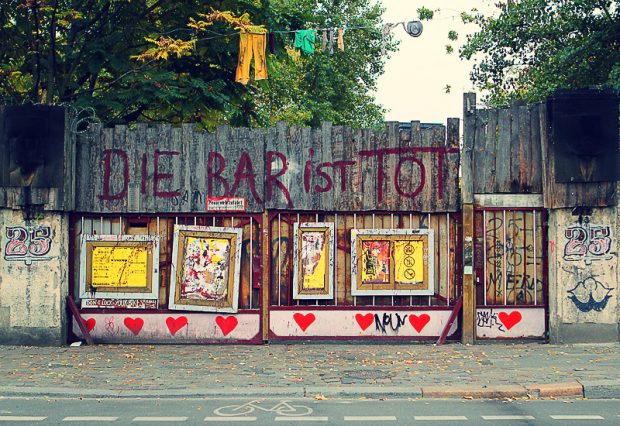
Although it closed in 2010, Bar25 still holds a very special place in Berlin clubbing history. Established in 2004, it introduced a hedonistic playground atmosphere to a scene that often preferred to appear sombre and serious. There are countless tales about what wild abandon happened between the wooden fence shielding the club from everyday life and its naturally occuring other boundary, the Spree river, where from the opposite bank or passing boats you could watch a very escapist crowd roam the vast area on marathon weekends. Its soundtrack of minimal and quirky tech house grooves that still work even when held back by a limiter is as synonymous with the Berlin party experience as are the improvised wooden interiors, psychedelic decor and joyful ideas that spawned a legion of other clubs to follow suit since its closure. Now rejuvenated as part of the Holzmarkt project in the same space, we’re taking a look back at the sounds that represented the club. To do this we enlisted someone very close to the project, who could also share some of his favorite memories from the club: Jake The Rapper, a former Bar25 resident DJ.
“This is an excellent example of original minimal, and minimal was my gateway into the whole techno scene and later Bar25. I feel like there were a lot of parallel scenes happening in the Bar at the same time, so I can’t really say this was the blueprint for the Bar25 sound, but it’s definitely the one I went deep into. When other DJs and their fans would take over right after something I was into, I’d be like, “What is this? This is totally different. I don’t get it”—which is just fine, as the place fed on variety and experimentation. There was also a whole other floor called The Circus that was dedicated exclusively to weirdness and avant-garde music. It was a very open time for music and a very open place. It certainly expanded my tastes and skills and every other part of my mind. But this track, although it came out three years before Bar25 opened, definitely laid the groundwork for the kind of vibe that was really appreciated. This was deep and trippy and softly took me to a place I really wanted to go after having been dancing, partying and socializing—sometimes for days on end.”
“This has some elements of electroclash that were really big at the time. This was the same time when Peaches, Mocky, Gonzales, Puppetmastaz and so on were some the biggest Berlin acts. It definitely influenced pop music and of course in the Bar as well, although it generally went with a more minimal sound than this. This was a big banger in comparison to what usually came before and after it. Is it a bit cheesy? Yes it is. But it’s so smooth that it inevitably got everyone deep up in there and fully involved. Plus I had a few numbers that use this same half-tone progression, and I chose this one for being the most representative of that time and also one that is still playable today.”
“I know this doesn’t even seem like a dance track at all—very mellow. But if I played this during the day between minimal tracks, people really loved it. it’s instantly recognizable without being too poppy or kitschy; it’s deep without being too melancholic—it’s really quite a piece of work. The lyrics are just single nouns in a row—“a life, a room, a house, a street.” It seems to comprise cut-up parts of a poem, and yet it expresses a mood and a scenario that’s somehow Lynchian. And then there are these minor guitar chords that go easy on ya. There’s no kick drum—or any drums per se—and yet it totally grooves and got people dancing, at least in the Ranchette at the Bar25. That may be why the place was unique, you could really DJ tracks to celebrate their spirit without having to kowtow to dance floor dynamics. There was already such a suspense and energy there, even when it was half full a little would go a long way.”
“I feel like this track, despite the fact that it became a tech house club hit nationally and internationally, nonetheless captured the sound of the Bar25. Remember that a lot of the time it was daytime, so something with a deep, warm sound made a lot more sense in bright sunlight than in a dark club. A lot of these kind of songs I think gained popularity through the surge in open-airs and daytime clubs like Bar25. This might have put everybody to sleep in the average German dance club in 2005. But when it’s around midday and you’re sitting, looking out at the Spree while a light breeze makes the straw in your gin and tonic move around so you hear the ice in your glass tinkle…you see yourself reflected in your friend’s sunglasses and you look like you’re really enjoying yourself, and then this big soothing, massaging synth surface lifts you up and you have to just stand up and go YEAHHH! …yeah, that’s a Bar25 moment for me.”Read the rest of this entry »
„Liquid Air“ erschien 1992, also zwei Jahre vor Eröffnung des Ultraschalls. War der Track wichtig bei den vorhergehenden Underworld-Parties, und dann auch noch im Ultraschall?
Monika Kruse: Air Liquide waren sehr oft als Live Act im ersten Ultraschall gebucht, irgendwie gehörten sie fast mit zur Familie. Der Track „Air Liquide“ war jetzt sicherlich nicht im weitläufigen Sinne ein großer Hit, aber er spiegelte den Sound vom Ultraschall und Air Liquide sehr gut wider.
Robert Armani – Circus Bells (Hardfloor Remix) (Djax-Up-Beats, 1993)
Dieser Track ist eine kongeniale Verbindung von Techno aus Chicago und Deutschland. Spielten solche kulturellen Transfers eine Rolle in der Münchner Szene? Und wie wichtig waren 303-Sounds?
Acid spielte natürlich ein große Rolle, aber eine größere Rolle spielte immer noch der Sound von Chicago und Detroit. Der Hardfloor-Remix von „Circus Bells“ hat beide Richtungen perfekt repräsentiert.
Wiener Techno Artists brachten Platten auf Upstarts in München ansässigem Label Disko B heraus. Gab es da eine Achse zwischen den beiden Städten, inklusive wechselseitiger Beeinflussung und Zusammenarbeit?
Es fand ein großer Austausch zwischen den Wiener Künstlern der sogenannten Cheap-Posse und dem Label Disko B statt. Upstart, einer der Ultraschall-Besitzer, dem auch das Label Disko B gehört, buchte gerne die ganze Posse um Patrick Pulsinger herum, wir wiederum fuhren auch für Disko B-Nächte nach Österreich. Wenn die Österreicher bei uns spielten, war das Überraschungsmoment immer gegeben, entweder total morbide Tracks, dann wieder seriöser Techno, oder auch mal House. Diese Alles-ist-möglich-Haltung im Sound der Österreicher war dem Ultraschall-Spirit sehr nahe.
K. Hand – Global Warning (Warp, 1994)
Ein klassischer Techno-Banger aus Detroit. War das ein Track, der für dich spezifisch für das erste Ultraschall ist?
Definitiv war das der Sound der Zeit des ersten Ultraschalls. Viele Künstler aus Detroit wurden damals gebucht, beispielsweise spielte am Eröffnungsabend Jeff Mills. Aber auch DJs wie K. Hand, Underground Resistance, Robert Hood, Juan Atkins und andere waren regelmäßige Gäste.
DBX – Losing Control (Accelerate, 1994)
Daniel Bells „Losing Control“ war ja ein international übergreifender Club-Hit. Welche Rolle spielte der Track im Ultraschall?
Für mich steht der Track eher für das gesamte Feeling, das wir im Ultraschall hatten . „I am losing control“. Da spielten DJs in der Gästetoilette, Robert Görl ( DAF) machte einen zehnstündigen Liveact genau an der Eingangstür, Matthew Herbert sampelte Chipstüten für sein Live-Set und einmal stand auf dem Dancefloor am Ambient-Wochenende ein Riesenbett. Jedes Wochenende passierte irgendetwas in diesem Club, was dir als Gast und als DJ das Gefühl gab, komplett weg aus der Realität zu sein, und die Kontrolle des Alltags abzugeben. Dazu passte der Track natürlich extrem gut!
Im Sommer 1996 schloss das erste Ultraschall, und das zweite eröffnete wenige Monate später. Markiert dieser Detroit Electro-Klassiker diesen Übergang?
Das würde ich so nicht sagen. Der Grund, dass das erste Ultraschall geschlossen wurde, war ja weil der Vertrag auslief, soviel ich weiß. „Pornoactress“ war einfach ein toller Track , der von uns oft gespielt wurde, hat jetzt aber nicht irgendein Ende oder einen Neuanfang eingeleitet. Damals spielte man einfach viel mehr Electro, Electro Boogie und sogar auch mal Drum & Bass.
I-F – Space Invaders Are Smoking Grass (Viewlexx, 1997)
Nochmal Electro, diesmal aus Holland. In jenen Jahren formulierte sich diese Mischung aus Electro, New Wave, Disco und Techno, die Hell dann auf seinem Label International Deejay Gigolos bündelte. Wurden die Weichen dafür im Ultraschall gestellt?
Das Ultraschall war immer sehr offen für alle Arten von Stilen. Wir Resident DJs wie Cpt. Reality, Lester Jones, DJ Hell, DJ Barbara Preisinger und ich hatten alle unseren eigenen Stil. Dazu kam dann noch das Booking der Gast-Djs, die den Sound noch spezieller machten. Ich glaube das Ultraschall hat viele Weichen für Labels und spätere Clubs gestellt , aber auch die einzelnen DJs haben durch ihren Stil das Ultraschall geprägt.
Grungerman – Fackeln Im Sturm (Profan, 1997)
Spielte die Kölner Auslegung von Minimal Techno eine besondere Rolle im Club, oder bezieht sich die Wahl dieses Tracks eher auf das Wirken von Wolfgang Voigt in dieser Zeit? Und mochte man in München diesen Humor?
Oh ja , im Ultraschall liebte man den Kölner Humor und überhaupt generell die ganzen Kölner DJ- und Produzenten-Szene. Ich betone das Ultraschall, ich würde das nicht auf die gesamte Münchner Techno-Szene übertragen. Das erste Ultraschall war immer eine Insel. Zwar lag der Club bei München, am ehemaligen Flughafen Riem, aber die Lage war wie der Club selbst, nämlich abseits. Der Club und sein Sound, die Gäste waren irgendwie so unmünchnerisch. Eher links, alternativ, punkig, verrückt. Somit passte der Kölner Sound, der auch sehr eigen war, da wunderbar rein. Mike Ink, Michael Meyer, Burger, Reinhardt Voigt etc. waren gern gesehene Gäste, und ihre Tracks liefen oft im Ultraschall.
Richard Bartz – Ghettoblaster (Kurbel, 1997)
Richard Bartz war sicherlich ein integraler Bestandteil der Geschichte des Ultraschalls. Wurde seine Musik durch den Club geformt, oder war es auch umgekehrt?
Ich glaube, dass er sich damals mit 17 Jahren schon in den Club geschlichen hatte und definitiv von dem Sound, der Wildheit, und dem ganzen Spielraum inspiriert war. Dadurch dass er später auf Disko B selber veröffentlichte und auch Produzent von DJ Hell wurde, hat er sicherlich auch wiederum etwas zur Soundgestaltung des Clubs beigetragen.
Johannes Heil – Paranoid Dancer (DJ Hell Remix) (Kanzleramt, 2002)
Das Ultraschall schloss im Januar 2003. War dieser Track ein definitiver Hit, der für die Endphase des Club steht?
Ich habe den Track eher aus dem Aspekt gewählt, dass er genau dem früheren DJ Hell- und Johannes Heil-Sound entspricht, bzw. einfach das Techno-Feeling der letzten Ultraschall-Jahre gut wiedergibt. Etwas düster, und wir waren natürlich alle etwas paranoid in München, als das zweite Ultraschall dann plötzlich mitten in der Stadt aufgemacht hatte, und die Polizei uns Raver nicht mit Samthandschuhen angefasst hat.
I loved a lot of David Bowie songs throughout my life. His landmark albums from the early 70s were still a staple of the radio shows I recorded to cassettes from the mid 70s on. Glam anthems, way ahead to my ears then what became of it in the charts around that time. Glam outfits that were equally way ahead. David Bowie was already somewhere else, of course, anticipating the Disco phenomenon I would soon so love, with Philly’s finest. Then following that up with the Berlin trilogy that would inspire legions to create something great, and look great while doing it, too. Then, when I ran around in 60s clothes in my early 80s coastal smalltown youth, I discovered that he already had been there in the best way imaginable, and his early Pye singles were exactly the attitude and sound I was looking for. He was the definite face. He made no mistakes. He even descended to the kids he created with „Ashes To Ashes“, and he blessed them, as they worshipped him. He was a terrific actor on screen as well, making good use of his ever magnetic charisma and sexually confusing identities there, too. Whatever he did, you watched him very closely, else you could have missed out on crucial developments.
When „Let’s Dance“ was announced as being produced by Nile Rodgers, another inerrable hero of mine, I had the highest expectations, but then could not help feeling let down. There were moments, but not enough of them. And in the period of the mid 80s shortly after, pop’s most successful stars could earn a fortune without even the slightest vision (let alone sound), and David Bowie simply became one of them. As soon as he was dancing in the street with Mick I was just embarrassed. Even his outfits were embarrassing. I was really surprised that this could happen. Enter the years of hit and miss. For every glimpse of his former cool self resurfacing, „Absolute Beginners“ or „Hallo Spaceboy“ for example, he took decisions that were unforgiveably below his par, think Tin Machine, among others. Given, you cannot be visionary forever, however visionary you once were. And David Bowie was more constantly visionary than anybody else, for a long time. But the visions at one point were had by others. Not surprisingly he displayed a clever instinct for picking the right ones to utilize for his purposes, but still they were attached. I did not mind, he was performing the elder statesmanship with grace, and as so many artists were still working ideas he already had before, there was nothing left to prove, only if he wanted to. So screw the stock bonds. I sincerely felt happy for him and his family. He deserved it. Then he kind of disappeared.
When he reappeared in 2013, it felt like out of the blue. „Where Are We Now?“ was the first song of his in years I listened to repeatedly. It was beautiful and it felt good to have him back. I was slightly surprised by its sadness, but I thought it was quite a statement to base its sentiment about the most lauded creative period of your career. It challenges comparisons, and I was sure he was still creatively ambitious enough to try and deal with them, no matter what he achieved before. „The Next Day“ was a good album, too. He did not try to reinvent himself, he looked back on what he invented. I visited the Bowie exhibition that was doing the same in Berlin, just in time before it closed, and I enjoyed it very much. It all came back, rather predictably. His stage outfits on display proved he was a small man, but he surely did not have a small mind.
I did not expect that he would follow that retrospective phase so soon, if at all. And I absolutely did not expect that he would follow it up with an album like „Blackstar“. As before, David Bowie chose to remain silent, relying on producer Tony Visconti to reveal the news of its release. I read his trusted cohort doing that in an interview while travelling. He spoke of references like Kendrick Lamar, Death Grips and Boards Of Canada, and that rock and roll was to be avoided. David Bowie recruited a potent jazz quartet from a New York bar for the recordings. It was all rather promising. When I got asked to write these lines I initially wished I could have listened to the entire album when he was still alive, as I was already overwhelmed to the point of numbness by the reactions to his sudden demise. But when I then listened to it, it became obvious very quickly that he was fully aware that he would have passed away once the public would be fully exposed to it. And that it is pivotal to picture the dying artist for the whole experience. The songs are brilliant. Complex and dense, or just stunning, indeed avoiding rock and roll stereotypes, even if the jazz only adds to the picture instead of dominating it. The mood is intense, but it is not entirely dark. Thinking of the motivation behind this album, David Bowie sounds astonishingly swinging, his beloved voice delivering clever lyrics ranging between the horror of his own decay and the feeling of arriving there content, at ease with himself, with truths simultaneously personal and universal. The video to „Lazarus“ is frightening to watch, but comically absurd as well. The last photographs of him taken show him in a sharp suit, lauging. The way he orchestrated his own requiem is incredible, exactly as he wanted to, and as only he could. Being David Bowie, setting lasting examples yet again. Superior, even in death.
This month, the D*ruffalo Hit Squad pays their dues to Northern Soul, the most stubborn of all underground dance music scenes. And in contrast to nearly all compilations documenting decades of ridiculously dedicated digging, this two hour set consists entirely of supreme anthems. Or “oldies”, as the veteran rare soul jocks and dancers call them (meaning neglected guilty pleasures that opened sesame all those years ago, more or less). Which is the same twisted logic applied that led to the term “Modern Soul”, the majority of which is not that modern at all. But that is another story that shall be told even more indulgently on you know where, but you don’t know when, but it could be soon.
In the meantime, lay out the towel, spread the talc, put on appropriate gear, turn it up some, and get seriously going. And keep the faith, of course!
Barrett Strong – Gonna Take A Journey Tommy Sears – Get Out Fred Hughes – I Keep Tryin’ Jackie Lee – Would You Believe Clifford Curry –I Can’t Get A Hold Of Myself The Valentines – Breakaway Dobie Gray – Out On The Floor Darrell Banks – Our Love Is In The Pocket Dave & Ruben – (I Love Her So Much) It Hurts Me Maurice Williams – Being Without You Gloria Jones – Finders Keepers The Olympics – The Same Old Thing Shirley Lawson – One More Chance Chuck Wood – Seven Days Too Long Edward Hamilton & The Arabians – Baby Don’t You Weep Ed Crook – That’s Alright The Inspirations – Touch Me Hold Me Kiss Me The Ballads – I Can’t See Your Love The Parliaments – Don’t Be Sore At Me Sid Barnes – I Hurt On The Other Side Trade Martin – She Put The Hurt On Me The Ad Libs – Nothing Worse Than Being Alone Duke Baxter – I Ain’t No Schoolboy Maurice Williams – The Night The Angels Cried Ronnie & Robyn – As Long As You Love Me Roscoe Robinson – That’s Enough Vivian Carroll – Oh Yeah Yeah Yeah Larry Santos – You Got Me Where You Want Me Ann Sexton – You’ve Been Gone Too Long Bobby Treetop – Wait Till Get To Know Ya The Inspirations – No One Can Take Your Place The Adventurers – Easy Baby Mill Evans – I’ve Got Have Your Love Sam Dees – Lonely For You Baby Don Thomas – Come On Train Barbara Lewis – I Remember The Feeling Fred Hughes – Don’t Let Me Down Joanie Sommers – Don’t Pity Me Rhetta Hughes – I Cry Myself To Sleep Steve Flanagan – I’ve Arrived The Barons – Walking In The City Willie Parker – I Live The Life I Love Sam Fletcher – I’d Think It Over Kenny Wells – Isn’t It Just The Same The Winstons – Color Him Father Clarence Hill – A Lot Of Love Goin’Round Little Esther Phillips – Just Say Goodbye The Exits – Under The Street Lamp
Nobody would probably expect anything else than deep emotional music on a label run by Robert Owens, but what Mark Rogers of Hollywood Beyond fame comes up with on the sublime “Twilight For Some”, is even more. Despite the gentle tone of the music and the understated vocal delivery, not too many vocal house tracks are as touching this. The lyrics are very melancholic, offering little relief to the troubled people they address, and the music is a companion that stresses rather than distracts. Everytime I listen to this, and the track fades out to a loop of the words “identity, identity, identity…”, I can’t help wishing this experience would last much longer, and more often than not, I put the needle right back to beginning.
Cabaret Voltaire “Searchin” [Parlophone]
A track lifted from the album “Groovy, Laidback and Nasty” from 1990, that most of the fans and critics of the UK electronic pioneers dismissed as mere attempt to cash in on the increasingly fertile house sound. Worse than that, nobody was really willing to accept Cabaret Voltaire venturing into musical terrain that was nothing else than pure pop, with one of post punk’s most recognizable voices crooning blissful melodies with uplifting messages, and one of post punk’s most adventurous experimentalists gladly supplying the according tunes and harmonies. But Cabaret Voltaire enlisted Marshall Jefferson at the time of full creative swing for the production, and he made this song his very own, even bringing in Paris Brightledge, on of Chicago’s most wonderful voices, for the background vocals. So this might be not the most original Cabaret Voltaire record, but they had proven their merits enough before and after, and I am really thankful that they took the chance of doing this album. Maybe imagine this track not being sung by Stephen Mallinder, but Brightledge all alone for instance, and not being by Cabaret Voltaire, but by Marshall Jefferson, and house’s history books would treat it like a bona fide classic. I at least do, no matter what constellation.
Shades Of Rhythm “Exorcist” [ZTT]
Shades Of Rhythm were better known for their rave anthems, filled to the brim with crowd noises, joyful diva vocals and plenty of pianos. And while there is nothing really wrong with that (but admitted, on many occasions it IS really wrong), they were also capable of doing something completely different. “Exorcist” is a pitch dark beast that establishes a really intense mood on nothing more than the basis of a break beat in moderate tempo and a plethora of sinister sequences that seem to spiral into the ether. This still makes any room go boom.
I-F “Energy Vampire” [Disko B]
Now that the UK bass elite is embracing an electro tinge to their latest dubplate, it is maybe a good time to drop a reminder for the Dutchman who already seemingly could look well into the future when he released a series of relentless and uncompromising classics in the past. The moody stop-and-go groove of “Energy Vampire” would not look out of place on a post-dubstep production of 2010, yet it already appeared on I-F’s album “Fucking Consumer” in 1998. Things go in circles, as they say, and the robots shall have the last laugh. And if sometime the italo disco groundwork will seep through the bassbins of the younger bass generation as well (there are already hints that this is not as improbable as it sounds), there is a good chance that I-F will be involved in something else entirely, and equally influential.
Cybersonik “Technarchy” [Plus 8 Records]
At a time when they had no interest in minimalism, conceptualism or fine wines, Daniel Bell, John Acquaviva and Richie Hawtin released “Technarchy” in 1990, the year their imprint Plus 8 came into being, and properly illustrated that techno could embrace the sound heritage of the pioneering industrial artists, acid house, and the emerging Detroit sound at the same time. The devastating result hinted at the hoovers, cornfields, and love parades to come but back then nobody would have predicted all that. What this record confirmed, however, was that there was a potential for all that. From the introducing metal beats, building a harsh yet funky groove, to the 303 squelches, and then, of course, to one of the most bone-crushing bass breakdowns in the history of club music. Most DJs playing the record at the time when it came out even emphasized the experience by turning up the bass even louder when the kick drum came to a halt and just the bassline was rummaging around in the intestines of the floor, but then again it was already doing its work untouched by any mixing antics. In any case whoever heard the track unprepared and for the first time in a club, would possibly never ever forget it. I certainly did not.
The Druffalo Hit Squad welcomes you to a new irregular series of showcases, which will feature our personal highlights from the international bastions of rave. For no particular reason whatsoever, we would like to dedicate the first installment to the most underrated rave nation: Canada. We assembled some extra hi-biased strobe anthems for the occasion, and played them on +8.
Nick Holder – Erotic Illusions (Strobe) Psyance – Andromeda’s Dance (Plus 8) Infra-Red – Metamorphis (Strobe) How II House – Lift The Nation (Outer Rhythm) Infra-Red – Love Me, Love Me (Strobe) F.U.S.E. – Phase 1 (Plus 8) Z-Formation – Brutal (Hi-Bias) Nick Holder – Frantic (Strobe) States Of Mind – Destiny (Strobe) Psyance – EQ (Plus 8) Infra-Red – Falling From The Light (Strobe) Psyance – Motion (Plus 8) Infra-Red – The Verge (Strobe) Cybersonik – Technarchy (Plus 8) Chrome – My Reflection (Plus 8) How II House – I Want U 2 Love Me (Strobe) Trancendence – Magique Noire (Strobe) States Of Mind – Elements Of Tone (Plus 8) Infra-Red – Calibrate This (Strobe) Hayden Andre Project – Broken Chains (Strobe) The Uprising – You Can Wait (Hi-Bias) Blunted Dummies – House For All (Definitive) The R.A.S.E. – Say It Loud (Strobe) Christina Lorr – Dark As The Night (Hi-Bias) Syndicate 305 – I Promise (Hi-Bias) Helen Sharpe – Got 2 Have Your Love (Strobe) Subculture – The Voyage (Strobe) Infra-Red – Love Honey (Strobe)





Recent Comments