When the brothers Stefan Mitterer (DJ Sotofett) and Peter Mitterer (DJ Fett Burger) decided to extend activities from their graffiti origins in their small hometown Moss in Norway to music, they founded the label Sex Tags for their own sounds and those of friends and artists they admired, either from their own country or met while travelling. Thus an ever growing and fiercely independent network came into being that by now is so complex and diverse that many find it difficult to decipher. But for the brothers it all makes perfect sense, and there is a coherence based on their own varied musical preferences, humour and attitude, and that of the likeminded collaborators they encountered along the way. There is also a vital dose of determination and conviction that ensures that the whole construct is as antithetic as it is cohesive, and as tight-knit as it is open-minded. We take a look on some choice tunes from the back catalogue of the parent label Sex Tags Mania and its leftfield offshoot Sex Tags Amfibia, plus the imprints the Mitterers run individually (Sotofett’s Wania, and Fett Burger’s Sex Tags UFO, Mongo Fett and Freakout Cult, the latter a joint venture with Jayda G). The other talents that populate the Sex Tags universe are too many to list, but we included some that pop up more frequently.
This joint venture of Norwegian old school don Bjørn Torske and the enigmatic Crystal Bois (or Siob Latsyrc, if you prefer) is a supreme example of how little a good house track needs to achieve magic. A deep and dubbed out chord, some improv percussion, and that is basically it. But it keeps moving floors since it first appeared twelve years ago, and will most likely continue to do so.
Acido – After Club Rectum (Crystal Bois’ 727 MANIA) (Sex Tags Mania, 2007)
An early appearance of the tag Acido (but confusingly not involving Acido label head Dynamo Dreesen himself) and Laton label head Franz Pomassl, who was to become a regular fixture in the Sex Tags universe. Crystal Bois on remix duty, and they transform the source material into a hard jacking rhythm tool track that you can most probably mix into anything and gather all attention. Erlend Hammer provides brilliant liner notes, making a perfectly valid point that every local scene needs a Club Rectum.
Doc L Junior – Baracuda (Sex Tags Mania, 2009)
Kolbjørn Lyslo had already released fine and highly individual tracks on the prolific Music For Freaks UK imprint in the early 00s, but the sound of this track (originally scheduled for Torske’s Footnotes label, but then lost for very obscure reasons) was not to be expected. A latin and jazz tinged summer breeze of a tune that could so easily have ended sounding camp and corny, but sounded absolutely sublime instead. A reproachful echo of the days when uplifing was not yet an insult.
Busen Feat. Paleo – Stream Of Love (Wania, 2010)
The first appearance of Greek vocalist and musician Paleo, the closest the Sex Tag empire has come to an in-house diva. He delivers his trademark meandering voice to a dark hypnotizing jam produced by Busen, an alias of Daniel Pflumm, a prolific graphic designer who also released on Elektro Music Department, General Elektro and Atelier, and Stefan Mitterer. Also well worth noting for a typically tripped out session on the flip, provided by Dreesvn alias Dynamo Dreesen and SUED label head SVN, at their Neues Deutschland studio HQ.
Another mainstay at Sex Tags and affiliated labels, Skatebård, who rides a psychedelic new wave take on new beat, before most even cared to remember what both were. Skatebård always manages to come across as both earnest and gleeful with every reference he works into his music, and is thus a perfect match. At Sex Tags, fun and seriousness go hand in hand.
As it was a continuation in the timeline of club music it is quite natural that via sampling the early years of house were already littered with references to what happened before: disco. Pioneering Chicago house records used vocal snippets of the classic repertoire of disco and replayed its basslines and arrangements. Just take Isaac Hayes’ „I Can’t Turn Around“ for example, which was not only used in Farley Jackmaster Funk’s „Love Can’t Turn Around“, but also numerous other house tracks at that time. And acapellas from the back catalogue of classic disco labels like Salsoul, Prelude or West End never stopped being used for giving a track that extra imperative on the floor. But as well as disco always remained an integral of house music’s matrix, particularly lesser productions means led to different approaches of utilizing it. From the mid 80s on, nearly no house producer could afford to set up an orchestra in a studio, also many were not trained to write and arrange music as many protagonists of the classic disco era were. Still, the desire to reference or recreate the disco legacy with a house groove was always there until today, and the ways with which disco and house connected were manfifold and innovative. We take a look at some prime examples.
Mitch Winthrop – Everybody’s Going Disco Crazy (Everybody’s Much Crazy Records, 1991)
I first heard this record at Hamburg’s Front club, where it was a total anthem. At the time most people were actually not disco crazy anymore, but this was a perfect reminder to never forget where it was all coming from.
Reese Project – Direct Me (Joey Negro Disco Blend Mix) (Network, 1991)
Dave Lee aka Joey Negro was one of the first house producers that were not content with only sampling disco elements, but who aimed for a production that came as close as possible to disco’s original production and arrangement values. His remix for Kevin Saunderson’s garage house project went all the way. Joey Negro had the knowledge and had paid close attention, and obviously his directive was to achieve anthemic euphoria, and as all was done with loving detail, straight to the syndrum pew pew pews, he proved himself to be a trustworthy ambassador of the disco heritage, and remained ever since.
Nature Boy – Tobago (Black Label, 1992)
Milo from Bristol’s legendary Wild Bunch soundsystem deconstructing disco source material down to dark and gritty netherworld. None of the glitz of the sample references survived the process, and the music seemed to rather kick you out into the back alley through the back door than sway you in through the velvet rope on the other side of the building. I found „Ruff Disco Volume One“ in a bargain bin in the early 90s and I think it still sounds totally visionary and unique.
Romanthony – In The Mix (Azuli Records, 1994)
A tribute to Tony Humphries and the whole New Jersey legacy by Romanthony, one of house music’s greatest producers ever. If there ever was a more convincing argument to never deny your roots and keep them alive in what you are doing, I would like to hear it.
Jump Cutz – House Luck (Luxury Service Records, 1995)
One of many highlights from the Jump Cutz series, produced by Rob Mello and Zaki Dee. This really shows that often a good disco house track is no rocket science. Deconstruct source material into several parts. Reconstruct said parts as you please. Watch them go.
The Morning Kids – Free Lovin’ (Housedream) (Balihu Records, 1996)
As a true disco lover and dancer, Daniel Wang knew that it is the early morning hours when the magic of a good night out really unfolds. A rather simplistic meditation based on just a few samples compared to his later vintage syntheziser led output, but it still works a treat if the DJ decides it is finally the right time to switch gear. When it was released, the balearic revival was just a few sunrises away.
Los Jugaderos – What You Doing To This Girl? (Jus’ Trax, 1996)
A rework of Dazzle’s „You Dazzle Me“ which is indeed dazzling. The well-proven disco evangelists Ashely Beedle and Phil Asher concentrate on building up the tension mesmerizingly and release the strings at exactly the right moment. A masterclass in structure.
Turntable Brothers – Get Ready (Music Plant, 1996)
There once was a seminal live recording archived on deephousepage.com that captured Ron Hardy whipping his floor into a frenzy with an extended reel-to-reel edit of Patti Labelle’s „Get Ready“. This Chicago label already carrries the legacy of two legendary windy city clubs in its name: the Muzic Box and the Warehouse (later Power Plant). So it should come as no suprise that most records on Music Plant are a straight homage, albeit with banging beats and the freewheelin’ demanour with the use of samples so typical for Chicago. „Get Ready“ skips the traditional verse part of the original and heads straight to the climactic chorus, then rides it far into ecstacy.
If Kassel is known in Germany for another cultural contribution besides the art fair Documenta it is the legacy of the techno club Aufschwung Ost, and its renamed successor Stammheim. Both clubs were located in a former textiles factory building called Kulturfabrik Salzmann that served mainly as an art space. When Aufschwung Ost opened in 1994, it quickly established a national and international reputation that exceeded those of clubs in similarly middle-sized cities. The main resident DJs, the late Pierre Blaszczyk aka DJ Pierre and Mark Pecnik aka DJ Marky, built a dedicated local following with their state of the art techno sound, and managed to pull in every main guest DJ important in the techno scene, propelling the club to the level of famous clubs in Berlin or Frankfurt, until its lease ran out in 2002 and it had to close. We asked DJ Marky to recall some of the tunes that ruled the floor in both clubs.
.xtrak – Facc (Peacefrog, 1995)
This bleep track by Todd Sines, who regularly collaborated with Daniel Bell, was played a lot at our club. It is had a minimal sound but a maximum impact on the floor. The hi-hats coming in at the first minute are just a dream.
Jiri.Ceiver – Osiac (Vogel’s Funky Sola Mix) (Harthouse, 1995)
It is very difficult to develop an own signature style. But what Cristian Vogel and other artists such as Neil Landstrumm, Dave Tarrida, Si Begg and Justin Berkovi released in the 90s was definitely new and not existent before. This track stands for the Brighton sound and its wonderful playfulness which was very influential over the years for the resident DJs at Aufschwung Ost and Stammheim.
DJ Hyperactive – Venus (Missile, 1996)
Chicago techno at its best. A peak time banger that never failed to work on the big floor. You still hear it in the sets of well-known DJs.
Daft Punk – Rock ‘n’ Roll (Virgin, 1996)
You just could not pass by Daft Punk in 1996, but you did not want to anyway. Their „Homework“ album included this track and to this day it is still one of the best house and techno albums for me. Either the album or other terrific releases on Thomas Bangalter’s label Roulé were constantly played on both our techno and floors.
Wishmountain – Radio (Evolution), 1996
Sven Väth played this as a white label at our club, in early 1996. It was way ahead of the official release date, so the whole crowd was unfamiliar with it. The energy this track built up on the floor in just a few minutes was just incredible. It was a miracle that the whole place did not just collapse at the last break. What Matthew Herbert created with this track is unique and it is perhaps THE quintessential Aufschwung Ost/Stammheim classic.
Skull vs. ESP – Power Hour (Sounds, 1996)
A beautiful track by DJ Skull and Woody McBride. It came out on Sounds back then, which was a sub label of Communique Records, a very popular label with the resident DJs that had several legendary releases. I liked to play it in the early morning hours.
Green Velvet – Destination Unknown (Relief, 1997)
I could have picked „Flash“, „La La Land“ other Green Velvet classics as well. The Relief and Cajual labels were essential to any of our parties. You can witness its effect at Green Velvet’s legendary gig at our club in 2001 ( https://www.youtube.com/watch?v=ES0ldBe4kZA).
Coldcut & Hexstatic – Timber (Ninja Tune, 1998)
This is an absolute DJ Pierre classic. There was not only hard techno being played at Aufschwung Ost and Stammheim, and this is a wonderful example. Particularly in the morning the residents had enough time to experiment with different styles and we did just that. Electro, big beat and cuts ‘n’ breaks, everything was tried and tested. That was just as much fun for the dancers as it was for us DJs.
DJ Rolando – Knights Of The Jaguar (Underground Resistance, 1999)
A masterpiece by Rolando and Underground Resistance. This track on the big floor at 10 A.M. meant instant goosebumps for everybody. The light came through the windows, and together with the music created a magical vibe each time the track was played. It will still put a smile on those dancers today.
DJ Rush – One Two Zero (Pro-Jex, 1999)
DJ Rush and Stammheim was love at first sight. The residents loved his mad beat constructions. There was probably was not one set from us big floor DJs without at least two tracks by him. And on the other hand DJ Rush adored Stammheim, it was the best club for him back then.
Aphex Twin – Windowlicker (Warp, 1999)
Aphex Twin was formative for his time, and „Windowlicker“ is just one example. I chose it because Pierre used to end long nights by playing this as his last record. It was always astonishing how much energy it could restore for one last time. So it is a classic forever connected to Pierre.
Stefan Küchenmeister – Soda Stream (Hörspielmusik, 2000)
Stefan Küchenmeister was one of the Stammheim residents and he delivered one of the big Stammheims anthems with this track. Fortunately it was released on „Hörspielmusik“, the label I ran with Pierre, and thus we had a home-made Stammheim hit record.
Labels such as Labels wie Profan, Kompakt and Auftrieb developed the sound of Cologne, that us residents really cherished back then. This remix was also one of the big Stammheim anthems.
Vitalic – La Rock 01 (International Deejay Gigolos, 2001)
What can you still say about this track? Pure energy on the dance floor! And one of my all-time favourites.
Depeche Mode – Dream On (Dave Clarke Remix) (Mute, 2001)
Depeche Mode and Dave Clarke? That is the perfect combination that could only lead to a killer track. Dave Clarke knows how to transform an already great track into his own style, resulting in something even better, without losing any of the source’s original greatness. This is a rare gift. A big peak time number at Stammheim.
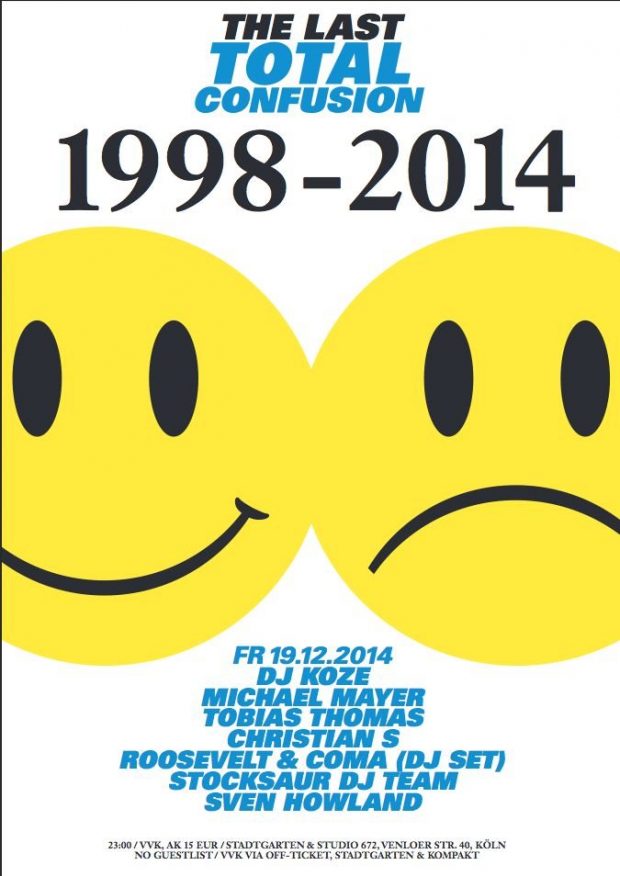
Total Confusion ging 1998 an den Start. War das eine symptomatische Platte, die den Sound dieser Frühphase definierte?
Tobias Thomas: Eher symptomatisch für eine bestimmte Uhrzeit, für die klassische Peaktime (damals ca. 3-4 Uhr morgens) und für eine allgemein sehr euphorische, ekstatische, affirmative Grundstimmung, die wir alle teilten. Es war die Zeit des Sägezahn-Technos, Nebel und Strobo, und alle drehten durch.
Wolltet ihr zu dieser Zeit ganz entschlossen Indie-Songs mit Clubmusik vereinigen und habt das vorangetrieben, oder war das eine Entwicklung die ihr eher aufgegriffen habt? Meintet ihr auch das mit „Total Confusion“?
Obwohl ich selbst als Teenager eher »Indie« war, haben uns immer eher die Verbindungslinien zwischen Pop und Techno interessiert. Als wir mit unserem damaligen Projekt Forever Sweet zu L’Age D’or/Ladomat kamen, waren Tocotronic quasi unsere Brüder im Geiste auf der Rock-Seite des Labels. Aus dieser ganzen “Lado-Szene”, die auch andere Acts wie Andreas Dorau, Egoexpress, Whirlpool und Die Sterne umfasste, entstanden im Laufe der Zeit viele gegenseitige Befruchtungen und vor allem Remixe, die u.a. deutsche Sprache auf den Technofloor brachte. Von “Girls in Love” bis “Pure Vernunft Darf Niemals Siegen”. Eine schöne Zeit und meiner bescheidenen Meinung nach der beste Remix, den ich (damals mit Kollege Olaf Dettinger zusammen) in meinem Leben zustande gebracht habe. Die Idee “Total Confusion” kreiste um diese Art Grenzüberschreitung, grundsätzlich ging es darum, sich selbst und das Publikum immer wieder von Neuem völlig durcheinander zu bringen.
Jan Jelinek – Tendency (Scape, 2000)
Habt ihr solch feinziselierten Tracks viel Platz eingeräumt? In welchen Phasen der Nacht habt ihr solche Platten gespielt?
Am ersten Tag erschuf Gott das Warm-Up. Eine dem DJ-Handwerk zwingend zugehörige Kunst, der Michael Mayer und ich schon seit unseren ersten Parties Anfang der Neunziger Jahre frönten und die wir nicht müde wurden, von jeder Kanzel herab zu predigen. Auch Aksel aka Superpitcher wurde in diese Kunst eingewiesen und mit der Zeit zum Meisterschüler.
Jede Nacht muss, wie jede andere Geschichte auch, einen Anfang haben. Jan Jelinek war einer der unerreichten Großmeister von solchen Tracks, die gegen 0:30 Uhr etwa den Übergang von Ambient und langsamen Beats hin zu knisternden, flirrenden, vertrackten Stücken markierten, bei denen die Teilchen in der Luft langsam anfingen, sich elektrisch aufzuladen. Jelineks “Loop-finding-jazz-records” ist ein Meilenstein der elektronischen Musik und gehört zur auralen Pflicht eines jeden Nachwuchs-DJs.
Luomo – Tessio (Force Tracks, 2000)
Ich vermute „Tessio“ wurde sehr rasch eine Hymne in eurem Club, oder? Brachte das Stück eure Vorstellung von elektronischen Songs auf den Punkt?
Was Sasu Ripatti aka Vladislav Delay aka Luomo damals mit House gemacht hat, kann man gar nicht hoch genug einschätzen. Er hat nicht weniger als den gesamten, in Stein gemeißelten Kanon von Bassdrum, Hi-Hat, Snare und Clap im 4/4-Takt in Frage gestellt. Seine ersten Tracks als Luomo waren Monster. Allen voran “Tessio”, eine Hymne, so randvoll mit Emotionen, Energie, Sex und Melancholie, dass einem noch heute schwindelig davon wird.
Static – Headphones (City Centre Offices, 2002)
Wie wichtig war IDM bei Total Confusion? Musste es mit einem guten Song verbunden sein, oder war das kein Kriterium?
Wir haben immer schon leidenschaftlich elektronische Musik gehört, die nicht zum Tanzen gedacht war. Von Underground Resistance und den “The Rings of Saturn” bis zu Aphex Twin, von Air Liquide bis zu The Bionaut. Chillen war vor 20 Jahren noch etwas von sehr intensiver Musik und auch entsprechenden Drogen durchwebter Zustand. Wenn sich solche Sachen dann wieder dem Format “Song” annäherten wie bei “Headphones” wurde es erst recht spannend für uns.
Heiko Voss – I Think About You (DJ Koze Remix) (Kompakt Pop, 2002)
Was machte diesen Track zu einer Total Confusion-Hymne? Die elegischen Streicher-Sounds, gepaart mit diesem bouncigen Groove? War das eine Qualität, die ihr verfolgt habt?
Heiko Voss ist nicht nur ein bis heute schmählich vom Weltgeist übergangenes musikalisches Genie, er war auch wahrscheinlich auf jeder verdammten Party in 16 Jahren Total Confusion zu Gast. Diese Nummer ist ein wundervolles Liebeslied, von Koze, einem anderen, mittlerweile anerkannten Genie, der im Studio 672 damals vieles gelernt und gelehrt hat, mit Samthandschuhen in den Club transportiert. Zu diesem Song haben die Menschen nicht nur getanzt, sie haben sich verliebt. Noch schneller als nur alle 11 Sekunden.
Dntel – The Dream of Evan and Chan (Superpitcher Remix) (Plug Research, 2002)
Ich nehme das war eine der größten Hymnen bei euch, die auch immer noch viel gespielt wird. Was hat das auf eurer Tanzfläche ausgelöst, und ging das von Anfang an los?
Ein kongenialeres musikalisches Zusammenspiel als das hier zwischen Jimmy Tamborello aka Dntel und Superpitcher hat es selten gegeben. Ein tieftrauriger Singer/Songwriter-Popsong geremixt von einem nicht weniger dauermelancholischen DJ und elektronischen Produzenten. Die Atmosphäre von “The Dream of…” beschreibt wie auf einem Gemälde unser damaliges Lebensgefühl. Entzieht sich jeder weiteren Beschreibung. Zuviel Gänsehaut.
Justus Köhncke – 2 After 909 (Kompakt, 2002)
Das kam mir immer vor wie Justus’ Annäherung an die großen Clubhits von Metro Area. Hat das bei euch eine Rolle gespielt, auch speziell dieser Groove?
Justus war und ist eben auch so ein Grenzgänger und die waren uns immer sehr willkommen. Damals hat er gefühlt alle zwei Monate so eine Nummer abgefeuert, immer getreu seinem Motto: “talent borrows, genius steals”. An Metro Area gab es ohnehin kein Vorbeikommen, genauso wie an Daft Punkt vielleicht. Die Nähe zu Disco generell war uns wichtig, es ging bei Total Confusion ja auch um eine gewisse sexuelle Ambivalenz. Und auch wenn diese Liste einen gewissen Eurozentrismus vermuten lässt, gab es auch unzählige Total Confusion-Hymnen von Moodymann, Carl Craig, Theo Parrish und diesen großen Helden. Aber das ist eine andere Geschichte…
LoSoul feat. Malte – You Know (Playhouse, 2004)
Zumindest in meinem Bekanntenkreis war das ein eher umstrittener Track, auch unter LoSoul-Fans. Es gab doch lange eine Abwehrhaltung gegen Clubtracks mit deutschem Gesang. Hat es euch bei der Etablierung dieses Aspektes geholfen, dass ihr als wöchentliche Residents ein loyales Publikum hattet, mit dem man das kontinuierlich aufbauen konnte?
“Umstrittene Tracks” wurden bei uns am Eingang immer direkt durchgewunken. Die standen sozusagen auf der permanenten Gästeliste von Total Confusion. Unser Publikum hat solche Sachen geliebt. Manchmal auf Anhieb, manchmal mussten wir es ihnen aber auch erst zärtlich reinprügeln. Der wöchentliche Rhythmus hat auf jeden Fall für eine soziokulturelle “Togetherness” gesorgt, die es so heute leider nicht mehr gibt. Isso.
Welche Rolle spielten trancige Elemente bei Total Confusion? Hattet ihr das schon immer bewusst integriert, und welchen Stellenwert hatte das?
Ich persönlich habe wenig Sinn für Trance, Michael schon eher. Aber wenn, dann ging es schon um die Elemente von Trance, die einen Laden in Schutt und Asche legen. “Happiness” war natürlich auch so eine Selbstvergewisserungs-Hymne, die sehr unserem damaligen seelischen Zustand entsprang. Es war eine Zeit voller Sehnsucht, aber auch noch eine voller wahrhaftiger Glücksmomente.
War diese Art von euphorischem Club-Pop gängig bei Total Confusion, oder waren das eher Ausreißer? Bei solchen Platten zählt der richtige Moment, oder? Habt ihr euch in diesem Feld auch manchmal verhoben?
Pop stand immer als Dessert auf der Karte. Als Nachspiel und Epilog. Nachdem die Leute zwei, drei Stunden durch den Fleischwolf gedreht wurden und nahe der Epilepsie standen, ging das Strobo aus, das Licht wurde wieder wärmer, der Fuß des DJs ging vom Gas… dann war es Zeit für Pop, Kitsch, alte Klassiker, Flohmarkt-Schätze und dergleichen. Das war Programm und immens wichtig, um dieser kalten Tristesse vorzubeugen, die unweigerlich entsteht, wenn man einfach immer weiter macht, ohne auf die Erschöpfung der Menschen und ihren emotionalen Zustand am frühen Morgen Rücksicht zu nehmen. In Zeiten von Clubs die heutzutage 72 Stunden durchmachen natürlich eine absurde Vorstellung. Aber wir waren eben Old School, Baby.
In discussion with Trusme on “Forevernevermore” by Moodymann (2000).
I doubt that „Forevernevermore“ was your first encounter with Moodymann. Did you eagerly await his third album, and how did it grab you?
100% I didn’t know who Kenny was till I found a copy of “Forevernevermore” in my friend’s record bag. He had left his records at my house and I was doing the usual noseying though the records when I found this CD. I was completely into Slum Village, MadLib and Jaydee collecting the samples from Jazz to Disco. When I first played this CD, everything just became clear in my mind. This is the sound I was looking for, from Hip Hop, House, Jazz, Soul and Disco all rolled into one. I became obsessed, wanting to understand the production techniques and went on to discover the whole world of Detroit right after this. Three years on, Moodymann was playing my first LP launch in a pub on Oldham street, home to where I had been buying his records for the past few years. KDJ and Theo were just No.1 at that time in Manchester and I couldn’t help but be influenced by the whole sound.
It seems that Moodymann matured up to the release „Forevernevermore“ in terms of the album format. „Silent Introduction“ felt like an anthology of 12“ material, even though it worked as an album. But with „Mahogany Brown“ he already aimed at a listening experience more true to the format. Would you say he topped this with „Forevernevermore“?
Yes, for sure. The whole LP worked as a cohesive hour of music yet there was something at every turn that was unique and compelling to me as a listener. I related to this LP in more ways than one, due to it’s almost Hip Hop nature with intros and outros connecting the tracks and glueing the whole piece together. There are so many seminal tracks on the LP that are still played out in the clubs today, yet they are tracks that remain LP cuts and for home listening only. This ideology is what I have embraced in all four LPs that I have produced over the last 8-9 years, with something for the dancefloor, something for the car and wherever else that one listens to LPs these days.
You told me that you wanted to talk about the CD version of „Forevernevermore“, which has lots of interludes and skits, and hidden tracks. Do they form an alliance with the music that almost works like a radio play? What is the special appeal of it?
When I think of an LP, I think of A Tribe Called Quest, Marvin Gaye or The Verve even. All these LPs are constructed to be a continuous piece of music, in which the listener is taken on a journey from the beginning to the end. With the CD format, there is extra playtime in which intros and outros can give a context to the background and making of the LP. On the “Forevernevermore” CD you are taken into the home of KDJ, as he sits playing with ideas on the piano with his child, to the studio discussions and even to listening to his local radio for inspiration. Hidden right at the end of the CD is a live recording of three hard-to-find cuts from the KDJ label, mixed together after 2 mins of silence. In many ways the CD provides the platform for further expression as an artist in the format of an LP.
I think the sound of „Forevernevermore“ was a step forward in terms of his distinctive sound. It was still dense and immersive, but also more refined. Do you think Moodymann’s sound evolved on „Forevernevermore“ in comparison to earlier works? And was it for the better?
This was for sure in an LP sense his best work. It is what most people say as their favourite work, when talking about Moodymann. He carved a sound out all for himself and also derived a unique long player format that until then was not seen in the dance scene. Most underground dance LPs were merely a collection of 12” tracks but this felt more like a well thought-out process, something like Daft Punk would execute. I believe Peacefrog Records also helped in this process and pushed KDJ, as they did all their artists to reach even further. In many ways, earlier LPs were a collection of his previous works but “Forevernevermore” was an LP made from beginning to end with a single LP idea and it feels very much that way.
Tracks like the Disco led „Don’t You Want My Love“ display a confidence to transcend mere club credentials for traditional songwriting, a path he followed ever since. Is there a side to Moodymann the producer you prefer to others, or is it not necessary to differentiate his persona as an artist?
The marriage between your typical MPC studio production and live instrumentation was what set out Kenny on his own. Working with local artists like the percussionist Andres, bass with Paul Randolph and keyboards by Amp Fiddler, on top of that raw production sound was just so unique. The juxtaposition of quantised groove and loose musicianship created a genre of its own and is still being replicated today. This LP was the beginning of that sound and Kenny is still using this formula very much in his productions today.
How do you rate the albums Moodymann released since „Forevernevermore“? Were they up to par with your expectations?
“Black Mahogani” is on par for me if not more refined than “Forevernevermore” but maybe it’s the rawness of the LP that better relates to me. With the following LPs I have enjoyed the productions but felt slightly less connection to the music I listen to and make today. Not that it’s not great music, but I started to feel that the tracks in the EP releases didn’t have that Peacefrog touch of which I’m such an admirer. The LP process began to evolve towards the creation of a new sound where he begins to sing and perform more as an artist and less in the background as a producer. Read the rest of this entry »
In discussion with DJ Fett Burger on “Homework” by Daft Punk (1996).
How did „”Homework”“ found its way to your years? Was it by coincidence, or did you seek it out on some recommendation?
It was totally by a coincidence. I think it was back in the fall or winter of 1996 or something, I can’t really remember. My brother and me were listening to the radio one evening in the kitchen. Back then, we always listened to the radio when we were eating or hanging out, usually making drawings. In Norway around the time it was a channel called NRK P3. It’s still around, and it was one of the main National broadcasting channels. There were three of them. NRK P1 the original, NRK P2 mostly for culture, and NRK P3 for the younger generation. This station was aiming for a younger audience – but in a very different way than today. They used to have a broad selection of different programs. My favorite was the programs in the morning and afternoon because they had a lot of intelligent humor and also sometimes pushed things a bit further in terms of what was socially acceptable, at least back then. In the evenings, six days a week, they had different shows dedicated to music belonging to a certain scene or niche. Tuesday, Wednesday and Thursday it was Roxrevyen, which later became Karlsens Kabin, and Hal 9000. Karlsens Kabin mainly covered indie music, but also electronic music. Hal 9000 with Harald Are Lund was a broad selection of rock, electronic and experimental music with a very open minded approach. A lot of older things got played as well. Friday, it was National Rap Show with Tommy Tee, Hip Hop concentration mostly on early nineties East Coast Hip Hop. And then, Saturday, it was DJ Dust with Funk and Disco, DJ Strangefruit with his eclectic selections, and later in the evening DJ Abstract with mostly House and Techno. On Sunday it was Chill Out with DJ Friendly in the morning and Ambolt on Sunday evening, which was dedicated to Metal and harder Rock. Overall, NPK P3 had a pretty broad selection of music from different scenes. It provided a great musical education for when you are young and from a small Norwegian town. These programs were so dedicated to their scene, they always played a lot of demos or unreleased music. Karlsens Kabin and Hal 9000 played some of our oldest music, even things only made on CD-R, so it was a very supportive scene on the radio back then. You can just imagine how crazy it was for us back then being played on national radio!
OK, now back to the question. First time I heard something from Daft Punk was through Karlsens Kabin or Roxrevyen as it was called then. It was a mid-week evening, and suddenly “Around The World” was on the radio. This was before it was a big hit, and before people knew what Daft Punk was. It was probably a radio promo that was played or something like that.
It just blew my mind at the time. Back then it was so cool, different, even strange. Right after they played the song, they said the name and title of the song. And one second later I forgot it all, except the song. But a few months later, Daft Punk was everywhere with “Da Funk” and “Around The World” on MTV all day long.
Do you like the album as a whole, or are there personal highlights, or even tracks you do not like as much?
I like the album as a whole. Before when it was new, you could hear the hits everywhere, so I was pretty familiar with them. I remember when my brother and I got the album. It was an interesting listening experience, since most of the tracks were actually not hits or mainstream material. For instance, “Rollin’ & Scratchin’, “High Fidelity”, “Rock’n Roll”, “Indo Silver Club”, “Alive” or the intro “Wdpk837 Fm.” But, since everything was on the album, it just became associated with something mainstream.
Now it’s a classic of course, but back then, it was the combination of making something catchy, a bit more demanding, and for a scene. In this case, obviously House and Techno. You can hardly say that something is demanding or edgy on the album anymore, because of its place in music history. I think there still are some tracks that are edgy. Back then, for a 15-year-old kid without any experience, this was a big and new thing. Just imagine what influence this had. I remember even in the beginning, I didn’t like “Rollin’ & Scratchin.’ However, it changed after I gained more of an understanding for where the song and its influences came from.
For me, the whole album is a personal highlight. There are different vibes to the tracks and your mood shifts. Some songs are more uplifting, some more mellow, and some noisy or slow. But everything is a favorite of mine in different ways. They all have different elements of influences for me in terms of musical education. The whole album is a favorite of mine. Everything, from how the sound is mixed, the way Daft Punk samples, the artwork aesthetic, the music videos and Daft Punk’s anonymity at the time. It’s a whole package, and I embraced it all. I loved it all and still do!Read the rest of this entry »
Luomo – Tessio Pépé Bradock – Life Photek – Mine To Give The Parallax Corporation – Anti Social Tendencies Recloose – Can’t Take It (Carl Craig Remix) Moodymann – Analog:Live Foremost Poets – Moon Raker (Phase II) Seal – The Latest Craze DJ Deep & Jovonn – Back In The Dark Blaze – Funky People The Closer – Sound Is The Device Stan Francisco – Lover 2 Lover Deep Sensation – Can’t Give You Up Victor Simonelli – Ease Into The Dance Daft Punk – One More Time Derrick L. Carter – 10 Jasper Street Company – Music Rhythm Section Featuring Donald O – Do You Know D.J Spen – Tedd’s Beat Goes On DJ Romain & Matt Keys – Jesse’s Speech Johnny D & Nicky P – Like Morning Agent X – In The Morning Kerri Chandler – I Found You Cooly’s Hot Box – What A Surprise Deep Theory Featuring Haley – Do It Mutiny UK – Bliss LoSoul – Sunbeams And The Rain Nick Holder – Show Me Love Scuba – Heavenly Saint Etienne – How We Used To Live
Daft Punk – Revolution 909 Charly Brown – The Twilight Zone Markus Nikolai – Rood The People Movers – C – Lime Woman Moodymann – Dem Young Sconies Green Velvet – Answering Machine Jedi Knights – Big Knockers Double 99 – Ripgroove Goldie feat. KRS One – Digital DJ Sneak – You Can’t Hide From Your Bud Kenny Dixon Jr. – Track 2 Track Arj Snoek – People Know Rick Wilhite – Dreams Of Yesterday Seven Grand Housing Authority – Ambient Disco E-Dancer – Heavenly Callisto – Ambent II Sluts’n’Strings & 909 – Past The Gates As One – Freefall Vincenzo – At Throb Faze Action – Plans & Designs Forever Sweet – Untitled Fresh & Low – No Going Back Tyree – Kan I Git High Callisto – The Cimmerian Âme Strong – Tout Est Bleu Abacus – We Cookin‘ Now Abacus – When I Fall Blaze – Lovelee Dae Big Moses Featuring Kenny Bobien – Brighter Day Carl Craig – Butterfly
Wenn heutzutage ein DJ in einem Techno- oder Houseset eine von der Geschwindigkeit passende Hip Hop-Platte auflegen würde, wäre mit großer Wahrscheinlichkeit augenblicklich Stille im Saloon, der betreffende Booker würde Stoßgebete gen Himmel richten, und die Forenserver gingen in Rauch auf. Gelegentliche Ausflüge von Erfolgsproduzenten -und Rappern in die Dance-Kultur einerseits, man erinnere sich beispielsweise an Snoop Doggs famosen Flötenhouse-Ausrutscher “Sexual/Sensual Eruption”, und gelegentliche Ausflüge von Erfolgsproduzenten- und DJs in die Hip Hop-Kultur andererseits, man erinnere sich beispielsweise an unselige Gastauftritte auf irgendwelchen Ed Banger-Platten o.ä., haben im Prinzip den Burgfrieden nicht wieder hergestellt. Hip Hopper halten Clubmusik für oberflächlich und schwul (oder auch für nicht lukrativ genug, zu wenig materialistisch, zu wenig poppende Glocks), und Clubmusiker halten Hip Hop für oberflächlich und nicht schwul genug (oder auch für zu lukrativ, zu materialistisch, zu viel poppende Glocks). Man wirft sich gegenseitig vor, falsche Botschaften auszusenden, und bezichtigt sich der Irrelevanz. Die eine Fraktion schüttelt den Kopf über falsche Drogen und Gehampel und sinnlose Eskapismen, die andere Fraktion schüttelt den Kopf über falsche Drogen, Statussymbole und sinnlose Gangsterismen. Die gemeinsamen Wurzeln, sie werden geschichtsklitternd unter den Teppich gekehrt. Die Zeiten, als im Club beides ging, sowieso. Alle Behauptungen, dass man sich da wieder annähern würde, sind Nischeneinblicke ohne Realitätsanbindung. Zulange hat es sich die große Mehrheit der Hip Hop-Kultur unterhalb der 120er-bpm-Grenze in Kopfnickertempi gemütlich gemacht, zulange hat sich die Tanzmusikkultur damit begnügt, der anderen Seite ein generelles inhaltliches Armutszeugnis auszustellen. 1988 etwa war das alles noch kein Problem. Der energetische Sloganismus von Public Enemy oder das unterschätzte Frühwerk der Stereo MCs liefen auf jeder amtlichen britischen oder kontinentaleuropäischen Acid House-Party (wo entgegen dem gegenwärtigen clubkulturellen Revisionismus keineswegs nur 303-Geblubber lief, sondern alles zwischen Barry White und Lisa Stansfield einen Auftritt haben konnte), und selbst ein düster-dräuendes Biest wie “Follow The Leader” war eine frenetisch gefeierte Hymne. Und warum auch nicht? Rakim, der weltcoolste MC, war schon früh via Sampling in den Dance-Kanon aufgenommen, und der soundtrackhafte Charakter des Stücks passte bestens in die funktionale Psychedelik der Strobonebelwelt. Noch war alles gemeinsam 4/4, und solange die DJs es schlüssig zusammenbringen konnten, war es schlüssig zusammengebracht. Und eigentlich könnte das jetzt wieder klappen. Die Slow Motion-House-Bewegung hat sich schon fast so heruntergedrosselt, dass man bei der überwiegenden Hängerdynamik von Hip Hop anklatscht, jeder dritte Pos(t)erboy-Emo-House-Produzent behauptet im ersten Interview, in der Jugend quasi nichts anderes gehört zu haben, ein bisschen House vielleicht noch, und die Rap-Elite ist auf der Sinnsuche immerhin schon bei Daft Punk und Haddaway angelangt. Man könnte also auch problemlos die Edit-Kanone aufeinander richten. Entweder es gibt dann wieder einen Leader mit reichlich Followern, oder man redet anschließend überhaupt nicht mehr miteinander, vielleicht nicht einmal mehr übereinander. Aber probieren geht über studieren.
> Backroom Productions – Definition Of A Track ( New York Underground Records) 1988
A rare tune from 1987. Indeed nothing but a track.
I knew this from the vinyl edition of the DJ-Kicks by Terranova. At that time it fit right in with what they were trying to represent with that compilation. I used to play this track regularly back then, it was very good for warming up.
So you actually know this for quite some time then.
Yeah, of course! I was not into Terranova that much, but the compilation had some brilliant tracks on it. East Flatbush Project and such.
This has some kind of Hip Hop vibe to it, too. But it does not exactly sound like 1988.
No, and I didn’t know that (laughs).
Would you still play it?
Definitely. I don’t know when and for what occasion but it is a class track.
It somehow reminds me of the bonus beats they used to have on the flipside of old House records.
Yeah, but bonus beats have gone out of fashion a bit, apart from Hip Hop. Argy had some for that Sydenham track “Ebian” on Ibadan last year. But I think it is not really relevant anymore for the current generation of House producers.
The percussive elements really distinguish the sound of that era from today’s productions. Lots of handclaps, or here it’s rimshots.
My problem is that I don’t really like all these percussion sounds from drum machines. I prefer sampled real instruments. This is probably some classic Roland drum machine, like a 606. I would take the bassdrum and hi-hats from somewhere else. The toms of these old machines are always cool, but the bongo sounds for example are not for me. I wouldn’t use that for my productions. I couldn’t do these 100 % authentic references. I think it’s supercool to listen to in a Prosumer record for example, but I couldn’t do that.
You got qualms about doing something like that?
No (laughs)! I’m just working on a new track for which I sampled an old Amen-break. I don’t care, if I like it I use it. This kind of break is in 90 % of all Drum and Bass tracks and nobody cares, so I don’t care either.
> Phortune – Unity (Jack Trax) 1988
This is an old track by DJ Pierre, from his Acid House days. But it is different to most tracks he produced back then. It is pretty deep.
It’s great. Awesome vibe for 1988, I could listen to this all day. It doesn’t tranquilize my feet, it’s not boring, it’s perfectly right. And I would grin from ear to ear if I would hear this in a club.
Some of its sounds have aged really well.
I really like this. I think it’s a pity that there are not so many tracks with great basslines at the moment. There are a lot of simple, functional basslines without much of a melody. Of course it’s effective and some current tracks need some of these dominating, functional elements, but a track like this for example needs a bit more, and I miss that. It’s also simple, but it has more and different harmonies. I like that, it gets me hooked. I would love to buy this on Beatport (laughs)!




Recent Comments