Posted: January 30th, 2011 | Author: Finn | Filed under: Mixes | Tags: 2011, Berlin, D*ruffalo Hit Squad, de:bug, Druffmix, Elektro Guzzi, Friedrich Goldmann, Groove, Interview, Jan Joswig, Kiel, Marco Bernardi, Playing Favourites, Radio, Resident Advisor, Rewind, Soju Bar, Stefan Goldmann, Sweatlodge | 4 Comments »

Mix recorded for Artist of the Week-feature @ Sweatlodgeradio.com
Interview (by Elie Eidelman)
You are a well respected music writer writing for publications like De:Bug, RA and your own blog (among others). Has music writing always been part of what you do, and what came first? The writing or the djing?
I write about music in public since the mid-90’s, and I started playing out in the late 80’s, so definitely DJing came first. My output as a writer has also been not as prolific as it turned out to be after I moved to Berlin in 2003. I knew Jan Joswig, the fashion editor at de:bug at that time, from former days in my hometown Kiel and he asked me to contribute. I started out writing reviews and then turned to features and especially interviews, some of which got quite some attention. So that eventually led to writing for other print and web publications too, like doing the “Playing Favourites” series for Resident Advisor, my “Rewind” series for sounds-like-me.com, Groove Magazine, and a lot of other media. The Website you’re referring to is not a blog in the sense that I write about everything that goes through my head, it is more like fragmentary online archive of my activities from the 90’s until now. Writings, Mixes, Gigs, the label, and a plethora of other things. It is not that I’m that vain to want everybody to know what I do and did, it is kind of a reminder for myself that others can follow if they like. Excuse the irregular updates at this point, but I slowed down all said activities a bit to have more time for my lovely wife and daughter, and I took up working at Hard Wax, too. Consider me well busy.
Can you please tell our readers what is D*ruffalo and who stands behind it?
I can’t possibly tell, at least not anymore. When D*ruffalo was unleashed 4 years ago, it was some sort of a media experiment initiated by a semi-anonymous collective of writers, producers and DJs based in several German cities, intended to be a platform to share love for what should be loved, free of any conventional restrictions. Soon some lack of love for what was deemed not as loveable showed up as well, but basically it was conceived to be the Fort Alamo of sincerity. Decidedly non-ironical, accidentally post-cool and fiercely anti-hype. At some point The D*ruffalo Hit Squad and the according Druffmix series was brought to life, to shine a light on music no light shined upon. But it totally spiralled out of control. I don’t know what it is right now, or if I am still a part of it even. But apparently D*ruffalo celebrates its sheer existence and the 50th Druffmix with a party at Berlin’s Soju Bar on February 11, and there are negotiations about a regular residency there. If the unpredictability and confusion of the D*ruffalo members allows. Which is probably unlikely, maybe. I can’t possibly tell.
You are running Macro Records together with Stefan Goldmann. How’s the process been running a label and what can we expect from Macro in 2011?
When we founded Macro we decided to only release music we find worth releasing, at the potential risk of longer stretches with no releases at all. But then the label took up so much momentum that we now have more releases lined up for this year than in the years before. March will see a new EP by the rather sensational Elektro Guzzi and Stefan’s magnificent “The Grand Hemiola” 2×12″, you can hear excerpts of both in the mix I recorded for you. We will follow that up in April with a live album by Elektro Guzzi and a compilation of the late works of the composer and conductor Friedrich Goldmann, Stefan’s father, who sadly and much too early passed away in 2009. We are also in the process of preparing several other projects for later this year, which are not yet ready to be unveiled, but well worth waiting for. We worked very hard to achieve a position in which we can do whatever we want, and as long as this strong support will stay with us, we will do just that. Expect the unexpected.
You’re known for your eclectic dj sets. What can you tell us about this set you prepared?
My sets, be it in a club or radio context, can be quite diverse, that’s true. But I don’t believe in eclecticism per se. Meaning, I don’t want to attract opposites just for the sake of it. If you neglect a certain coherence, structure and narrative you will end up sounding like a jukebox, however interesting it might be musically equipped. I like thinking of a concept when doing a mix, as subliminal or not it might be. With this one, I just intended to combine an experimental streak with a dancefloor functionality, while providing a glimpse of unreleased Macro material and tracks of artists I consistently admire, and tracks I still find as interesting as the day I first heard them. Which in the case of this playlist, was not too long ago. At any other time the set would probably have sounded differently, but this was what I then had in mind for this purpose and I hope it makes as much sense to the listeners as it made to me when I recorded it.

Stefan Goldmann – Mining The Vein / The Grand Hemiola
Raime – This Foundry (Regis Version)
Shackleton Vs. Kasai Allstars – Mukuba Special
Theo Parrish Ft. IG Culture – Traffic
Elektro Guzzi – Boom Room
Margaret Dygas – Hidden (NSI Mix)
Farben – Kursbuch 1&2
Son Of Sam – Nature Makes A Mistake (Âme Mix)
Marco Bernardi – Klinsfrar Melode (Sprinkles Deeperama)
WK7 – Higher Power (Hardcore PCK Mix)
Pinch – Croydon House
Posted: November 29th, 2010 | Author: Finn | Filed under: Interviews Deutsch | Tags: Frankie Knuckles, Front, Interview, Klaus Stockhausen, Patrick Cowley, Radio, Rewind, Tom Moulton | No Comments »

Im Gespräch mit Klaus Stockhausen über “Party Boys” von Foxy (1980).
Wie bist Du auf „Party Boys“ gekommen? Beim Plattenkaufen für DJ-Gigs? Du hattest ja 1980 schon mit Auflegen angefangen, als die Platte rauskam.
Die Platte ist, denke ich, von 1979, aber es war wohl 1980. Angefangen habe ich drei Jahre vorher. Ehrlich gesagt war ich in Amsterdam in einem Plattenladen, Rhythm Import, und es war der Nachfolger von „Get Off“, und „Get Off“ ging relativ gut ab. Ich habe in drei Clubs gearbeitet zu dieser Zeit. Donnerstags/Freitags in Frankfurt in so einem Armee-Schwuchtelladen, der hieß No Name. Da waren nur stationierte Soldaten, sehr amerikanisch. Samstag/Sonntag Coconut in Köln, und Montag in Amsterdam im Flora Palace, was hundert Jahre später zum It-Club wurde. Und du hattest drei verschiedene Musikrichtungen. In Köln war es diese Hi-NRG-Nummer mit sonntags Schwuchtel-Tea-Dance, Poppers etc., bei den Amis hattest du funky to Disco, und Amsterdam war britisch angehaucht. Diese Fusion war ganz gut.
Wie hat sich denn das Britische in der Musik in Amsterdam manifestiert?
Es war soulig, Hi-NRG, aber später auch so etwas wie Loose Ends. Es waren Elemente von Rare Groove drin. Und bei „Party Boys“ fand ich einfach diesen Hook so toll, der eben wesentlich eleganter war als zum Beispiel „Cruisin’ The Streets“ von der Boystown Gang. Eigentlich könnte man diese beiden Platten übereinander legen, es funktioniert perfekt. Und diese schrägen Stimmen. Ich mag Stimmen gerne, und wenn sie slightly off sind, mag ich sie noch viel viel lieber. Read the rest of this entry »
Posted: November 22nd, 2010 | Author: Finn | Filed under: Interviews English | Tags: Eric D. Clark, Funkadelic, Interview, Justus Köhncke, Motown, Paris, Radio, Rewind, Romanthony, Talking Heads, Thomas Dolby, Whirlpool Productions | 3 Comments »
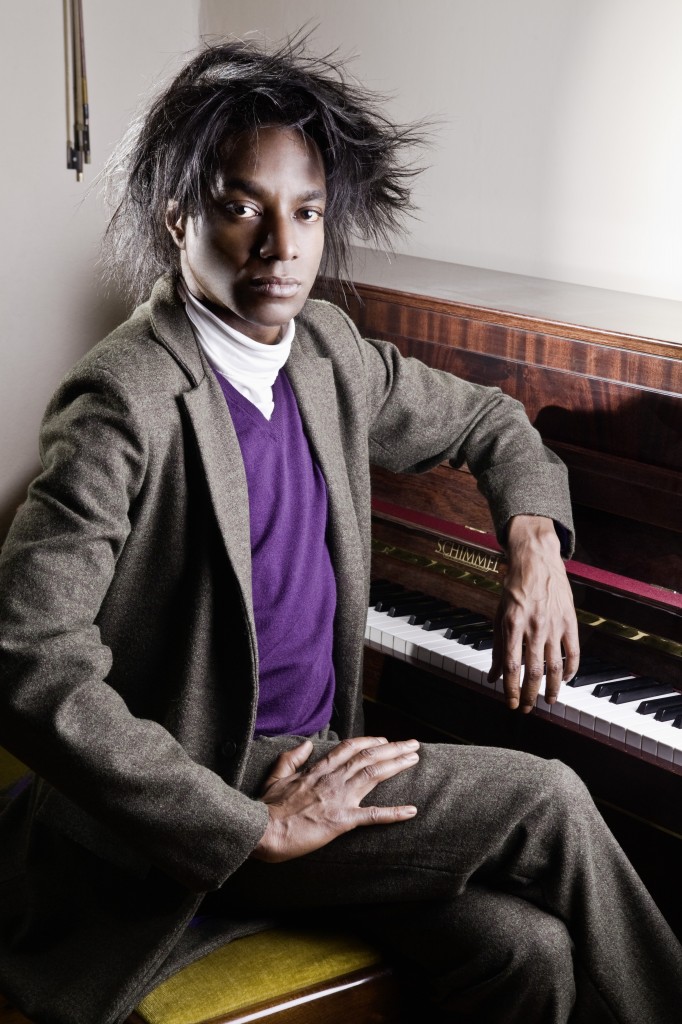
In discussion with Eric D. Clark on “Atmosphere” by Funkadelic (1975).
How were you initiated to the Funkadelic world?
That’s rather hard to say; I believe I first heard Funkadelic… early 70’s? Seems as though I remember hearing “Maggot Brain” as my introduction to their music? And it would most probably have been at a party; maybe a cousin’s house or on a military base at a function? Don’t really know. However I seem to remember that piece first: I certainly had no idea what or who it was? At the time I thought the label art was somehow the band’s responsibility, therefore I would buy records according to the artwork; if I was at a friend’s house and they had something I liked I would go to the record store, usually with my father, and look for the same artwork and buy the record (we’re talking 7″ singles here). Needless to say it was often not what I was looking for. However, rarely did I return anything! This is how I ended up finding out about Led Zeppelin at age 5 or 6. I was looking for Rare Earth. When I finally witnessed Funkadelic’s artwork first-hand it cemented my high regard for their overall “thang”!
Was it a part of your childhood and youth in California?
There was a very strong and rich musical culture in our house. Every morning before school we were allowed to listen to music (no TV, only on Saturday mornings) that we selected from an extensive record collection procurred over previous decades and life in Kansas, Philadelphia, St. Louis and Poplar Bluff Missouri, Osaka, and wherever else our parents had been on their journeys with the military. This included 78 rpm shellac discs and 7″ children’s records recorded at 16 rpm. Father always loved Jazz and has an extensive collection of Blue Note recordings from the label’s inception until around 1970 something. Errol Garner was a big favourite, Booker T. & the MG’s. I did not really get into Jazz though until much later, though I liked Errol Garner! The rest was boring to me then. “Shotgun” and “Green Onions” I liked a lot but until this day I can’t stand James Brown for example?! Only one song that I can’t remember the title of, from around 1958. Mother was into Gospel and female vocal performers such as Morgana King, Dinah Washington, Mahalia Jackson, Dakota Stanton, Aretha of course, also some guys like Major Lance and Joe Simon both of whom I still love today. This collection still exists, excerpts of which you can hear in a set I uploaded to soundcloud.com/eric-d-clark under the moniker “The OZ Effect”. When I’d go looking for what I liked and tried to share it with them it was not met well. They tried to form me with classical which I found to be very little of a challenge, especially as I could trick the teachers by learning pieces twice or even three times as fast by listening to them on vinyl (my component stereo system was right on top of the piano next to my father’s AKAI reel-to-reel, which he bought in Osaka three years before I was born and I adopted; when I am at our house in Sacramento I still use this machine!). Funkadelic were strictly off-limits (very enticing) but I kept the records anyway, even though they were considered to be devil music by Mom and Dad. I was still under ten? Read the rest of this entry »
Posted: November 15th, 2010 | Author: Finn | Filed under: Interviews English | Tags: Depeche Mode, Front, Hardrock Striker, Interview, Marc Almond, New Order, Panorama Bar, Paris, Radio, Rewind, Suicide, Terre Thaemlitz | No Comments »
In discussion with Hardrock Striker on “I’m A Cult Hero” (1989).
Do you have a past acquainted with this music? Is this the compilation that nailed down musical preferences you already had, or did you have a different background and were you just looking for something in that direction?
This is clearly the music I was listening to as a kid. Back then, my biggest dream was to be in a rock’n’roll band, no way I wanted to become a DJ (“what a joke I could have thought”) as this meant nothing to me, imagine playing guitar and being on stage screaming in front of a crazy crowd or mixing records, even a monkey could do it! Obviously, it’s only when I started DJing that I understood the power of it and realized my immaturity.
I chose this compilation because even if it looks like a pure rock record, many of the bands inside are using electronic, though I had no clue about it while I was listening to them. I discovered house in Los Angeles in the late 90’s, I went there to form a heavy rock band but I ended up going out with some friends who were doing house, especially Peter Black who introduced me to Doc Martin, the Wax connection, DJ Harvey. We started being friends, speaking about art, music and I discovered that he was also into New Order, Front 242, Ministry, Echo and the Bunnymen, Joy Division and that he was doing house too, so I thought this music finally wasn’t that bad! I started digging, to sum it up, New Order leads me to italo, italo to chicago, chicago to techno. We did a record company called Parisonic / Square Roots where I was doing reissues (already in 2003) of obscure stuff such as It Ain’t Chicago’s “Ride The Rhythm”, Mickey Oliver “In-Ten-Si-t”, Ralphi Rosario “In The Night” etc. I educated myself through the records I was putting out.
“I’m A Cult Hero” is a bootleg compilation with 80’s dark synth pop music, originally released in 1989. Why do you think such a record was released at a time when acid house ruled the clubs? Was this a reminder to what was going on a few years before, or even a counter-reaction to what followed? What might have been the motivation of the label to do this record?
I think that even if house and acid were blowing up at that time, dark synth-pop and minimal wave were still huge. Remember in 1989, Depeche Mode was also on the verge of getting the biggest rock stars in the world with the 101 Rose Bowl concert and the release of one of the best trio of singles of the 80’s: “Strangelove”, “Behind The Wheel” (Mmmh, the Shep Pettibone Mix!) and “Personal Jesus” which was a combination of rock guitars and electronic so it makes totally sense.
The motivation of these guys was primarily cash I guess but I honestly think they did an amazing job! There are two categories of bootleggers: the creative ones and the thieves, I guess they belong to the first one. Read the rest of this entry »
Posted: November 9th, 2010 | Author: Finn | Filed under: Interviews English | Tags: Carl Craig, Echologist, Interview, Playing Favourites, Radio, Resident Advisor, Ron Trent, Sandwell District, Silent Servant, Suburban Knight, Suicide, Tuxedomoon | No Comments »

Doctor Mix And The Remix – Out of the Question (1979)
A lot of the music we’ve picked out to discuss comes from a similar background in terms of time period, style and sound, but I think this one is pretty obscure. How did you find it?
Through a friend of mine. There’s a label in New York called Acute Records maybe eight years ago or so. A few of my friends in California are really obsessed with The Jesus and Mary Chain, and one of the members of the band mentioned once that this was one of their favourite records of all time. The thing I like about it is the extremity of the music. It’s super high-pitched, with distortion and tinny drum machines but then it’s covers of, like, Stooges songs.
This track in particular has this really insane, rhythmic track that’s super metronomic but super heavy at the same time. It’s very aggressive, but not because of the levels of distortion. The first time I heard it I thought I was listening to [The Jesus and Mary Chain’s] Psycho Candy. The more I looked into it, the more I realized how much of an influence it had on them.
It’s funny. The Jesus and Mary Chain were always compared to The Velvet Underground, but apparently there’s much more to it than that.
Sure. There’s not a lot of stuff like this. The guy was in one of the first French punk bands. And, with this, they kind of combined the attitude of the Velvets with these misinterpretations from a different country. I love that because, for me, techno in California was always a misinterpretation of what was happening in Berlin and Detroit and Chicago just because we didn’t really have a big scene. We had a club scene, but not a techno scene. I just really love the weird interpretations of The Stooges and stuff like that.
Are you interested in bands that deconstruct rock tradition in some way?
At the end of the day it’s all about attitude. Willing to push things a lot and not really care. It was the same when I first heard Cabaret Voltaire’s “Messages Received.” I just didn’t know what to say, I was blown away. I thought, “It doesn’t get any more honest than that.” I think that’s the whole thing. There’s an honesty in the music that you can’t remove. There’s a visceral element to it. That’s how myself, Karl [O’Connor], Dave [Sumner] and even Pete [Sutton] interpret music in some way I think.
Cabaret Voltaire – Messages Received (1980)
There was a very heavy art slant on what Cabaret Voltaire did. I think it’s very, very art driven. They’d also have the influence of The Velvet Underground and all that ’60s psych rock, but they’d do all these awesome records and what came through the most was the attitude. “This is what I wanna do, this is how I’m gonna do it.” And they just went for it.
Is that a quality you try to pursue? Not thinking about what you can or can’t do?
Yeah, I talk to Karl every other day on the telephone, we’re in very heavy contact on a weekly basis, same thing with Dave. But it’s funny because when I make music it’s purely to see what he thinks, just for us to discuss… “Oh, I really like this. What do you think?” It’s more a conversation from an art base. I try to work in a very automatic response way. I work in art direction, so I work quite a bit on TV commercials and magazines and stuff like that. So when I work on music it’s usually very late at night and I have to work in headphones, so it’s usually like a weird mantra type state, kinda conscious and unconscious, while I’m working.
It’s nice because there’s a sense that I’m not really thinking about anything particularly. I’m able to work on music in that mindframe where I’m doing it purely just because I want to see what I can come up with. In a more artistic sense, sometimes I will make a visual and we will work to the visual. Like with the artwork for the album. That was made first. Then we made a record that matched that.
For labels like Factory, design labels were incredibly important. They were, in many cases, as important as the music.
When you get that double impact of visual and audio, you’re like, “Wow, this is really intense.” Cabaret Voltaire for me has always done that. All the artwork on their covers. The early ones especially had that handmade element, which I’m sure was some of the guys in the band literally cutting things out by hand and assembling collages. Read the rest of this entry »
Posted: November 8th, 2010 | Author: Finn | Filed under: Interviews English | Tags: Arthur Russell, Bob Blank, Dinosaur L, Francois Kevorkian, Interview, Joe Claussell, Rewind, Tim Lawrence, ZE Records | No Comments »

In discussion with Tim Lawrence on “Go Bang #5″ by Dinosaur L (1982).
The work on your book on Arthur Russell, “Hold On To Your Dreams”, has probably made you quite an expert on his works, but when was actually the first time you heard “Go Bang! #5″? Was it the song as a single, or did you hear it in the context of the whole “24 – 24 Music” album?
I first heard François Kevorkian’s remix of “Go Bang! #5” when I bought the “Spaced Out: Ten Original Disco Funk Grooves” back in 1997. I was living in New York at the time, and being a bit of a house head, had been quite resistant to buying so-called “disco classics”. By then I had already heard Todd Terry’s sampling of Lola Blank’s crazed-girl-on-helium rendition of the “Go Bang” lyric, which appeared on “Bango (To The Batmobile),” a 1988 house track. I only got to hear the version that appears on the “24 → 24 Music” album – which is titled “#5 Go Bang!” – later on.
Arthur Russell was responsible for a whole lot of outstanding music. Why did you choose “Go Bang! #5″ over other of his songs? What makes it so important for you?
The first thing I should probably say is that “#5 Go Bang!” appeared on an album by Dinosaur L, not an album by Arthur Russell. Of course Arthur (if I can call him by his first name; at times I feel as though I know him, even though we never met) was the key figure behind Dinosaur L, and pulled all of the appearing musicians together. But Arthur was dead-set on the idea of collaboration, and believed that the relationships he formed with other musicians were meaningful, so he introduced different names for the different line-ups he formed.
Why is “Go Bang” so important? That’s the record that I’ve always thought his most complete, inasmuch as it seemed to capture Arthur’s utopian desire to combine the various sounds of downtown New York – disco, punk/new wave, loft jazz, and the post-minimalist form of compositional music known as new music – in a single piece of music. The record also combines complexity and simplicity; it contains scores of ideas, yet never relinquishes the centrality of the groove. I like all sorts of music, but I particularly like music that manages to combine these elements. I could have also opted instead for “Kiss Me Again”, “Platform On The Ocean”, the “World of Echo” album, “This Is How We Walk On the Moon”. “World of Echo” is an extraordinary piece of work, “Kiss Me Again” gets better by the listen. But “Go Bang” is the one that stands out, especially in terms of dance floor dynamics, plus Arthur was happy with the “Go Bang” turned out, whereas he hated the final mix of “Kiss Me Again” and seemed to feel awkward about the obscure quality of “World of Echo”. Read the rest of this entry »
Posted: November 1st, 2010 | Author: Finn | Filed under: Interviews English | Tags: Interview, Oliver Ho, Psychick Wariors Ov Gaia, Raudive, Rewind, Ricardo Villalobos | No Comments »

In discussion with Oliver Ho on “Psychick Rhythms Vol. 1” (1993).
Were you already familiar with the Psychick Warriors Ov Gaia, or was “Psychick Rhythms Vol. 1″ your first encounter with their music?
I was already familiar with their music, I think the first thing I had heard was the album, “Ov Biospheres and Sacred Grooves”. The thing on that album that really struck me was “Linkage”. The way they sampled Egyptian rhythms, and the fact that the track was purely made up of rhythms in a very stripped back way, that were also at a slow bpm. It had a purity and a different edge, very tribal, not techno or house in style at all.
Why did you choose this particular release out of their back catalogue? What made, or still makes, it so special for you? Is it a blueprint for aspects that interest you in electronic music?
The thing about this release that struck me at the time and what continues to be relevant to me is the is the purity of intention. It was an attitude towards music as ‘magick’ that was inspirational. The idea that a particular rhythm is like a spell, something that isn’t just about entertainment, but is operating on a more powerful level. There is a message on the record sleeve artwork that reads: “Warning! This object has nothing to do with art or artificial intelligence. This double package (12″ version) was designed for mixing, for breaks, for possession, for collectors.” This seemed to articulate that there were was something inside the music, that was waiting to released, some kind of energy, that had been placed there by the makers… Read the rest of this entry »
Posted: October 27th, 2010 | Author: Finn | Filed under: Interviews English | Tags: Berlin, DJ Harvey, Front, Groove, Interview, Kraftwerk, Paris, Radio, Tony Humphries | 32 Comments »

You’ve been away for a quite a while now.
Yes, almost ten years since I left England. The reason was not by my design. I was enjoying America so much that I overstayed my visa. If I was to leave, I would have not been allowed back for another five or ten years and I was planning on making my life there. And only a year and a half ago I got married and applied for my green card. And I now have the green card, and my work visa and my right to travel and re-enter the States. So here I am, back in the world. I recently completed a big tour of Japan and I’m on a major tour of Europe right now.
You got married and still it took such a while to get your green card?
Well, actually the process is a lot quicker now than it used to be. From the time I put my application in it was actually only four months until the card came through. Since 9/11 the background check is a little more stringent, but the whole process is now centralized, instead of the department in Washington, and the department in Detroit and so on. There’s one computer, and if you fit the criteria then it’s all good.
So you spent all those years of your self-imposed exile just playing in the States?
Yes, but on a regular basis. America is a big place. And I have a regular circuit. Starting on the Northeast coast, Detroit, Chicago, New York City, Philadelphia, Washington, Miami, then skipping over to the other side, San Diego, Los Angeles, San Francisco, Boulder and Seattle. And that’s not even including Hawaii. So that’s plenty of work, even if I do that once every couple of months.
But your main bases are Hawaii, Los Angeles and New York City?
Basically yes. My most regular gigs would be there.
Would you say that these are also the cities where your music fits best? Is there a better scene for what you play?
Everywhere I play people come to hear me play. I regularly play in Miami for the Winter Music Conference and Art Basel, that’s my two gigs a year mainly there. Towns like San Diego and San Francisco have a scene, too. Most of the places have a scene as such. It’s not the biggest scene, but with all the internet communication and stuff like that it’s small but healthy.
And since you are allowed to travel again, is it some kind of relief and you accept many gigs abroad?
Not really. It is nice to travel and just to have the freedom. I haven’t been around for ten years so it’s nice to pop out and go to Japan and Europe again. But I don’t plan to spend the next ten years on the road. There are a lot of opportunities, basically everywhere I ever played before plus twice as many places again.
How does it feel to get out again? Has the scene changed in the meantime?
I don’t think it has changed at all.
Is that disappointing?
No, that’s not disappointing at all. I always had a good time. There are certain focuses on particular kinds of music over the years, whether it’s Electroclash, or Minimal, or Drum ‘n’ Bass, but in general the dance music scene still goes bang bang bang between 110 and 130 bpm. And I don’t really see boundaries between the so-called genres. I play the music that I like, whether it’s a Techno record, or a Disco record, or whatever. I think more than the music has changed the people have changed. Kids that weren’t born when I was DJing in the mid 80’s are now in their mid 20’s, there’s a whole new generation of people who have come through as well as the survivors from the old school. The formula of a dance party is still very similar. I suppose communication via internet had an impact. Even though I have been away for ten years people know exactly what I have been doing. It’s not like I completely disappeared during that time. The networking has made sure that my influence via production or gossip has been maintained.
I think the internet helped to keep your status alive. All you did was thoroughly discussed on specialist websites and message boards. I guess this is quite different to how it was before.
Yeah. Scenes used to be localized, and now it’s globalized. Which is good and bad. If something fresh happens in a small area it doesn’t have time to develop, it is instantly global. Early Punk or Hip Hop had two to five years a hardcore scene as such. Whereas now, as soon as there’s a bright idea it’s everywhere in the world and everyone’s had a piece of it before it maybe manages to have a big foundation.
Nowadays it might also be easier to get influenced by another DJ, or even to imitate somebody. In pre-internet days you could maybe get your hands on some mixtape, but it was difficult. Maybe you read about DJs, but you never had the chance to hear them. And now you can download tons of sets from legendary DJs, and from legendary clubs, too.
Yeah. I think that’s good and bad, too. These days I don’t let people record my sets. I suffered from heavy bootlegging. And a lot of the time when I play it’s for that moment. Maybe you’re sitting in your car, listening to a set, but you have no idea of the atmosphere or the climate at the moment when the record was being played. The tape might sound bizarre or disjointed or strange and it might not particularly work in the car or the boutique or at home. But at the particular moment, that was the right thing to do. So I try and keep my sets for the people who were there and it’s for memory banks only.
So you think it gets watered down?
It’s a double-edged sword. Sometimes there’s a little bit too much access. Some of the mystery is gone. If you think of DJs like Ron Hardy, I’ve only see one small grainy photograph of him, and you wonder who this guy is and what his character is. If you want to find about me, just hit Wikipedia, DJ Harvey images, and you know what I look like, my style. But there is a little mystery to who or what I am and I quite enjoy that. Luckily the personal appearance still counts for something. Because they have had absolutely everything besides me physically. And here I am, in the flesh, I actually exist. I’m not just this digital entity. Read the rest of this entry »
Posted: October 25th, 2010 | Author: Finn | Filed under: Interviews Deutsch | Tags: Berlin, Depeche Mode, Deutsch Amerikanische Freundschaft, Front, Gabi Delgado, Interview, Marcel Dettmann, Rewind, Robert Görl, Suicide | No Comments »

Im Gespräch mit Marcel Dettmann über “Ich und die Wirklichkeit” von Deutsch Amerikanische Freundschaft (1981).
Die entscheidende Frage zuerst, wie bist Du zu DAF gekommen?
Ich komme aus dem Ostteil Deutschlands, und nachdem man zu DDR-Zeiten nur Depeche Mode, Madonna oder Prince hatte, die richtig dicken Pop-Acts, kam kurz nach der Wende ein ganzer Schwall von Musik, wie z. B. auch DAF, Throbbing Gristle oder Front 242, später auch Nitzer Ebb. Der Bruder eines Freundes von mir hat uns ständig mit CDs ausgerüstet, da war ich 12, und habe das erste Mal DAF gehört und fand das total verrückt.
Du hattest vorher nie von ihnen gehört?
Nein. Ich hatte vorher Ultravox, Erasure oder Depeche Mode gehört. Poppige Sachen. Und dann kamen DAF oder auch Nitzer Ebb, was ja artverwandt ist, sie waren ja quasi die englische Version von DAF. Wir hörten „Der Räuber und der Prinz“ und „Der Mussolini“ auch im Jugendclub, der von vier Uhr nachmittags bis abends um zehn offen hatte. Dort wurde in Runden gespielt, eine Runde für die Hip-Hopper, eine Runde für die Elektronikleute usw. Read the rest of this entry »
Posted: October 18th, 2010 | Author: Finn | Filed under: Interviews English | Tags: Bill Drummond, Fantastikoi Hxoi, Interview, Jimmy Cauty, Rewind, The KLF, The Orb, The Sex Pistols | No Comments »

In discussion with Fantastikoi Hxoi on “The White Room” by The KLF (1991).
What introduced you to the KLF? Were you already familiar with their previous incarnations as Justified Ancients Of Mu Mu or The Timelords, or did it start with their period from KLF onwards?
Well, I was something like twelve years old when “The White Room” broke internationally. I remember the “Last Train To Trancentral” video coming on after Paula Abdul on TV. I was like “ok, this is different”. It was a bit spooky to my young mind to be honest, all that faux-ritualistic imagery – and the music was equally gripping. Some years later I discovered The Orb and re-discovered the KLF and all their previous incarnations. Slowly I started to realise what they were really about.
Considering that “What Time Is Love?” was already released in 1988, would you say that The KLF introduced rave to dance music with all the according signals, stadium noises and such, or did they pick up on developments that were already there? Did they actually relate to a timeline in dance music?
As far as I can tell, they are one of the first underground rave acts that brought this kind of music (or elements of it) to the mainstream, complete with conceptual visual imagery and a certain philosophy. And ‘mainstream’ of course, is not 20.000 punters in a field in the UK. It’s a 12-year-old in Greece, on telly. Read the rest of this entry »


Recent Comments