At the end of the 80s house music added deep. Seminal artists like Larry Heard, Marshall Jefferson or Virgo Four abandoned the track-dominated sound palette and introduced musicianship to a genre that was then better known for dancefloor functionality. But it was from 1990 on that the vibe really spread and developed, particularly in New York City. I first heard the term flute house when Roger Sanchez released „Luv Dancin‘“ by Underground Solution. Some also called it ambient or mellow house. But the music was not made for home listening purposes, DJs would use it, too. As a gentle introduction, or as a moment of regeneration during peak time, or as the best possible way to ease the crowd out again into the early morning, so that not a single glorious moment of what just happened the hours before was tainted by something less. A lot of these tracks had enough kicks to have you working at any time, but they also seemed to be created for unique moments, closed eyes, embraces, disbelief evoked by sheer beauty. A lot of these tracks had tags like ambient or jazz in their titles and credits, but they did not really try to be either. The artists involved liked to display their musical abilities, and their skills to establish a mood and an atmosphere. They knew how to write a melody, they knew how to arrange their layers and instruments, they were determined to sound as good as their means would allow. By the time Frankie Knuckles‘ Whistle Song was released in 1991, the flutes, vibraphones, saxophones or similar instruments were already derided, but the sound had come to stay, until this day. This playlist gathers some classic moments that paved the way.
Logic – The Final Frontier (Acoustic Mix) (Strictly Rhythm, 1990)
Wayne Gardiner took Larry Heard’s gentle elegance (the bassline is lifted from Fingers Inc.’s deep house blueprint “Can You Feel It”) and added the archetypical swing of early 90s New York City house. His back catalogue is filled with lots of sublime grandeur, but this track is structured like a jazz band taking turns on their respective instruments, and steadily building up layer after layer of tension and drama in the process. The result is still peerless.
That Bobby Konders quit producing house music for a career in dancehall and dub productions when he was capable of track like this, is still a an irreparable trauma for many. As with many of his tunes, this can completely zone you out. Eight minutes of considerably relentless flutiness, accompanied by a dubbed out bassline and some eerie strings. A psychedelic masterpiece.
The Vision – Shardé (Nu Groove, 1991)
Eddie Maduro was an accomplice of Wayne Gardiner (for example he co-wrote Logic‘s „The Warning“ and supplied its seminal vocal introduction), and this is one of his finest moments. It is named after his daughter, and I am very convinced that the world would be a better place if such a beautiful piece of music would be composed for every child.
The Nick Jones Experience – Wake Up People (Massive B, 1991)
New Jersey DJ and producer Nick Jones with a total gem on Bobby Konders‘ Massive B imprint, with some help by Satoshi Tomiie. Not your typical house groove, but this forever remained a special track for special moments anyway. But if chosen wisely, it can elevate those moments to something completely else, be it in the club or when you are on your own.
Beautiful People – I Got The Rhythm (Club Mix) (Cabaret, 1991)
I assume this collaboration of Joey Longo aka Pal Joey with Manabu Nagayama and Toshihiko Mori came into being when King Street Sounds label head Hisa Ishioka introduced American and Japanes producers to each other in the early 90s. This tracks bears the trademark Pal Joey mixture of hip hop ruffness and deep sounds, but it is way longer, more complex in structure, and it even adds a steady breakbeat to fine effect. Beautiful People indeed, and they sure got the rhythm.
The people of Hamburg rarely boast about their achievements, which is why you probably do not know about the club this compilation is about. But you should know about it. The club was called Front, and it lasted from 1983 to 1997, which in itself is quite an achievement. But what happened there in those years is the real treat.
Hamburg in the 1980s had a vibrant nightlife. Mod, soul and (post) punk culture had seemingly always been covered by numerous record stores, live and dance venues, such was the diversity of styles after disco collapsed in on itself when its boom was over at the end of the 1970s. A lot of people say that this was the time when things got really interesting in terms of music, and they are probably right. Klaus Stockhausen definitely knew that. He started DJing in 1977, in clubs in Cologne, Frankfurt and Amsterdam, and had already reached considerable status when Willi Prange and his partner Phillip Clarke opened Front six years later. They were very keen on laying the focus on quality dance music at their club. They knew about Stockhausen and had been travelling to Cologne frequently to hear him play. And when he happened to visit Front by chance in early 1983, Prange recognized him, fell onto his knees and asked him to become the resident DJ. Stockhausen accepted.
His new workplace offered few distractions from the music. It was located in the basement of a high-rise building owned by Leder-Schüler, a leather manufacturing company, in a rather nondescript business district near the Berliner Tor station, away from the traditional entertainment hotspots near the harbour. But in its early years Front was a strictly gay club, and its clientele made no little effort to enjoy the experience, doubtless content that the straight crowds amusing themselves elsewhere across town were shying away from it. The rooms were raw, with low ceilings and bare walls, and through a long corridor you could either descend further into a bar area, or turn right to the dance floor, which was surrounded by low platforms with railings. The quadrophonic sound system was not exactly an audiophile’s dream, but it was very efficient, and very loud. The light-show consisted simply of strobes and multicoloured fluorescent tubes, lighting up the dark at mysterious intervals, and an illuminated sign reading “Danger”. But the boldest statement was that you could not see the DJ. The booth in the corner was completely secluded, leaving the DJ to check the intensity level through some tiny portholes or, more commonly, by gauging the sheer volume of screaming on the floor (thankfully there was plenty of that). It is still unclear what led the Front owners to build the booth in that way, but it was there right from the beginning, and both the DJs and the dancers appreciated it. It meant that the music unfolded like some force from somewhere else, and it was more important than anything else in the room. Of course you can only make this setup work if you know your crowd exceptionally well and, in return, if your crowd trusts you blindly. And the music was much better than good enough, keeping the attention of revellers throughout the night.
Klaus Stockhausen got to know his crowd very well indeed. Being a resident in those days meant that he played every night from Tuesday to Sunday, for eight to nine hours that he programmed more like a rollercoaster, in terms of tempo and intensity, than a constant peak time. He loved it. He had enough time to test new records and develop a sound that fitted the location and educated the crowd perfectly. Sure, old and new disco and other subsequent sounds as synthpop, electro, freestyle, boogie, hi-NRG and italo where played by other DJs in other clubs around town, but they were not played in the same manner as they were at Front. Klaus Stockhausen had unique mixing skills, with an unerring and adventurous taste, and he worked according to his own intuition, which soon made the Front experience incomparable to other places. He had a preference for edgier, more dynamic dub and instrumental versions and utilized scratching, a capellas and sound effects (the tractor sound bookending the mixes of this compilation being a prime example), and, generally, even if you knew some of the records, at Front they never sounded like you remembered. And they were all played in a way that was so coherent that every further development to the sound palette of the time was immediately sucked into the sound of Front. Thus, from 1984 on, when well selected local stores like Tractor and later Rocco and Container Records started stocking the first house music imports, it did not feel like a major change to proceedings; it felt like an addendum.
But still, after a transitional period, the house sound gained momentum. Around the same time, Klaus Stockhausen started to have a second, equally successful, career as a stylist and fashion editor and, never having been interested in the techno craze or the cult of personality that was beginning to emerge around DJs, he felt it was time to cut down on playing out. Thankfully another, equally talented DJ appeared on the scene with whom he shared the residency until he finally quit in 1992 to concentrate fully on his work in fashion.
In 1984, at the age of 16, Boris Dlugosch educated himself on cassette live recordings from the club and began practicing his own skill set. In 1986 he handed in a demo tape and was rewarded with the job, which, of course, really says something. And soon it became obvious that he could fill the shoes of his predecessor and mentor, even though Klaus Stockhausen had shaped the needs of the Front crowd for such a long time. It certainly helped, though, that the now-dominating house music was evolving so quickly, and that the Front DJs had easy access to the newest releases. But after the early sounds from Chicago had morphed into acid house in the late 1980s, the stylistic variety for which the club was so cherished seemed to be at risk, and the Front residents decided to keep any potential conformity at bay. So when techno established itself in 1990/91, Front did not give in to the desire for harder and steadier beats but instead embraced the machine funk of Detroit, the freestyle hybrids from New York City, and sounds emanating from the UK (the latter also helped by the anglophile tradition of Hamburg’s club culture, the proximity of which had always led to a healthy exchange of ideas taking place either side of the North Sea). Still, techno was increasingly defining itself in terms of harder and faster and, in the process, it lost its groove. Thus, Boris Dlugosch switched the mode nearly overnight to garage and deep house, and mixed these sounds to such new heights that the typical Front floor dynamics were never lost, they just sounded different. The reputation of Hamburg as national and international hub for house music has its origins right there. House had been played at Front since 1984, so it was one the first clubs outside of the US to feature it, but now it was also defining it. And it was opening up. The door policy was not strictly gay anymore, and guest DJs like Frankie Knuckles, DJ Pierre or the Murk Boys from the US were invited, often playing their first gigs abroad. Nevertheless the club was, in the main, ruled by its resident DJs, first and foremost Boris Dlugosch, but also Michi Lange and Michael Braune. They all defined the ‘90s at Front, as the club managed to uphold its wild hedonism, inventiveness and versatile approach for nearly another decade.
But it was also undeniable that nightlife was changing. More and more DJs entered the scene, and the identification with weekly residencies was fading. In Hamburg, as in any other local club scene, competition was soaring and increasingly crowds grew eager to catch a glimpse of the next big thing, something new, something unfamiliar (however great that was). And, feeling their club was growing apart from that with which they had once fallen in love, the original Front dancers were no longer as fiercely loyal. But pioneering is always easier than maintaining status quo, arguably better, and, true to its original spirit, the club closed its doors at a level that was still extraordinary. And it lives on – you can trace its legend in so many wonderful things.
It really is something to boast about. These mixes by Klaus and Boris in commemoration of Front are long overdue and they stay true to its legacy. Even if they represent but a tiny fraction of the whole picture, they still belong to that picture. And I hope you now want to know more.
As it was a continuation in the timeline of club music it is quite natural that via sampling the early years of house were already littered with references to what happened before: disco. Pioneering Chicago house records used vocal snippets of the classic repertoire of disco and replayed its basslines and arrangements. Just take Isaac Hayes’ „I Can’t Turn Around“ for example, which was not only used in Farley Jackmaster Funk’s „Love Can’t Turn Around“, but also numerous other house tracks at that time. And acapellas from the back catalogue of classic disco labels like Salsoul, Prelude or West End never stopped being used for giving a track that extra imperative on the floor. But as well as disco always remained an integral of house music’s matrix, particularly lesser productions means led to different approaches of utilizing it. From the mid 80s on, nearly no house producer could afford to set up an orchestra in a studio, also many were not trained to write and arrange music as many protagonists of the classic disco era were. Still, the desire to reference or recreate the disco legacy with a house groove was always there until today, and the ways with which disco and house connected were manfifold and innovative. We take a look at some prime examples.
Mitch Winthrop – Everybody’s Going Disco Crazy (Everybody’s Much Crazy Records, 1991)
I first heard this record at Hamburg’s Front club, where it was a total anthem. At the time most people were actually not disco crazy anymore, but this was a perfect reminder to never forget where it was all coming from.
Reese Project – Direct Me (Joey Negro Disco Blend Mix) (Network, 1991)
Dave Lee aka Joey Negro was one of the first house producers that were not content with only sampling disco elements, but who aimed for a production that came as close as possible to disco’s original production and arrangement values. His remix for Kevin Saunderson’s garage house project went all the way. Joey Negro had the knowledge and had paid close attention, and obviously his directive was to achieve anthemic euphoria, and as all was done with loving detail, straight to the syndrum pew pew pews, he proved himself to be a trustworthy ambassador of the disco heritage, and remained ever since.
Nature Boy – Tobago (Black Label, 1992)
Milo from Bristol’s legendary Wild Bunch soundsystem deconstructing disco source material down to dark and gritty netherworld. None of the glitz of the sample references survived the process, and the music seemed to rather kick you out into the back alley through the back door than sway you in through the velvet rope on the other side of the building. I found „Ruff Disco Volume One“ in a bargain bin in the early 90s and I think it still sounds totally visionary and unique.
Romanthony – In The Mix (Azuli Records, 1994)
A tribute to Tony Humphries and the whole New Jersey legacy by Romanthony, one of house music’s greatest producers ever. If there ever was a more convincing argument to never deny your roots and keep them alive in what you are doing, I would like to hear it.
Jump Cutz – House Luck (Luxury Service Records, 1995)
One of many highlights from the Jump Cutz series, produced by Rob Mello and Zaki Dee. This really shows that often a good disco house track is no rocket science. Deconstruct source material into several parts. Reconstruct said parts as you please. Watch them go.
The Morning Kids – Free Lovin’ (Housedream) (Balihu Records, 1996)
As a true disco lover and dancer, Daniel Wang knew that it is the early morning hours when the magic of a good night out really unfolds. A rather simplistic meditation based on just a few samples compared to his later vintage syntheziser led output, but it still works a treat if the DJ decides it is finally the right time to switch gear. When it was released, the balearic revival was just a few sunrises away.
Los Jugaderos – What You Doing To This Girl? (Jus’ Trax, 1996)
A rework of Dazzle’s „You Dazzle Me“ which is indeed dazzling. The well-proven disco evangelists Ashely Beedle and Phil Asher concentrate on building up the tension mesmerizingly and release the strings at exactly the right moment. A masterclass in structure.
Turntable Brothers – Get Ready (Music Plant, 1996)
There once was a seminal live recording archived on deephousepage.com that captured Ron Hardy whipping his floor into a frenzy with an extended reel-to-reel edit of Patti Labelle’s „Get Ready“. This Chicago label already carrries the legacy of two legendary windy city clubs in its name: the Muzic Box and the Warehouse (later Power Plant). So it should come as no suprise that most records on Music Plant are a straight homage, albeit with banging beats and the freewheelin’ demanour with the use of samples so typical for Chicago. „Get Ready“ skips the traditional verse part of the original and heads straight to the climactic chorus, then rides it far into ecstacy.
Down in a raw basement near Hamburg’s Berliner Tor station, Willi Prange and his partner Phillip Clarke opened the mostly gay oriented club Front in 1983. The majority of nights at Front were not played by guests, but by the main resident DJs Klaus Stockhausen and his successor Boris Dlugosch, who steered the club through the most cutting edge music the disco aftermath had to offer, until it eventually became one of the first clubs in Continental Europe to embrace house music and the styles that followed suit. The club’s intense nights were built on a wildly hedonistic and loyal crowd, a fierce quadrophonic sound system, a secluded DJ booth that seemed to antagonize the cult of personality of the years to come, and thus created a legacy that lasted well beyond the club’s closure in 1997. We asked Boris Dlugosch to guide us through the sound of the pivotal years of Front.
Shirley Lites – Heat You Up (West End, 1983)
This was one of my first lasting musical impressions at the club. Klaus Stockhausen played it nearly every Saturday then. It was more of an after hours record and it fitted perfectly.
Syncbeat – Music (Streetwave, 1984)
Klaus played this record when it came out, and when I started as a DJ in 1986 it had a small revival because I rediscovered it for myself. It was one of the most formative records for me. I did not know until then what this record was. I found it by chance in the club’s own record inventory. I loved this track very much and one day I could get a hold of it in a grab bag at Hamburg’s Tractor store for import records, where I was working at the time. Those bags were sealed and contained 10 records. I actually flicked through several other bags until I had two copies of it.
Connie – Funky Little Beat (Sunnyview, 1985)
This kind of Electro was the sound of Front from 1983 to 1984. I was not going to other clubs much, I was still too young and could not get in, but I heard this record on old tapes recorded live at the club (https://hearthis.at/front/). When I started going to Front from 1985 on this sound slowly faded away and was replaced by early house music.
Harlequin Four’s – Set it Off (Jus Born, 1985)
For me this was a quintessential Freestyle and Electro record. Klaus Stockhausen used to play it mostly as a break, often mixed with „Operattack“ by Grace Jones, or with space effects records. This and the Grace Jones album were milestones for my musical socialisation and they always worked on the floor.
Adonis – No Way Back (Trax, 1986)
This record and Farley Jackmaster Funk’s „Love Can’t Turn Around“ came out in 1986, shortly before I started playing at the club myself. At Front club changes in pace and style were elementary and the according setting was sometimes prepared over the course of hours, and sometimes just introduced by a quick break. House music brought along a different structure, and there was a steady beat for hours. At that time this was the defining new feature of the genre. Music was mixed seamlessly throughout the night at Front in all the years before, but with house music the rhythm became more homogeneous.
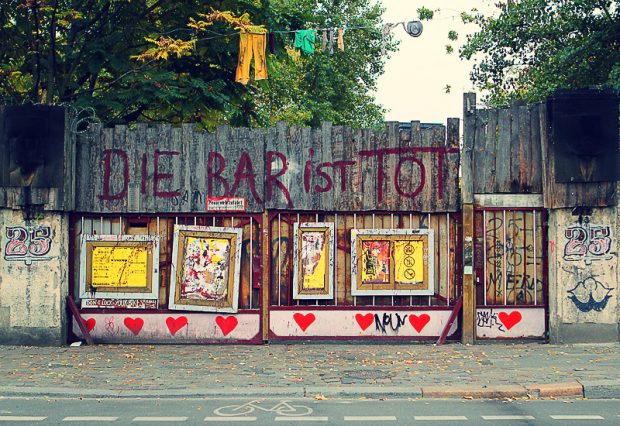
Although it closed in 2010, Bar25 still holds a very special place in Berlin clubbing history. Established in 2004, it introduced a hedonistic playground atmosphere to a scene that often preferred to appear sombre and serious. There are countless tales about what wild abandon happened between the wooden fence shielding the club from everyday life and its naturally occuring other boundary, the Spree river, where from the opposite bank or passing boats you could watch a very escapist crowd roam the vast area on marathon weekends. Its soundtrack of minimal and quirky tech house grooves that still work even when held back by a limiter is as synonymous with the Berlin party experience as are the improvised wooden interiors, psychedelic decor and joyful ideas that spawned a legion of other clubs to follow suit since its closure. Now rejuvenated as part of the Holzmarkt project in the same space, we’re taking a look back at the sounds that represented the club. To do this we enlisted someone very close to the project, who could also share some of his favorite memories from the club: Jake The Rapper, a former Bar25 resident DJ.
“This is an excellent example of original minimal, and minimal was my gateway into the whole techno scene and later Bar25. I feel like there were a lot of parallel scenes happening in the Bar at the same time, so I can’t really say this was the blueprint for the Bar25 sound, but it’s definitely the one I went deep into. When other DJs and their fans would take over right after something I was into, I’d be like, “What is this? This is totally different. I don’t get it”—which is just fine, as the place fed on variety and experimentation. There was also a whole other floor called The Circus that was dedicated exclusively to weirdness and avant-garde music. It was a very open time for music and a very open place. It certainly expanded my tastes and skills and every other part of my mind. But this track, although it came out three years before Bar25 opened, definitely laid the groundwork for the kind of vibe that was really appreciated. This was deep and trippy and softly took me to a place I really wanted to go after having been dancing, partying and socializing—sometimes for days on end.”
“This has some elements of electroclash that were really big at the time. This was the same time when Peaches, Mocky, Gonzales, Puppetmastaz and so on were some the biggest Berlin acts. It definitely influenced pop music and of course in the Bar as well, although it generally went with a more minimal sound than this. This was a big banger in comparison to what usually came before and after it. Is it a bit cheesy? Yes it is. But it’s so smooth that it inevitably got everyone deep up in there and fully involved. Plus I had a few numbers that use this same half-tone progression, and I chose this one for being the most representative of that time and also one that is still playable today.”
“I know this doesn’t even seem like a dance track at all—very mellow. But if I played this during the day between minimal tracks, people really loved it. it’s instantly recognizable without being too poppy or kitschy; it’s deep without being too melancholic—it’s really quite a piece of work. The lyrics are just single nouns in a row—“a life, a room, a house, a street.” It seems to comprise cut-up parts of a poem, and yet it expresses a mood and a scenario that’s somehow Lynchian. And then there are these minor guitar chords that go easy on ya. There’s no kick drum—or any drums per se—and yet it totally grooves and got people dancing, at least in the Ranchette at the Bar25. That may be why the place was unique, you could really DJ tracks to celebrate their spirit without having to kowtow to dance floor dynamics. There was already such a suspense and energy there, even when it was half full a little would go a long way.”
“I feel like this track, despite the fact that it became a tech house club hit nationally and internationally, nonetheless captured the sound of the Bar25. Remember that a lot of the time it was daytime, so something with a deep, warm sound made a lot more sense in bright sunlight than in a dark club. A lot of these kind of songs I think gained popularity through the surge in open-airs and daytime clubs like Bar25. This might have put everybody to sleep in the average German dance club in 2005. But when it’s around midday and you’re sitting, looking out at the Spree while a light breeze makes the straw in your gin and tonic move around so you hear the ice in your glass tinkle…you see yourself reflected in your friend’s sunglasses and you look like you’re really enjoying yourself, and then this big soothing, massaging synth surface lifts you up and you have to just stand up and go YEAHHH! …yeah, that’s a Bar25 moment for me.”Read the rest of this entry »
First thing Front club in Hamburg, what made the place magical and what made you follow Klaus Stockhausen, and his way of DJing?
There were different things falling into place then. I was always interested in club culture and music, but pre-internet you could mostly only read about legendary clubs and its resident DJs. When I first went to Front in 1987 I was 18 years old, and up to then I never heard a DJ who could really mix. Klaus Stockhausen played there since 1983, several times a week, and he had built up a very loyal crowd. The club itself was a raw basement, there was not much to distract from the music, apart from the hedonistic dancers. The place was very intense, and Stockhausen as well as his protegé and successor Boris Dlugosch were incredibly good. Of course you tend to be sentimental about times and places that intiated you into something, but I still have not experienced anything close, both in terms of clubs and DJing. Of course it also helped that those years saw very crucial developments in club music. When I started going there it was the end of that transitional period between Disco and House, which was extremely exciting. And in the following years I frequently went there that excitement persisted. Those were the blueprint years for everything we still dance to now, and I had the privilege to experience it right on the floor. And I learnt a lot of things that I still use.
How did you become part of Hard Wax, was it hard to get that job?
No. Seven years ago all my freelance activities and the according deadlines began to collide with being a father. My wife suggested some more steady work to complement and that I could ask for a job at the store, as I was a very regular customer anyway. Coincidentally Achim Brandenburg aka Prosumer quit working there at that time and they were thinking about asking me to replace him. So within a short time I sat down with the owner Mark Ernestus and the store manager Michael Hain and got the job.
I know you like to write about music, but why do you hate to write reviews?
I actually do not hate writing reviews at all. But after doing that for several years at de:bug magazine I felt I was increasingly running out of words to accurately describe the music I was given the task to review, and I think keeping a fresh perspective is mandatory in that aspect. But more importantly writing reviews does not work too well with running a label yourself, and working at Hard Wax. On the one hand I wanted to avoid allegations of being biased, on the other hand I had to keep potential implications of my writing commitments out of my other work. So I began to lay my focus on features and interviews, mostly from a historical perspective. I am not afraid of discourse and speaking my mind on certain topics if I feel it is necessary, but I am very cautious to remain objective.
Can you tell us what is Druffalo?
Druffalo is a semi-anonymous collective of six seasoned DJs and writers living in Berlin, Mannheim and Cologne, and was founded in 2007. It used to be a rather notorious web fanzine celebrating aspects of culture we felt were worth celebrating, and we were pretty merciless in pointing out aspects of culture we felt were not worth celebrating at all. The web magazine is defunct for a while now, as at some point the server we were running on mysteriously disconnected us and we thought it was a good statement to just disappear. The whole archive is backed up though, so nobody should feel too safe. Attached to it was a DJ collective called the Druffalo Hit Squad, consisting of the same six editors and likeminded guests. We did an influential mix series that is archived on Mixcloud, and we were constantly throwing parties that were pretty anarchic. Since the end of 2015 we took up a bi-monthly residency at the club Paloma Bar in Berlin, where we mostly define our idea of a modern Soul allnighter, using our vast archive of Disco, Soul and Garage House records. But there are also plans to return to the eclecticism of former years.
Do you think your Macro label is becoming a genre in itself, like RE-GRM, ECM, L.I.E.S., or Blackest Ever Black?
No, I do not think so, nor were Stefan Goldmann and me ever interested in establishing a certain trademark label sound that we have to fulfill with every release. We are more interested in working with producers that have developed their own signature sound, as long as it fits in with our own preferences. Our idea of running a label is very open, it is only determined by what we are interested in, and we are both very different individuals. We only release what we both agree on and that, combined with the consistent collaboration with our designer Hau, resulted in a certain coherence, although our back catalogue is rather diverse. We were also always aiming for the long run, and we both feel that you only can achieve that with a healthy amount of leeway and fresh ideas. Of course it is also important to have an identity, but we much prefer that to be based on reliable quality than sound aesthetics that create or reflect trends but are likely to end up as mere expectations. I do not think we are really comparable to the labels you mentioned, too. We had some archival releases, and we might have influenced some musical developments, but neither are essential to what we do.
Wie wichtig war die englische Explosion zwischen Indie- und Clubkultur im Gründungsjahr des Milk! Wollte man diese Entwicklung bewusst auffangen, oder war das nur ein Bestandteil unter vielen?
DJ Seebase: Es erschien mir schlicht konsequent. Insbesondere Dirk (D-Man) Mantei und Gregor (G.O.D.) Dietz haben da schon lange vor dem Milk mittels diverser Parties und Clubreihen die Grundsteine gelegt. Und Holger „Groover“ Klein hat schon immer alles aufgesagt, was es an Aufregendem gab und gibt. Ich weiß es zum einen nicht genau und ich will keinem der Jungs zu nahe treten aber als „Entwicklungen bewusst auffangen“ hätte das vermutlich keiner verstanden. Es fühlte sich so vieles so richtig und so wichtig an. Und „Loaded“ steht hier ja für sehr, sehr vieles zwischen Sheer Taft, Peter Hooton, Boy’s Own und Shaun Ryder. Unter anderem auch für das riesige Screamadelica-Wandbild in Holgers Küche (das von einer hochbegabten Freundin gemalt wurde, die wie man sagt, nach dem unsäglichen Green-Day-Konzert im Milk mit einem von ebendenen gefummelt haben soll, haha). Und natürlich für den immergroßen evergrowing Andrew Weatherall. Aber nunmal in der Hauptsache schlicht für das, was da gesagt wird: „And we wanna get loaded. And we wanna have a good time. That’s what we’re gonna do. (No way, baby, let’s go!). We’re gonna have a good time. We’re gonna have a party“. Und nun ja, dann haben wir das eben gemacht.
Ramjac Corporation – Massif (Irdial Discs, 1990)
Das exzentrische wie innovative Irdial-Label war stets ein Garant für Kreativarbeit auf Nebenspuren. Das war ein Prototyp für das, was wenig später flächendeckender kommen sollte. Damals nannte man das noch Breakbeat Techno, nicht wahr? Leiteten solche Platten im Milk! die spätere Breakbeat-Begeisterung ein?
Breakbeat war in der Tat die gängige Nomenklatur. Aber das hier war fast schon ein mythischer Tune, an dem sich sehr sehr viele Geschichten festmachen. Von echten Schamanen, die eine „planetare Aktivierung“ propagierten, über sagenhafte Morgen auf der Heidelberger Neckarwiese mit Holgers Boombox bis hin zu der Tatsache, dass Redagain P (Milk EP) Riesenfan des Stückes war. Auch der Beatdown war irgendwie wichtig für’s Selbstverständnis. Da war ja immer noch dieser Teil in vielen von uns, der auf der Ami-Kirmes am Boxauto gestanden hatte und der Native Tongues wie Silver Bullet gleichermaßen verehrte. Und Soul II Soul (Phil Asher hat auch einmal im Milk aufgelegt). Welche Platten es waren, die da den Ausschlag gaben, ist schwer zu sagen. Es war ein sicher wichtiger DJ-Auftritt von Nils Hess und dann nunmal in allererster Line Holger, die die Begeisterung für Breakbeats eingeleitet haben. Und eine nicht zu unterschätzende spätpubertäre Frankfurt-Opposition, von der noch zu reden sein wird.
Rotor – Salad Hammer (Chill, 1991)
Ich nehme an Bleeps aus Sheffield waren ein anderer wichtiger Bestandteil des Milk!-Sounds. War diese Kombination von hohen und tiefen Frequenzen besonders effektiv in diesem Club?
Für mich persönlich waren „Testone“ oder „Clonk“ von Sweet Exorcist echte und beinharte Erweckungserlebnisse. Und wenn ich irgendetwas aus dem Milk-Kosmos nochmal gerne fühlen würde, dann wäre es dieser spezielle, und wahrscheinlich irrsinnig verklärte, Keller-Basspunch. Diese Bassline und Blitzlicht. Danke, Glück, verweile doch! Ich war 94 mal im Warp-Laden in Sheffield. Ich habe vor Ehrfurcht keinen Ton herausgebracht. Die Tüte habe ich heute noch. Und die gute alte, später ebenfalls für’s Milk nicht unwichtige Hazel B arbeitet jetzt bei Designers Republic. Sie war ja vorher schon eine super Person aber, hey, die kennt diese Legenden! Im Ernst: Dieser Tune trägt in seiner Rohheit für mich ganz essenzielle Züge. Und jetzt bitte noch im Geiste die Shoutouts aus „How Ya doin“ von Nightmares On Wax runtersingen.
Altern 8 – Infiltrate 202 (Network, 1991)
Altern 8 waren ja so eine Art Rave-Fortführung von The KLF, und ihre Tracks oft eine wilde Mischung aus allen Winkeln energetischer Clubmusik. War das ein Milk!-Kriterium, alles geht, so lange es euphorisch ist?
Holger hat die spätere Residency von ihm und Bassface Sascha im XS in Frankfurt hiernach benannt: Bassbin. Ansonsten ist das hier alles so wahnsinnig stimmig. Bis hin zur Druckluft-Tröte. Und „Euphorie“ war sicher ein Thema, aber als ganz so wahllos würde ich das nicht stehen lassen wollen. Holger und ich vereint u.v.a. eine sehr skeptische Haltung gegenüber den Quatschtüten von Prodigy („Android“ jetzt mal bei Seite – was zu „Infiltrate 202“ ganz gut passt). Ich würde eher sagen, dass im Milk! eine irgendwie unausgesprochene Soundsystem-Kultur herrschte. Das Publikum hat schon sehr stark interagiert, und z. B. auf uns eingeredet jetzt doch endlich mal den „Haifisch-Tune“ (DJ Excel – Just When You Thought It Was Safe) zu spielen. Nicht eben ein fröhliches Liedlein. Wie auch „Mr. Kirk’s Nightmare“ und andere. Aber Altern 8 habe ich einfach nur geliebt. Ob nun das hier oder „Frequency“ oder, ebenfalls ein Muss: „ Brutal-8-E“
QX-1 – Love Injection (Rhythm Beat, 1991)
Mike Dunn trifft Larry Heard, eine geradezu erschütternde Deep House-Hymne. Wurde mit solchen Tracks die Ekstase in emotionalere Bahnen gelenkt? Wie wichtig war Deep House im Milk!-Kosmos?
Ich für meinen Teil, und ich glaube Holger stimmt da mit mir überein, habe das nicht so getrennt betrachtet. Ich empfinde das hier zudem als ausgesprochen ekstatisch. In dem Sinne, der irgendwann mal als „Trance“ verdummbeutelt wurde, aber ja nunmal nicht von der Hand zu weisen ist. „House“ war für mich persönlich allerdings der Weg. Wen es interessiert, in Hans Nieswandts Buch „Plus Minus Acht“ steht auch ein bisschen was zu dem, was für mich im Milk seinen Anfang nahm. Und wenn Du wissen willst, wie wichtig Deep House war, frag mal irgendeinen aus der Posse nach M1’s „Feel The Drums“ oder Basil Hardhaus’ „Hard For The DJ“. Oder nach „Generate Power“. Oder U.P.I.s „She’s A Freak“ und so unendlich vielen mehr. Die werden reihenweise Tränen in den Augen haben. Das waren alles Milk-Hits. Und dann gab es noch dieses Tape von DJ Ralphie aus Riccione (wo Dirks damalige Freundin Susanne und Tabea Heynig getanzt hatten), das uns verzaubert hat und eben einen ganz anderen Vibe, ganz anderes Mixing, ganz anderes alles repräsentierte. Im Übrigen sei hier dann angemerkt, dass das Milk kein originärer Gay-Laden war aber von hier aus eine ganze Reihe wegweisender Gay-House-Parties ihren Weg nahmen.
Rum & Black – Insomnia (Shut Up And Dance Records, 1991)
Shut Up And Dance waren enorm wichtige Pioniere der Breakbeat-Musik, und diese dreiste Version von Badalamentis Twin Peaks-Thema ziemlich typisch für ihre Haltung. Aber warum speziell dieser Track aus ihren an Höhepunkten reichen Back-Katalog?
Ich hätte gerne „The Green Man“ genommen, weil das Sakamoto-Sample eine Tür zu Gregors (Ruhe in Frieden, mein großer Freund) riesiger Sammlung u.a. des Yellow Magic Orchestra aufgemacht hätte. „Autobiography Of A Crackhead“, „Lamborghini“, Nicolettes Gesamtwerk, bis hin zu „Raving I’m Raving“ natürlich, was zweifelsfrei für einen der großartigste Momente stünde, den ich je auf einer Love Parade erleben durfte. „Ecstasy pouring down on me“ 1992 am Wittenbergplatz. Als Andre DJ Pussylover am Milk-Truck vor Glück die Rasenrabatten gevögelt hat. Und er war noch nicht mal der Glücklichste, meine ich mich zu erinnern. Aber zum einen wird generell viel zu selten auf „Rum & Black“ und dieses großartige Album hingewiesen („Funky Emotions“ allein!) und zum anderen ist der Umgang mit dem Twin-Peaks Thema in Ergänzung zu Mobys „Go“ schon sehr typisch für unser damaliges Mannheimer Selbstverständnis. Von Moby lief bei uns zu der Zeit „Next Is The E“, während in der Frontpage die wirklich dämliche B-Seite „Thousand“ für wegweisend befunden wurde. Was jetzt mal wirklich Quatsch war.
YBU – Soul Magic (SSR, 1991)
In den frühen 90ern war es ja durchaus üblich das Tempo mehrmals pro Nacht zu variieren. Wann liefen solche sonnendurchfluteten Downbeat-Hymnen? Und wie wichtig war das Balearic-Thema jener Zeit in Mannheim?
YBU war neben „Strings Of Life (Beatless)“ wohl der wichtigste Putzlicht-Track. Tempodrosselung mag ja ein Merkmal sein aber „Soul Magic“ fordert ununterbrochen auf es „zu fühlen“. Das haben die Leute mitgehaucht und empfunden. Dass man heute erklären muss warum Slow Jam und in-your-face durchaus intensitätsgleich sein können, scheint mir schon vielsagend. Und klar ging es irgendwie balearisch eklektisch zu, nur dass ich zumindest das Wort nicht kannte. Ich kannte einen für mich damals magischen Ort, der an einem Abend namens Mo-better-Milk so etwas wie Dance-Jazz aus einer durchaus auch balearischen Mod-Ska-Tradition beleuchtete und an einem anderen Abend von Manchester und New York über Kingston nach London und Detroit alles abklapperte was irgendeinen bestimmten Geist atmete.
The Morning Glory Seeds – E-Motions X-Pressed (Djax-Up-Beas, 1992)
Mediterran anmutender Rave-Techno aus Holland. Ich mochte es ja sehr, dass zu dieser Zeit so viele landestypische Indikatoren völlig vermengt und verwischt wurden, bis zur Unerheblichkeit. Wurde das ein Peaktime-Track, oder eine Mobilisierung zu anderen Zeitpunkten der Nacht?
Dieser Track steht hier für etwas vollkommen anderes. Nämlich für den Back-Room, in dem eine Zeit lang DJ Soundball eine irrwitzige Kaskade von Detroit-Techno-Soul aufgelegt hat. Das Hinterzimmer war ein wichtiger Ort. Eine Zeit lang war es insofern wortwörtlich der Chill-Out-Raum, als dass KLFs gleichnamige Jahrhundertplatte einfach nonstop die ganze Nacht lief. Und dann eben ein Spielfeld, wo Eddie Flashin’ Fowlkes sicher viel Freude gehabt hätte. Es war aber auch der Ort, an dem Holger überhaupt angefangen hat das Milk! zu formen. Aber es war eben auch so, dass aus dem eher Hintergründigen, Kontemplativen des Raumes solche Rave-Momente erwuchsen.
Nu-Matic – Hard Times (XL Recordings, 1992)
Noch trug UK Breakbeat stolz die traditionelle Reggae-Soundsystem-Kultur vor sich her, das Tempo war noch moderat. Aber hier setzen auch schon die härteren Sounds ein, und nur wenig später sollte sich das mit Hardcore alles potenzieren. Wie ging man im Milk! mit diesen Tendenzen um?
An dieser Stelle sollten Unmengen klassische Milk-Hits wie Agents Oranges „Sounds A Bit Flakey“, Acens „Trip To The Moon“ oder Sound Corps „Dream Finder“ stehen. Man könnte hier natürlich auch Unmengen deutlich aufregenderer Reggae/Ragga-Sample-Tunes aufzählen, wenn es da nicht diese eine Begebenheit mit „Hard Times“ gäbe. Sie kulminiert in einem Moment, als während irgendeiner Groß-Rave-Afterhour Mark Spoon, ich meine von Holger nahegelegt, diesen Track auflegte. Irgendjemand hatte das nun folgende Ritual schon Wochen vorher eingeführt. Ich halte heute nicht mehr viel von „Wir-Gefühl“, „Family“-Gequatsche oder Kollektivierung insgesamt. Aber als an Stelle von „hard times must be“ alle wie immer at the top of their lungs dem sichtlich beindruckten großen Frankfurter gemeinsam „Mannheim Posse“ entgegenbrüllten? Hands in the air und alles? Good Golly, war das geil!
Tronikhouse – Up Tempo (KMS, 1992)
Besonders Kevin Saunderson und auch Carl Craig setzten sich ja gerne mit UK-Breakbeat-Kultur asueinander, wohingegen das bei anderen Detroit Techno-Produzenten eher verpönt war. Dabei funktionierte das ja offensichtlich bestens zusammen. Gab es im Milk! generell einen Soundclash zwischen Detroit und UK Breakbeats?
Nein. Man könnte sagen, Sascha kam eher vom Detroit-Techno, Frankfurter Lesart, und Holger war eher englisch sozialisiert. Aber das wäre zu einfach. Es ging uns, wenn ich das für alle sagen darf, um ein bestimmtes ästhetisches und energetisches Level, das unterschiedliche Interpretationen kannte. Auf URs „Revolution For A Change“ fragen sie „live in Utrecht“ „are u down with the underground?“ Rhetorische Frage. Und ehrlich gesagt erscheint mir die Entwicklung der Breakbeats ohne Reese-Bässe kaum vorstellbar. Aber auch ohne Inner City nicht. Es gab auch Links wie Edge Records one, die zunächst einmal ordentlich 4/4telt, bevor ein klassischer Milk-Breakbeat Hit daraus wird.
Love Revolution – I Feel It (Network, 1992)
Italo-geschulte Piano-Hymen mit Rave-Elementen waren wohl sicherlich ein integraler Bestandteil des Milk!. Ist dieser Track ein besonderes Beispiel dafür? Und was machte diese Tracks dort so wichtig?
Auch hier muss ich sagen, dass es weniger der spezifische Titel ist, um den es hier geht. Gat Decors „Passion“, Andronicus’ „Make You Whole“ und von mir aus auch Felix’ „Don’t You Want Me“ könnten hier stehen. Dass hier schon wieder wie bei YBU „Feelings“ im Mittelpunkt stehen, ist entscheidend. Wir haben nichts mehr gefeiert als Emotionalität. Das ging dann mit Energy 52 oder einiges später mit Cleveland City Records weiter und erklärt die aufflammende Liebe vieler in der Posse zu Kid Paul, dem Dubmission-E-Werk und solchen ungebrochenen Spitzentypen wie DJ Clé. Ich kann und will bis zum heutigen Tage nicht davon lassen, dass ein anständiges Rave-Signal noch keiner Party geschadet hat. Ich weiß, in einem Club-Zeitgeist-Umfeld, in dem schon ein buntes T-Shirt als emotionale Entgleisung gilt, eine potenzielle Außenseiterposition.
In discussion with Steve Fabus on “Let’s Start The Dance” by Hamilton Bohannon (1978).
How did you discover „Let’s Start The Dance“? Was it in a record store, or in a club?
I discovered “Let’s Start the Dance” in my slot at my record pool, BADDA (Bay Area Disco DJ Association) in San Francisco in 1978. It was the album „Summertime Groove“, where „Let’s Start the Dance“ is the first track on side A. When I first heard it I was blown away by it and couldn’t wait to play it at the club that night. When I played it the crowd went crazy and it was the peak record of the night, not surprisingly.
When the record came out, you had already started your career as a DJ in San Francisco. What makes this record so special for you? And was „Let’s Start The Dance“ a defining record for the sound you played back then?
I was playing loft parties and underground clubs and at two of the major clubs in San Francisco, the I-Beam and Trocadero Transfer. I know one of the reasons I was brought into the scene was because I incorporated a lot of the R&B, Groove, Funk and soulful sounds from Chicago and New York and mixed it with the NRG and Electronic sounds already being made in San Francisco, and coming in from Europe. „Let’s Start the Dance“ was and still is a defining record for me because it is such a fusion of so many of these sounds but most importantly — it’s a jam. Its many elements, Jazz, Blues, Rock, Funk, Electronic, Boogie, take you on a trip in a whole movement building up to a crescendo of orgasmic release. It relates to other fusion sounds like the Isley Brothers’ „Live It Up“, Crown Heights Affair’s „Dancin“ and many of James Brown’s tracks.
Hamilton Bohannon was a drummer originally, and he started releasing records that were very focussed on rhythm and very distinctive from the early 70s on. What was his role in the history books of Disco music?
I first heard Bohannon in Chicago in 1975 at Dugan’s Bistro, a major downtown gay club. The track I heard was „Bohannon’s Beat“ which is on one of the early albums on the Dakar label. It stood out to me because it didn’t follow any of the commercial rules of the day. It presented itself as a unique sound — experimental and minimal, a mantra to hook into. It inspired and encouraged DJs to take Disco underground. It was like a loop, a tool to use to improvise, phase or use as a bridge. Mantra is a major theme for Bohannon and he carries it forward with „Let’s Start the Dance“, which is just the opposite of minimal. He turns it up with the full on jam that puts dancers in an intense trance that they have no choice but to ride to its conclusion. It is very rich with a number of instruments played including guitar and keyboard with Carolyn Crawford’s couldn’t-get-any-better-voice. What this record represents to every generation is that this is the real deal musically.
Are there other Bohannon records you rate nearly as much?
My other all time favorite is „The Groove Machine“ – as intense as “Let’s Start the Dance” but trippier with its phased out psychedelic break and its total fusion hard funk rock electronic groove. When I hear this it makes sense that Bohannon early on drummed with Jimi Hendrix. Both “Groove Machine” and “Let’s Start the Dance” feature guitar riffs prominently.
1977 saw the peak of the classic Disco era. Was „Let’s Start The Dance“ an early sign that Disco could live well past the end of that boom? That the sound could move on and still matter?
“Let’s Start the Dance” is timeless because as I had mentioned before it’s a whole movement and jam where you’re hearing real instruments. It always ignites a dancefloor and from the first note you want to pay attention. The lyrics come fast with “Everybody get up and dance – Ain’t ya tired of sitting down?” This could be cheesy but it’s not, and you know it’s not and surrender completely to it right away. There is no way you couldn’t let yourself be seduced by it and every generation experiences this seduction. It still matters because it’s a prime example of the authenticity of Disco of that time period and that’s what lives on. Read the rest of this entry »
We should probably start at the very beginning. What were your baby steps as a DJ, what led you to being a DJ in the first place?
I think in the first place was the love for music. And I can remember when I was really, really young, with a babysitter, and we’re talking about the days of 45s. The first record that I actually remember and I was spinning was „Spinning Wheel“ by Blood, Sweat & Tears.
Good choice.
You know my family was from Puerto Rico and there was no American music in my house.
It was mostly Latin music?
Only Latin music. And we’re talking about Merengue, Salsa. Folk music from Puerto Rico. And I didn’t like it. And it’s funny because today I appreciate Latin music. Since I became a producer, now I appreciate Latin music for the production, the instrumentation, the musicians, because Latin music is not machine-made, not at all. So the first 45 that was in my house was “Jungle Fever” by Chakachas. My parents had this fucking 45 that was this erotic fucking record. And we’re talking about these stereos that were like these big fucking wooden consoles with the big tuner for the radio and the thing with the record where you put some records in the thing and it dropped one at a time and when it ended the thing drops. It must’ve been when I was about six or seven there was an illegal social club. You know I was living in the ghetto. So there were illegal social clubs that were like a black room, with day-glo spray paint, fluorescent lights to make the paint glow and they had a jukebox. And they’d play the music back then. „Mr. Big Stuff, who do you think you are“. It was all about the O’Jays and that kind of music. And I liked that. I used to sneak downstairs and such.
So when was that?
It was like the late sixties. Because I was born in ’62 so by ’70 that makes I was 8 years old. So it was before that because then I moved. Anyway, so fast forward the first 45 that I liked was the O’Jays. The first 45 I actually bought. And I remember playing that record I a hundred times a day. Putting the bullshit speaker we had in the house outside the window, we lived on the first floor. I played the record to death.
So you played it to the whole neighborhood?
The whole neighborhood. The only record I had really. So then when I graduated elementary school, I used to be into dancing, like the Jackson 5 they had “Dancing Machine”, there were The Temptations and Gladys Knight & The Pips and I liked that music. So then when we got into Junior High School – when I was like 13 years old, I had a girlfriend and we went out when the first DJs came on in the neighborhood, which was like the black DJs. I saw the first two Technics set up and a mixer in someone’s house. I was like “Wow! That’s interesting.” I saw somebody doing this non-stop disco mix and I never knew what that was all about. So, I used to hang out with all my friends. I was a dancer, we used to do all this what we now call breakdancing. We would do battles. So, I had one turntable and my friend would say “David, we hangin’ at my place” and I would play some music for us. So I just was a kid that sat by the stereo with the records and put on the tunes, one at a time. Because back then that’s what it was, you’d play one tune at a time. If it ended, the people clapped and you’d play the next tune. And it was all songs.
How did you proceed from there?
I was one of those kids that used to go to the record store even though I had no money. Just to look at the records. To walk by a store that sold turntables and a mixer and be like “one day, one day…” And I’m not working so I can’t afford to buy anything. My first mixer was a Mic mixer. 1977 there was a blackout in New York and there was a lot of stealing so I came across a radio shack little Mic mixer that I set up to make it work with two turntables. You had to turn two knobs at the same time and it was like mixing braille because there was no cueing. My one turntable had pitch control, the other one had none. I was too young to go to clubs, so I never saw a proper DJ mixing. I only saw people outside, we would have block parties and people would be mixing. And I was one of those kids that was just standing there, watching. The first time I went to a club I was 15 years old, it was Starship Discovery One. It was on 42nd street in Times Square, and we got in. We shouldn’t have got in, but you know it was the end of the club, I was 15 and I got in. The DJ had three Technics, the original 1200s, and a Bozak mixer. The booth was a bubble, and I had my nose at the fucking bubble and I was just mesmerized. The first time I actually played on a real mixer I went to a house party at my friend’s brothers apartment. And in those days, most of the DJs who were really playing were gay DJs. “San Francisco” by the Village People was the big record. But I was into The Trammps, I was into James Brown, I was into Eddie Kendricks, Jimmy Castor Bunch, “The Mexican”, Sam Records and of course Donna Summer and all this kind of stuff. So I went to this house party and he was the DJ, the first proper mixer I saw – this was before I went to that club. And it was a black mixer, it had two faders and it had cueing. So I see the DJ there, he’s using headphones to cue. So my friend says “D, you wanna play some music?” and I’m like “Yeah, sure.” I grabbed the headphones, put them on and I hit the cueing, because I was watching the guy, and I’m hearing some music and and I was like “Oh shit…” When I played at that party, I’d still play how I know how to play, which was braille. Intro, outro. And it wasn’t about mixing. All the new bars at that time were advertising nonstop disco mixes.
It was even mentioned on the record sleeves.
Yes. And all that meant was that the music never stopped. Because before the music used to stop before the next record came in. So now it was continuous. That worked, so here came the name nonstop disco mix. And then at that time all these records started coming out. The disco 45 record. At my junior high school prom “Doctor Love” by First Choice was big. And I remember the guy playing it about four times. So my first 12″ of course was “Ten Percent” by Double Exposure, on Salsoul. Another record that I played to death out the window.
You were still doing that?
I was still doing that. I used to live to just play music. I loved it. I would leave in the morning to go to school because my parents would go to work. I would buy a bag of weed, buy a quart of beer and I would go home. And you know in the old days we had all those buildings where you could really play loud music and I had these stupid double 18 boxes in my fucking bedroom. Before I’d take a piss, I turned my system up. My mother used to be like “turn that music down, turn that music down, turn that music down!”
Did you begin to play out around that time?
Yes, and playing at parties in those days meant you carried your records. Because you didn’t play for two hours, you played the whole party. And the thing is, if you owned 5000 records, you took 5000 records to the party. And in those days we carried milk crates. So here I am carrying eight to ten milk crates to a party. Getting in a car, getting a cab, you have all your friends who would help you going there, but when you’re leaving there is nobody to help. And you had to take the stereo system with you. So you carry the sound system and you carried your records. You took everything. It wasn’t like going somewhere and you just bring your records and they have everything. You had to take everything. I did parties for 15 dollars, for 25 dollars and you had to chase people down for your money.
What kind of events were you doing?
I played in clubs, I did Sweet Sixteens, I did weddings, I did corporate events. I did anything. I also did parties in high school. I would advertise a party, we would bring the sound system to some kid’s house, the parents left to go to work, we’d bring the sound system fast, and I would advertise free beer and free joints. Even 50 people is a lot of people in somebody’s apartment. Imagine we’d take over the apartment and it’s like 10 in the morning and we’d be fucking banging it, banging it, banging it — and we’d get out by 3 in the afternoon before the person’s parents come home. God knows the mess, whatever the case, baby. And in those days the sound system was in the living room, the DJ booth in the bedroom. No monitors, it was just bang bang bang. As I started doing parties at an apartment I used to charge a dollar to get in, decorate the apartment, put up balloons, and it just started with friends. Obviously still free beers, free joints, the whole thing. And like I said, I just loved the music, it was just everything for me. I wanted to play every single day. Even when I didn’t have the equipment, I knew friends that bought decks and a mixer and a small sound system for their house and they weren’t DJs and they used to say “David, come to my house and play music for me.” And I would just die to play, it was just everything for me. Read the rest of this entry »
In discussion with Trusme on “Forevernevermore” by Moodymann (2000).
I doubt that „Forevernevermore“ was your first encounter with Moodymann. Did you eagerly await his third album, and how did it grab you?
100% I didn’t know who Kenny was till I found a copy of “Forevernevermore” in my friend’s record bag. He had left his records at my house and I was doing the usual noseying though the records when I found this CD. I was completely into Slum Village, MadLib and Jaydee collecting the samples from Jazz to Disco. When I first played this CD, everything just became clear in my mind. This is the sound I was looking for, from Hip Hop, House, Jazz, Soul and Disco all rolled into one. I became obsessed, wanting to understand the production techniques and went on to discover the whole world of Detroit right after this. Three years on, Moodymann was playing my first LP launch in a pub on Oldham street, home to where I had been buying his records for the past few years. KDJ and Theo were just No.1 at that time in Manchester and I couldn’t help but be influenced by the whole sound.
It seems that Moodymann matured up to the release „Forevernevermore“ in terms of the album format. „Silent Introduction“ felt like an anthology of 12“ material, even though it worked as an album. But with „Mahogany Brown“ he already aimed at a listening experience more true to the format. Would you say he topped this with „Forevernevermore“?
Yes, for sure. The whole LP worked as a cohesive hour of music yet there was something at every turn that was unique and compelling to me as a listener. I related to this LP in more ways than one, due to it’s almost Hip Hop nature with intros and outros connecting the tracks and glueing the whole piece together. There are so many seminal tracks on the LP that are still played out in the clubs today, yet they are tracks that remain LP cuts and for home listening only. This ideology is what I have embraced in all four LPs that I have produced over the last 8-9 years, with something for the dancefloor, something for the car and wherever else that one listens to LPs these days.
You told me that you wanted to talk about the CD version of „Forevernevermore“, which has lots of interludes and skits, and hidden tracks. Do they form an alliance with the music that almost works like a radio play? What is the special appeal of it?
When I think of an LP, I think of A Tribe Called Quest, Marvin Gaye or The Verve even. All these LPs are constructed to be a continuous piece of music, in which the listener is taken on a journey from the beginning to the end. With the CD format, there is extra playtime in which intros and outros can give a context to the background and making of the LP. On the “Forevernevermore” CD you are taken into the home of KDJ, as he sits playing with ideas on the piano with his child, to the studio discussions and even to listening to his local radio for inspiration. Hidden right at the end of the CD is a live recording of three hard-to-find cuts from the KDJ label, mixed together after 2 mins of silence. In many ways the CD provides the platform for further expression as an artist in the format of an LP.
I think the sound of „Forevernevermore“ was a step forward in terms of his distinctive sound. It was still dense and immersive, but also more refined. Do you think Moodymann’s sound evolved on „Forevernevermore“ in comparison to earlier works? And was it for the better?
This was for sure in an LP sense his best work. It is what most people say as their favourite work, when talking about Moodymann. He carved a sound out all for himself and also derived a unique long player format that until then was not seen in the dance scene. Most underground dance LPs were merely a collection of 12” tracks but this felt more like a well thought-out process, something like Daft Punk would execute. I believe Peacefrog Records also helped in this process and pushed KDJ, as they did all their artists to reach even further. In many ways, earlier LPs were a collection of his previous works but “Forevernevermore” was an LP made from beginning to end with a single LP idea and it feels very much that way.
Tracks like the Disco led „Don’t You Want My Love“ display a confidence to transcend mere club credentials for traditional songwriting, a path he followed ever since. Is there a side to Moodymann the producer you prefer to others, or is it not necessary to differentiate his persona as an artist?
The marriage between your typical MPC studio production and live instrumentation was what set out Kenny on his own. Working with local artists like the percussionist Andres, bass with Paul Randolph and keyboards by Amp Fiddler, on top of that raw production sound was just so unique. The juxtaposition of quantised groove and loose musicianship created a genre of its own and is still being replicated today. This LP was the beginning of that sound and Kenny is still using this formula very much in his productions today.
How do you rate the albums Moodymann released since „Forevernevermore“? Were they up to par with your expectations?
“Black Mahogani” is on par for me if not more refined than “Forevernevermore” but maybe it’s the rawness of the LP that better relates to me. With the following LPs I have enjoyed the productions but felt slightly less connection to the music I listen to and make today. Not that it’s not great music, but I started to feel that the tracks in the EP releases didn’t have that Peacefrog touch of which I’m such an admirer. The LP process began to evolve towards the creation of a new sound where he begins to sing and perform more as an artist and less in the background as a producer. Read the rest of this entry »




Recent Comments