Posted: April 13th, 2012 | Author: Finn | Filed under: Interviews English | Tags: Berlin, Interview, Kiel, Louche Podcast, Podcast, Prosumer, Stefan Goldmann | 1 Comment »
To mark the start of our new podcast mini-series on record shops, Finn Johannsen of Hard Wax Records Berlin chats to Josh about his place of work, the state of the vinyl industry, and of course his excellent newly recorded Louche Podcast.
So Finn, this marks the first of a new mini series of Louche podcasts, focusing on dudes like yourself who work in record shops. Tell us, how long have you been working in Hard Wax and how did it come about?
I’m working there since the end of 2010. It was basically coincidental. I realized that all the deadlines that come with working solely as a freelancer were not that compatible with my newborn daughter and I was vaguely looking for some additional steady work. I was a regular customer at Hard Wax and dropped some hints that I would be up for it if there was some vacancy. Then Achim (Prosumer) decided to quit working at Hard Wax and I got the job within just a few weeks.
Your one of the shop’s house music specialists right? Do you take pleasure from discovering music to sell in store?
I’m probably particularly knowledgeable with House and Disco. But then I’m over 40 now and buy club music as long as I can remember, thus I’m able to offer some good advice on almost anything we are selling. And this applies to anybody working at Hard Wax. We all know a lot about music, and all of us are eager to learn much more. And we like to provide our customers with what we know and love. You need the urge to do so by any means, else maintaining the high standards of the store would not be possible. If you lose the thrill of unpacking and checking the week’s news or delving into sounds you were not accustomed with before, you better reconsider. But I doubt that will happen too soon. There is always good music to discover, every day.
Do you feel responsible for breaking any producers into the scene? Has anyone seriously blown up after Hard Wax stocked their music?
I certainly helped some producers before I started working at Hard Wax, particularly as a journalist. But I’m modest enough to not drop names. They know. As an institution, Hard Wax surely plays a role. A record stocked and recommended at Hard Wax is still a welcomed quality marker, and it takes some responsibility and care to maintain that status and also not to abuse it. There are quite a few labels and producers affiliated with the store who left their mark after the heyday of the classic Hard Wax labels, which is great. The same goes for labels and producers we discovered or supported over the years. If you follow our tracks on a regularly basis, you should be aware of who I am talking about. But any store in our position should do that the best they can, to keep things going.
You must have an absolutely massive vinyl collection at home, but whats the deal- do you get to take home whatever records you want?
I have a few thousand records but I decided to keep it at a certain level and thus my collection is now more or less like a revolving door. Whenever I buy some records, I also sell some. I have the privilege of being handed vinyl promos and of securing records that sell out quickly, but it is not that anything that might interest me automatically gets put into my shelf. When I’m not in the shop, I check out the website like any other customer, and I also miss out on releases if I do not have the time to do so. But if you are surrounded by so many new releases every week you also learn to distinguish what kind of records you really need. I only buy records on the terms of my musical preferences, and nothing else.
What do make of the vinyl game currently, or after the last few years? Do you think there has been a noticeable resurgence in people buying wax recently?
Vinyl sales are still going very strong at Hard Wax, but sadly that is not necessarily a reality for other smaller shops, who are often struggling to stay open or have to close down eventually. There will always be music collectors who prefer the convenience aspects of digital releases, and music collectors who favour a haptic vinyl release. It is a fact that there still is a DJ and collectors vinyl market that labels and producers can cater for. And I do not blame anybody for preferring a certain format, as long as they make good use of it. Hard Wax is very determined to sell vinyl as long as possible, that is for sure.
Do you produce Finn? Or ever considered getting into it?
No, I don’t. Being a father, working at Hard Wax, co-running the Macro label with Stefan Goldmann, playing out in clubs, writing. Consider me well busy. Who knows, someday a ridiculously limited stamped white label hyped and killed for by people of all nations could be my doing, but I probably won’t tell. As for now, I have nothing to tell. That is the absolute truth.
Can you tell us a little bit about the mix you recorded for us please?
It’s basically a run through records I took home from the shop and played out regularly at the moment I recorded the mix, two months ago. A mixture of artists and producers I think are well worth supporting and who have their own distinctive signature sound, and some tunes that just stood out for me. It also touches most characteristics I look for when buying records. If you would have heard me playing out at that time, this is what it probably would have sounded like. I rarely ever play the same set twice, but some of these are still in good use. Which speaks for the records included.
And lastly, what are your favourite record shops to go digging through?
Since I started working at Hard Wax, I have considerably less time for digging than before, but I try to spare some if possible. But then it is mostly shops with second hand vinyl, or flea markets. In Berlin, I like shops like Audio-In, O-Ton, Power Park, Cover Music and some more. I also love checking out shops I haven’t been to before, which luckily enough is still happening. Shops in other cities that I enjoyed the most recently were ZeroZero in Zürich, and A-Musik in Cologne. My favourite shop ever for digging is a store called Plattenkiste, in my hometown Kiel. The sheer amount of rare and good stuff I bought there since the 80’s is just incredible. The owner is not really interested in music, and every record costs 1 €, regardless of format. You have to dig deep, but you will find.
Thanks Finn!
Words by Josh T
Interview for Louche April 2012

Posted: February 26th, 2012 | Author: Finn | Filed under: Interviews English | Tags: Berlin, de:bug, dj-rooms.com, Groove, Interview, Resident Advisor | No Comments »
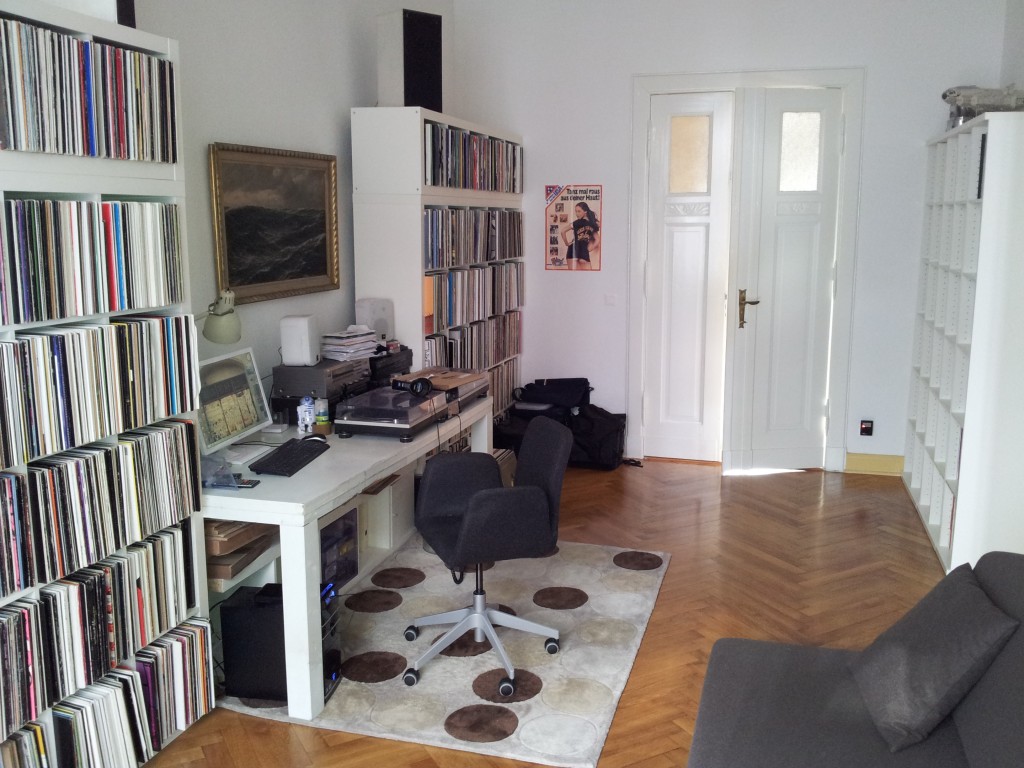
We go back in the days when DJ rooms only existed as an expanding Facebook page. Finn Johannsen, author, label owner and DJ from Berlin sent us his wonderful room, packed full with records. Of course we’ve had a little interview with him…
Tell us and our readers, when you started DJing:
“I’m playing records in public since the mid-80’s”
What else can you tell us about you:
“I’m an author for several mags (de:bug, resident advisor, sounds like me, groove and numerous other print and web publications). I’m also co-running the label Macro Recordings, and working at Hard Wax. I live in Berlin”
The size of your record collection?
“I think around 8000 records”
What equipment do you use in your room?
“2x Technics SL-1200 MK2 turntables, 1x Ecler SmacFirst mixer, 1x Yamaha RX-495RDS Receiver, 1x Harman Kardon HD7300 CD Player, 2x 1970′s Bang & Olufson speakers, 2x JBL Control 1 Pro monitor speakers, 1x Sony MDR-7506 headphones, 1x Technics Stereo Cassette Deck RS-TR373, 1x Technics Cassette Deck RS-B675″
Your record choice for the lonely island?
“Sister Sledge – Thinking Of You”
dj-rooms.com 02/2012
Posted: January 31st, 2012 | Author: Finn | Filed under: Interviews English | Tags: Edits, Interview, Resident Advisor, Tom Moulton, Will Lynch | No Comments »

Contributed some thoughts on edits for Will Lynch’s feature at Resident Advisor.
Another prevalent argument has more to do with artistic merit. When Tom Moulton and his peers made the first edits on reel-to-reel tape, they were, intentionally or not, designing a musical experience that had never existed before. The same could hardly be said for many of today’s edits. “You have this glut of edits which are no longer interested in diving deeper and deeper,” says Finn Johannsen, the DJ, music critic and Hard Wax employee. “Back then, there were no computers, so beatmatching and the convenience aspect was not the point of it. Today, there are a lot of edits floating around where the only purpose is to make DJing easier.” He finds many of the arguments in favor of edits “valid but lazy. You can always say ‘It’s always been this way,’ and of course it was, but to make that your main mission… it’s just a question of what you’re aiming for as an artist.”
Posted: September 30th, 2011 | Author: Finn | Filed under: Interviews English | Tags: de:bug, Interview, Philip Marshall | No Comments »

Should anybody starting up a label in these crisis-shaken times even consider commissioning a proper graphic designer for label artwork, or is it better to spend the money elsewhere first? Have priorities changed?
Running a boutique label is a very good way to spend a lot of money with no real certainties of seeing that money again… A label’s or artists’ art direction can be an amazing strength, if well done. But, the initial attitude and concept of the release, the sequencing, its originality, the quality of the mastering – all these factors are important. I would suggest that unless you view every aspect of the release, including the cover art, as essential, then don’t bother. It’s all part of a beautiful whole.
Could you observe some sort of increasing DIY approach from the labels’ side in reaction to shrinking production budgets?
More, an increasing desire from labels to ask designers to work on tiny budgets. DIY: whereas at one point one would have a budget for a full campaign, these days the money goes less far – sometimes the finest details are skipped…
As someone who designed for bigger labels and smaller ones, are there differences in the assignments and necessities besides financial aspects?
In my experience, the success of any project, regardless of size of the label, depends entirely on a client/artist/someone in the process, having an eye for such details. Simple as that. I have worked for both large and small labels where a key individual has had personal interests in the whole and has allowed more time, money or “play” to occur. I’ve also known indie labels, full of cred, simply not be bothered by their design output. I’ve known major artists and marketing teams get very excited about artless details – “make the logo bigger” etc… But, so long as someone cares, or someone trusts enough, something good is usually allowed to happen…
Do you think that the flooding with releases even requires a bigger effort in the design stakes, to already stand out visibly?
The flood is a digital one, mostly, and there artwork is somewhat lost – and few artists have begun to think, or had budgets to realise, what an album could be in these iPadded times… An effort, a point of difference, always is a good thing. However, there are so many people broadcasting on so many blogged-out channels, broadcasting to an ever-distracted audience, that one wonders if much what one sees sticks in the memory… Famous for 15 people…
How do you best make a point if you opt for artwork as a label owner?
I prefer direct – one message, simple, clear, yet with attention to detail, something other…
Are there rules for what a good artwork for a record release should display?
That’s a very difficult question to answer, as each release/artist/label has different requirements. Each project should be approached on its own terms.
Is there some kind of solidarity between designers and label owners to keep both fields going?
There are definitely teams – links between musicians, labels, archivists, curators, designers – who work well together, who have a shared agenda to keep on keeping on.
What do you think of alternative ways for artworks, like stamps, stickers, inserts etc. Do they limit the possibilities, or the opposite?
Again, each project should have its own voice, its own language – sometimes such things could work.
Would you say that the days of stamped white label releases to generate some mystery are soon over?
A mystery lasts a lot less long these days; “I have a mystery to share with you all” screamed from many social networks… One can still try to work in hiding, and this to me seems increasingly appealing, when there’s simply so much noise out there, so much broadcasting of average product. But then, to generate mystery in itself, the release must be perfect.
Is corporate identity still important for a label, or should every release test new ground?
I think that depends on whether the label wants to be an artist itself, to have a curatorial role. Certainly a house-style can amplify an imprint’s voice.
What will the near future be for graphic designers in the music business? Is a designed physical release something that will still matter?
I hope that as long as there are people making music and releasing music who have a passion for the sheer beauty of what an object can be, and as long as there are designers who simply want to do something out of love, not money, there will be. …but, if I knew the answer to that… I’d be learning Android app programming.
de:bug 10/11

Posted: August 10th, 2011 | Author: Finn | Filed under: Interviews English, Macro | Tags: Interview, Pulse Radio, Radio, Stefan Goldmann | No Comments »

Macrospective is the new mix compilation from Macro Recordings due out 12th September. The label, owned by Stefan Goldmann and Finn Johannsen, is known for pushing the boundaries of regular techno and to demonstrate its back catalogue as well as their inventive approach to the scene, this is a double mix with a twist. The pair have selected exactly the same tracks for each of their mixes, but compiled the tracks in an alternative way- a method that highlights their individual talents as well as different parts of the tracks themselves. So when Pulse caught up with Finn and Stefan, we decided it’d be rude not to try and replicate their idea in interview form. Here’s what the pair had to say in answer to the same questions in a different order- Stefan’s turn first!
Pulse: Tell us a bit about your history as a producer/DJ. Stefan Goldmann: Around the year 2000 I had some basic equipment together and quickly learned to program nice House beats. I spent some years deepening my skills and knowledge, working with different labels. When I felt comfortable enough to do my own thing and not needing an A&R to tell me what can be released and what not, it was time for Macro.
Talk to us about the new Macrospective CD mix and how it all came about. Label compilations are boring. DJ mix CDs are boring. We wanted to do both in a way that excites us AND that reveals deep mystic truths to the listeners. I think our label catalogue isn’t boring. We love it. Even those who know it all might still find it interesting to listen how two DJs work it to get the best mix out of it. It is a contest with no winner or loser – I believe the material allows for several interpretations. That’s what we prove. I can’t recall anyone having done that before. That’s why we did it. Actually, we could have got all our DJs on it – that’s actually an idea: the Macrospective DVD with 10 mixes. But just with the two of us you get an insight of what drives us as DJs and A&Rs, too. It’s more compact and concentrated. Clarity is important.
You’re known as someone who likes to push the boundaries of concepts and techno itself. Where are you trying to push it to? To where no one else has bothered to push them yet.
What was the inspiration behind setting Macro recordings up and who runs what at the label? To me, that my ideas of what I wanted to do grew beyond what most A&Rs considered acceptable for their labels. I needed to eliminate the discussions and headaches. So one summer night, while having a beer in the park, Finn and I just where like: can we do it? Ok, let’s just do it. Now I make the tea, while Finn puts paper in the copier – meanwhile our mysterious boss, who is hidden from the public, sits in a mailbox in the Caymans and reaps all the money.
What’s getting you most excited in your musical life right now? That Finn is an official releasing artist now. And that everything is new and amazing. My whole life as a musician is changing. I’m happy I have a constant flow of ideas what to work on and how to make it work. Everything is shifting away from the traditional structures to new structures. While many are in panic, I’ve never before felt so free to pursue the music I want to do, to ignore what others believe is necessary to oblige to and to find new ways to support it all.
Pulse: Talk to us about the new Macrospective CD mix and how it all came about. Finn Johannsen: We found that it might be time to take a look back on what we did so far and to thank our artists for their contributions, but at the same time the usual formats for label retrospectives did not appeal to us. Stefan and me work together so well because we are very different persons and we are very different as DJs, too. Thus we came up with this concept because we thought it would reflect all that. When we compared the results it quickly became apparent that the experiment was successful.
What’s getting you most excited in your musical life right now? Music I had not heard before and which I find interesting basically excites me the same as when I carried my first money to the store to purchase records at the age of 6 or so. And I’m confident that it will never stop. And all the possibilities!
Tell us a bit about your history in music. Pretty much all I do for a living is closely connected to music. I buy music since the 70’s, I play music since the 80’s, I write about music since the 90’s. In the last ten years I co-founded Macro to release music, and I took up working at Hard Wax to sell music. Music Music Music.
What was the inspiration behind setting Macro recordings up and who runs what at the label? It was out of discontent mainly. We felt the complaint is not as productive as the act. Since then what we do and who does what is constantly in flux. We have friends that help, collaborators we collaborate with, and we establish missions to accomplish with every new week.
You’re known as someone who likes to push the boundaries of concepts and techno itself. Where are you trying to push it to? We just try to push things forward, no matter in which direction. And since we do that, with every closing door several other doors opened. And now our imagination is running wild.
Pulse Radio 8/11

Posted: November 22nd, 2010 | Author: Finn | Filed under: Interviews English | Tags: Eric D. Clark, Funkadelic, Interview, Justus Köhncke, Motown, Paris, Radio, Rewind, Romanthony, Talking Heads, Thomas Dolby, Whirlpool Productions | 3 Comments »

In discussion with Eric D. Clark on “Atmosphere” by Funkadelic (1975).
How were you initiated to the Funkadelic world?
That’s rather hard to say; I believe I first heard Funkadelic… early 70’s? Seems as though I remember hearing “Maggot Brain” as my introduction to their music? And it would most probably have been at a party; maybe a cousin’s house or on a military base at a function? Don’t really know. However I seem to remember that piece first: I certainly had no idea what or who it was? At the time I thought the label art was somehow the band’s responsibility, therefore I would buy records according to the artwork; if I was at a friend’s house and they had something I liked I would go to the record store, usually with my father, and look for the same artwork and buy the record (we’re talking 7″ singles here). Needless to say it was often not what I was looking for. However, rarely did I return anything! This is how I ended up finding out about Led Zeppelin at age 5 or 6. I was looking for Rare Earth. When I finally witnessed Funkadelic’s artwork first-hand it cemented my high regard for their overall “thang”!
Was it a part of your childhood and youth in California?
There was a very strong and rich musical culture in our house. Every morning before school we were allowed to listen to music (no TV, only on Saturday mornings) that we selected from an extensive record collection procurred over previous decades and life in Kansas, Philadelphia, St. Louis and Poplar Bluff Missouri, Osaka, and wherever else our parents had been on their journeys with the military. This included 78 rpm shellac discs and 7″ children’s records recorded at 16 rpm. Father always loved Jazz and has an extensive collection of Blue Note recordings from the label’s inception until around 1970 something. Errol Garner was a big favourite, Booker T. & the MG’s. I did not really get into Jazz though until much later, though I liked Errol Garner! The rest was boring to me then. “Shotgun” and “Green Onions” I liked a lot but until this day I can’t stand James Brown for example?! Only one song that I can’t remember the title of, from around 1958. Mother was into Gospel and female vocal performers such as Morgana King, Dinah Washington, Mahalia Jackson, Dakota Stanton, Aretha of course, also some guys like Major Lance and Joe Simon both of whom I still love today. This collection still exists, excerpts of which you can hear in a set I uploaded to soundcloud.com/eric-d-clark under the moniker “The OZ Effect”. When I’d go looking for what I liked and tried to share it with them it was not met well. They tried to form me with classical which I found to be very little of a challenge, especially as I could trick the teachers by learning pieces twice or even three times as fast by listening to them on vinyl (my component stereo system was right on top of the piano next to my father’s AKAI reel-to-reel, which he bought in Osaka three years before I was born and I adopted; when I am at our house in Sacramento I still use this machine!). Funkadelic were strictly off-limits (very enticing) but I kept the records anyway, even though they were considered to be devil music by Mom and Dad. I was still under ten? Read the rest of this entry »
Posted: November 15th, 2010 | Author: Finn | Filed under: Interviews English | Tags: Depeche Mode, Front, Hardrock Striker, Interview, Marc Almond, New Order, Panorama Bar, Paris, Radio, Rewind, Suicide, Terre Thaemlitz | No Comments »

In discussion with Hardrock Striker on “I’m A Cult Hero” (1989).
Do you have a past acquainted with this music? Is this the compilation that nailed down musical preferences you already had, or did you have a different background and were you just looking for something in that direction?
This is clearly the music I was listening to as a kid. Back then, my biggest dream was to be in a rock’n’roll band, no way I wanted to become a DJ (“what a joke I could have thought”) as this meant nothing to me, imagine playing guitar and being on stage screaming in front of a crazy crowd or mixing records, even a monkey could do it! Obviously, it’s only when I started DJing that I understood the power of it and realized my immaturity.
I chose this compilation because even if it looks like a pure rock record, many of the bands inside are using electronic, though I had no clue about it while I was listening to them. I discovered house in Los Angeles in the late 90’s, I went there to form a heavy rock band but I ended up going out with some friends who were doing house, especially Peter Black who introduced me to Doc Martin, the Wax connection, DJ Harvey. We started being friends, speaking about art, music and I discovered that he was also into New Order, Front 242, Ministry, Echo and the Bunnymen, Joy Division and that he was doing house too, so I thought this music finally wasn’t that bad! I started digging, to sum it up, New Order leads me to italo, italo to chicago, chicago to techno. We did a record company called Parisonic / Square Roots where I was doing reissues (already in 2003) of obscure stuff such as It Ain’t Chicago’s “Ride The Rhythm”, Mickey Oliver “In-Ten-Si-t”, Ralphi Rosario “In The Night” etc. I educated myself through the records I was putting out.
“I’m A Cult Hero” is a bootleg compilation with 80’s dark synth pop music, originally released in 1989. Why do you think such a record was released at a time when acid house ruled the clubs? Was this a reminder to what was going on a few years before, or even a counter-reaction to what followed? What might have been the motivation of the label to do this record?
I think that even if house and acid were blowing up at that time, dark synth-pop and minimal wave were still huge. Remember in 1989, Depeche Mode was also on the verge of getting the biggest rock stars in the world with the 101 Rose Bowl concert and the release of one of the best trio of singles of the 80’s: “Strangelove”, “Behind The Wheel” (Mmmh, the Shep Pettibone Mix!) and “Personal Jesus” which was a combination of rock guitars and electronic so it makes totally sense.
The motivation of these guys was primarily cash I guess but I honestly think they did an amazing job! There are two categories of bootleggers: the creative ones and the thieves, I guess they belong to the first one. Read the rest of this entry »
Posted: November 9th, 2010 | Author: Finn | Filed under: Interviews English | Tags: Carl Craig, Echologist, Interview, Playing Favourites, Radio, Resident Advisor, Ron Trent, Sandwell District, Silent Servant, Suburban Knight, Suicide, Tuxedomoon | No Comments »

Doctor Mix And The Remix – Out of the Question (1979)
A lot of the music we’ve picked out to discuss comes from a similar background in terms of time period, style and sound, but I think this one is pretty obscure. How did you find it?
Through a friend of mine. There’s a label in New York called Acute Records maybe eight years ago or so. A few of my friends in California are really obsessed with The Jesus and Mary Chain, and one of the members of the band mentioned once that this was one of their favourite records of all time. The thing I like about it is the extremity of the music. It’s super high-pitched, with distortion and tinny drum machines but then it’s covers of, like, Stooges songs.
This track in particular has this really insane, rhythmic track that’s super metronomic but super heavy at the same time. It’s very aggressive, but not because of the levels of distortion. The first time I heard it I thought I was listening to [The Jesus and Mary Chain’s] Psycho Candy. The more I looked into it, the more I realized how much of an influence it had on them.
It’s funny. The Jesus and Mary Chain were always compared to The Velvet Underground, but apparently there’s much more to it than that.
Sure. There’s not a lot of stuff like this. The guy was in one of the first French punk bands. And, with this, they kind of combined the attitude of the Velvets with these misinterpretations from a different country. I love that because, for me, techno in California was always a misinterpretation of what was happening in Berlin and Detroit and Chicago just because we didn’t really have a big scene. We had a club scene, but not a techno scene. I just really love the weird interpretations of The Stooges and stuff like that.
Are you interested in bands that deconstruct rock tradition in some way?
At the end of the day it’s all about attitude. Willing to push things a lot and not really care. It was the same when I first heard Cabaret Voltaire’s “Messages Received.” I just didn’t know what to say, I was blown away. I thought, “It doesn’t get any more honest than that.” I think that’s the whole thing. There’s an honesty in the music that you can’t remove. There’s a visceral element to it. That’s how myself, Karl [O’Connor], Dave [Sumner] and even Pete [Sutton] interpret music in some way I think.
Cabaret Voltaire – Messages Received (1980)
There was a very heavy art slant on what Cabaret Voltaire did. I think it’s very, very art driven. They’d also have the influence of The Velvet Underground and all that ’60s psych rock, but they’d do all these awesome records and what came through the most was the attitude. “This is what I wanna do, this is how I’m gonna do it.” And they just went for it.
Is that a quality you try to pursue? Not thinking about what you can or can’t do?
Yeah, I talk to Karl every other day on the telephone, we’re in very heavy contact on a weekly basis, same thing with Dave. But it’s funny because when I make music it’s purely to see what he thinks, just for us to discuss… “Oh, I really like this. What do you think?” It’s more a conversation from an art base. I try to work in a very automatic response way. I work in art direction, so I work quite a bit on TV commercials and magazines and stuff like that. So when I work on music it’s usually very late at night and I have to work in headphones, so it’s usually like a weird mantra type state, kinda conscious and unconscious, while I’m working.
It’s nice because there’s a sense that I’m not really thinking about anything particularly. I’m able to work on music in that mindframe where I’m doing it purely just because I want to see what I can come up with. In a more artistic sense, sometimes I will make a visual and we will work to the visual. Like with the artwork for the album. That was made first. Then we made a record that matched that.
For labels like Factory, design labels were incredibly important. They were, in many cases, as important as the music.
When you get that double impact of visual and audio, you’re like, “Wow, this is really intense.” Cabaret Voltaire for me has always done that. All the artwork on their covers. The early ones especially had that handmade element, which I’m sure was some of the guys in the band literally cutting things out by hand and assembling collages. Read the rest of this entry »
Posted: November 8th, 2010 | Author: Finn | Filed under: Interviews English | Tags: Arthur Russell, Bob Blank, Dinosaur L, Francois Kevorkian, Interview, Joe Claussell, Rewind, Tim Lawrence, ZE Records | No Comments »

In discussion with Tim Lawrence on “Go Bang #5″ by Dinosaur L (1982).
The work on your book on Arthur Russell, “Hold On To Your Dreams”, has probably made you quite an expert on his works, but when was actually the first time you heard “Go Bang! #5″? Was it the song as a single, or did you hear it in the context of the whole “24 – 24 Music” album?
I first heard François Kevorkian’s remix of “Go Bang! #5” when I bought the “Spaced Out: Ten Original Disco Funk Grooves” back in 1997. I was living in New York at the time, and being a bit of a house head, had been quite resistant to buying so-called “disco classics”. By then I had already heard Todd Terry’s sampling of Lola Blank’s crazed-girl-on-helium rendition of the “Go Bang” lyric, which appeared on “Bango (To The Batmobile),” a 1988 house track. I only got to hear the version that appears on the “24 → 24 Music” album – which is titled “#5 Go Bang!” – later on.
Arthur Russell was responsible for a whole lot of outstanding music. Why did you choose “Go Bang! #5″ over other of his songs? What makes it so important for you?
The first thing I should probably say is that “#5 Go Bang!” appeared on an album by Dinosaur L, not an album by Arthur Russell. Of course Arthur (if I can call him by his first name; at times I feel as though I know him, even though we never met) was the key figure behind Dinosaur L, and pulled all of the appearing musicians together. But Arthur was dead-set on the idea of collaboration, and believed that the relationships he formed with other musicians were meaningful, so he introduced different names for the different line-ups he formed.
Why is “Go Bang” so important? That’s the record that I’ve always thought his most complete, inasmuch as it seemed to capture Arthur’s utopian desire to combine the various sounds of downtown New York – disco, punk/new wave, loft jazz, and the post-minimalist form of compositional music known as new music – in a single piece of music. The record also combines complexity and simplicity; it contains scores of ideas, yet never relinquishes the centrality of the groove. I like all sorts of music, but I particularly like music that manages to combine these elements. I could have also opted instead for “Kiss Me Again”, “Platform On The Ocean”, the “World of Echo” album, “This Is How We Walk On the Moon”. “World of Echo” is an extraordinary piece of work, “Kiss Me Again” gets better by the listen. But “Go Bang” is the one that stands out, especially in terms of dance floor dynamics, plus Arthur was happy with the “Go Bang” turned out, whereas he hated the final mix of “Kiss Me Again” and seemed to feel awkward about the obscure quality of “World of Echo”. Read the rest of this entry »


Recent Comments