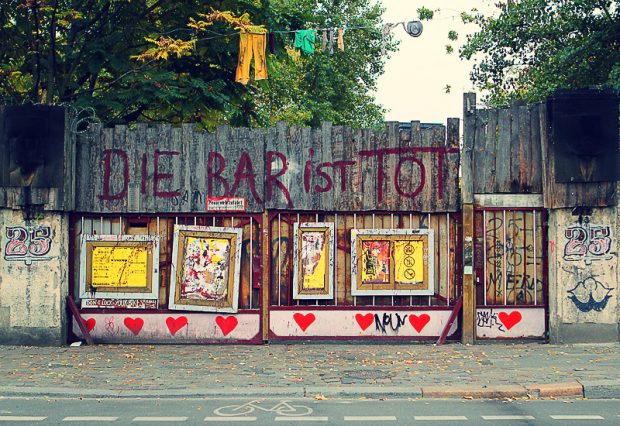
Although it closed in 2010, Bar25 still holds a very special place in Berlin clubbing history. Established in 2004, it introduced a hedonistic playground atmosphere to a scene that often preferred to appear sombre and serious. There are countless tales about what wild abandon happened between the wooden fence shielding the club from everyday life and its naturally occuring other boundary, the Spree river, where from the opposite bank or passing boats you could watch a very escapist crowd roam the vast area on marathon weekends. Its soundtrack of minimal and quirky tech house grooves that still work even when held back by a limiter is as synonymous with the Berlin party experience as are the improvised wooden interiors, psychedelic decor and joyful ideas that spawned a legion of other clubs to follow suit since its closure. Now rejuvenated as part of the Holzmarkt project in the same space, we’re taking a look back at the sounds that represented the club. To do this we enlisted someone very close to the project, who could also share some of his favorite memories from the club: Jake The Rapper, a former Bar25 resident DJ.
“This is an excellent example of original minimal, and minimal was my gateway into the whole techno scene and later Bar25. I feel like there were a lot of parallel scenes happening in the Bar at the same time, so I can’t really say this was the blueprint for the Bar25 sound, but it’s definitely the one I went deep into. When other DJs and their fans would take over right after something I was into, I’d be like, “What is this? This is totally different. I don’t get it”—which is just fine, as the place fed on variety and experimentation. There was also a whole other floor called The Circus that was dedicated exclusively to weirdness and avant-garde music. It was a very open time for music and a very open place. It certainly expanded my tastes and skills and every other part of my mind. But this track, although it came out three years before Bar25 opened, definitely laid the groundwork for the kind of vibe that was really appreciated. This was deep and trippy and softly took me to a place I really wanted to go after having been dancing, partying and socializing—sometimes for days on end.”
“This has some elements of electroclash that were really big at the time. This was the same time when Peaches, Mocky, Gonzales, Puppetmastaz and so on were some the biggest Berlin acts. It definitely influenced pop music and of course in the Bar as well, although it generally went with a more minimal sound than this. This was a big banger in comparison to what usually came before and after it. Is it a bit cheesy? Yes it is. But it’s so smooth that it inevitably got everyone deep up in there and fully involved. Plus I had a few numbers that use this same half-tone progression, and I chose this one for being the most representative of that time and also one that is still playable today.”
“I know this doesn’t even seem like a dance track at all—very mellow. But if I played this during the day between minimal tracks, people really loved it. it’s instantly recognizable without being too poppy or kitschy; it’s deep without being too melancholic—it’s really quite a piece of work. The lyrics are just single nouns in a row—“a life, a room, a house, a street.” It seems to comprise cut-up parts of a poem, and yet it expresses a mood and a scenario that’s somehow Lynchian. And then there are these minor guitar chords that go easy on ya. There’s no kick drum—or any drums per se—and yet it totally grooves and got people dancing, at least in the Ranchette at the Bar25. That may be why the place was unique, you could really DJ tracks to celebrate their spirit without having to kowtow to dance floor dynamics. There was already such a suspense and energy there, even when it was half full a little would go a long way.”
“I feel like this track, despite the fact that it became a tech house club hit nationally and internationally, nonetheless captured the sound of the Bar25. Remember that a lot of the time it was daytime, so something with a deep, warm sound made a lot more sense in bright sunlight than in a dark club. A lot of these kind of songs I think gained popularity through the surge in open-airs and daytime clubs like Bar25. This might have put everybody to sleep in the average German dance club in 2005. But when it’s around midday and you’re sitting, looking out at the Spree while a light breeze makes the straw in your gin and tonic move around so you hear the ice in your glass tinkle…you see yourself reflected in your friend’s sunglasses and you look like you’re really enjoying yourself, and then this big soothing, massaging synth surface lifts you up and you have to just stand up and go YEAHHH! …yeah, that’s a Bar25 moment for me.”Read the rest of this entry »
In discussion with Trusme on “Forevernevermore” by Moodymann (2000).
I doubt that „Forevernevermore“ was your first encounter with Moodymann. Did you eagerly await his third album, and how did it grab you?
100% I didn’t know who Kenny was till I found a copy of “Forevernevermore” in my friend’s record bag. He had left his records at my house and I was doing the usual noseying though the records when I found this CD. I was completely into Slum Village, MadLib and Jaydee collecting the samples from Jazz to Disco. When I first played this CD, everything just became clear in my mind. This is the sound I was looking for, from Hip Hop, House, Jazz, Soul and Disco all rolled into one. I became obsessed, wanting to understand the production techniques and went on to discover the whole world of Detroit right after this. Three years on, Moodymann was playing my first LP launch in a pub on Oldham street, home to where I had been buying his records for the past few years. KDJ and Theo were just No.1 at that time in Manchester and I couldn’t help but be influenced by the whole sound.
It seems that Moodymann matured up to the release „Forevernevermore“ in terms of the album format. „Silent Introduction“ felt like an anthology of 12“ material, even though it worked as an album. But with „Mahogany Brown“ he already aimed at a listening experience more true to the format. Would you say he topped this with „Forevernevermore“?
Yes, for sure. The whole LP worked as a cohesive hour of music yet there was something at every turn that was unique and compelling to me as a listener. I related to this LP in more ways than one, due to it’s almost Hip Hop nature with intros and outros connecting the tracks and glueing the whole piece together. There are so many seminal tracks on the LP that are still played out in the clubs today, yet they are tracks that remain LP cuts and for home listening only. This ideology is what I have embraced in all four LPs that I have produced over the last 8-9 years, with something for the dancefloor, something for the car and wherever else that one listens to LPs these days.
You told me that you wanted to talk about the CD version of „Forevernevermore“, which has lots of interludes and skits, and hidden tracks. Do they form an alliance with the music that almost works like a radio play? What is the special appeal of it?
When I think of an LP, I think of A Tribe Called Quest, Marvin Gaye or The Verve even. All these LPs are constructed to be a continuous piece of music, in which the listener is taken on a journey from the beginning to the end. With the CD format, there is extra playtime in which intros and outros can give a context to the background and making of the LP. On the “Forevernevermore” CD you are taken into the home of KDJ, as he sits playing with ideas on the piano with his child, to the studio discussions and even to listening to his local radio for inspiration. Hidden right at the end of the CD is a live recording of three hard-to-find cuts from the KDJ label, mixed together after 2 mins of silence. In many ways the CD provides the platform for further expression as an artist in the format of an LP.
I think the sound of „Forevernevermore“ was a step forward in terms of his distinctive sound. It was still dense and immersive, but also more refined. Do you think Moodymann’s sound evolved on „Forevernevermore“ in comparison to earlier works? And was it for the better?
This was for sure in an LP sense his best work. It is what most people say as their favourite work, when talking about Moodymann. He carved a sound out all for himself and also derived a unique long player format that until then was not seen in the dance scene. Most underground dance LPs were merely a collection of 12” tracks but this felt more like a well thought-out process, something like Daft Punk would execute. I believe Peacefrog Records also helped in this process and pushed KDJ, as they did all their artists to reach even further. In many ways, earlier LPs were a collection of his previous works but “Forevernevermore” was an LP made from beginning to end with a single LP idea and it feels very much that way.
Tracks like the Disco led „Don’t You Want My Love“ display a confidence to transcend mere club credentials for traditional songwriting, a path he followed ever since. Is there a side to Moodymann the producer you prefer to others, or is it not necessary to differentiate his persona as an artist?
The marriage between your typical MPC studio production and live instrumentation was what set out Kenny on his own. Working with local artists like the percussionist Andres, bass with Paul Randolph and keyboards by Amp Fiddler, on top of that raw production sound was just so unique. The juxtaposition of quantised groove and loose musicianship created a genre of its own and is still being replicated today. This LP was the beginning of that sound and Kenny is still using this formula very much in his productions today.
How do you rate the albums Moodymann released since „Forevernevermore“? Were they up to par with your expectations?
“Black Mahogani” is on par for me if not more refined than “Forevernevermore” but maybe it’s the rawness of the LP that better relates to me. With the following LPs I have enjoyed the productions but felt slightly less connection to the music I listen to and make today. Not that it’s not great music, but I started to feel that the tracks in the EP releases didn’t have that Peacefrog touch of which I’m such an admirer. The LP process began to evolve towards the creation of a new sound where he begins to sing and perform more as an artist and less in the background as a producer. Read the rest of this entry »
I loved a lot of David Bowie songs throughout my life. His landmark albums from the early 70s were still a staple of the radio shows I recorded to cassettes from the mid 70s on. Glam anthems, way ahead to my ears then what became of it in the charts around that time. Glam outfits that were equally way ahead. David Bowie was already somewhere else, of course, anticipating the Disco phenomenon I would soon so love, with Philly’s finest. Then following that up with the Berlin trilogy that would inspire legions to create something great, and look great while doing it, too. Then, when I ran around in 60s clothes in my early 80s coastal smalltown youth, I discovered that he already had been there in the best way imaginable, and his early Pye singles were exactly the attitude and sound I was looking for. He was the definite face. He made no mistakes. He even descended to the kids he created with „Ashes To Ashes“, and he blessed them, as they worshipped him. He was a terrific actor on screen as well, making good use of his ever magnetic charisma and sexually confusing identities there, too. Whatever he did, you watched him very closely, else you could have missed out on crucial developments.
When „Let’s Dance“ was announced as being produced by Nile Rodgers, another inerrable hero of mine, I had the highest expectations, but then could not help feeling let down. There were moments, but not enough of them. And in the period of the mid 80s shortly after, pop’s most successful stars could earn a fortune without even the slightest vision (let alone sound), and David Bowie simply became one of them. As soon as he was dancing in the street with Mick I was just embarrassed. Even his outfits were embarrassing. I was really surprised that this could happen. Enter the years of hit and miss. For every glimpse of his former cool self resurfacing, „Absolute Beginners“ or „Hallo Spaceboy“ for example, he took decisions that were unforgiveably below his par, think Tin Machine, among others. Given, you cannot be visionary forever, however visionary you once were. And David Bowie was more constantly visionary than anybody else, for a long time. But the visions at one point were had by others. Not surprisingly he displayed a clever instinct for picking the right ones to utilize for his purposes, but still they were attached. I did not mind, he was performing the elder statesmanship with grace, and as so many artists were still working ideas he already had before, there was nothing left to prove, only if he wanted to. So screw the stock bonds. I sincerely felt happy for him and his family. He deserved it. Then he kind of disappeared.
When he reappeared in 2013, it felt like out of the blue. „Where Are We Now?“ was the first song of his in years I listened to repeatedly. It was beautiful and it felt good to have him back. I was slightly surprised by its sadness, but I thought it was quite a statement to base its sentiment about the most lauded creative period of your career. It challenges comparisons, and I was sure he was still creatively ambitious enough to try and deal with them, no matter what he achieved before. „The Next Day“ was a good album, too. He did not try to reinvent himself, he looked back on what he invented. I visited the Bowie exhibition that was doing the same in Berlin, just in time before it closed, and I enjoyed it very much. It all came back, rather predictably. His stage outfits on display proved he was a small man, but he surely did not have a small mind.
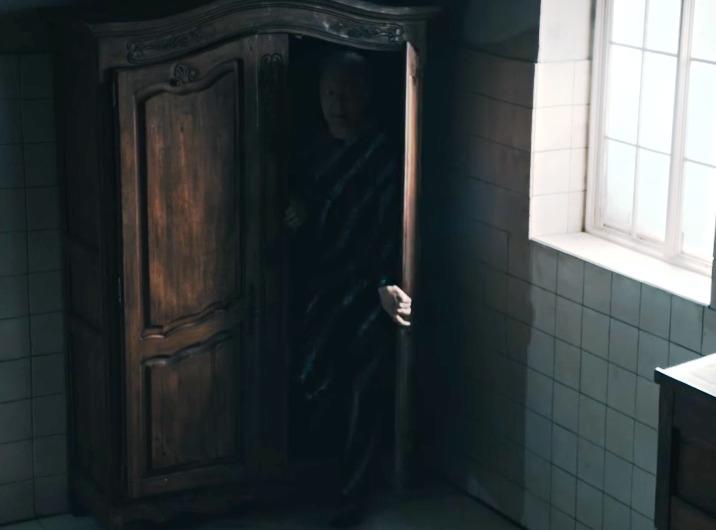
I did not expect that he would follow that retrospective phase so soon, if at all. And I absolutely did not expect that he would follow it up with an album like „Blackstar“. As before, David Bowie chose to remain silent, relying on producer Tony Visconti to reveal the news of its release. I read his trusted cohort doing that in an interview while travelling. He spoke of references like Kendrick Lamar, Death Grips and Boards Of Canada, and that rock and roll was to be avoided. David Bowie recruited a potent jazz quartet from a New York bar for the recordings. It was all rather promising. When I got asked to write these lines I initially wished I could have listened to the entire album when he was still alive, as I was already overwhelmed to the point of numbness by the reactions to his sudden demise. But when I then listened to it, it became obvious very quickly that he was fully aware that he would have passed away once the public would be fully exposed to it. And that it is pivotal to picture the dying artist for the whole experience. The songs are brilliant. Complex and dense, or just stunning, indeed avoiding rock and roll stereotypes, even if the jazz only adds to the picture instead of dominating it. The mood is intense, but it is not entirely dark. Thinking of the motivation behind this album, David Bowie sounds astonishingly swinging, his beloved voice delivering clever lyrics ranging between the horror of his own decay and the feeling of arriving there content, at ease with himself, with truths simultaneously personal and universal. The video to „Lazarus“ is frightening to watch, but comically absurd as well. The last photographs of him taken show him in a sharp suit, lauging. The way he orchestrated his own requiem is incredible, exactly as he wanted to, and as only he could. Being David Bowie, setting lasting examples yet again. Superior, even in death.



Recent Comments