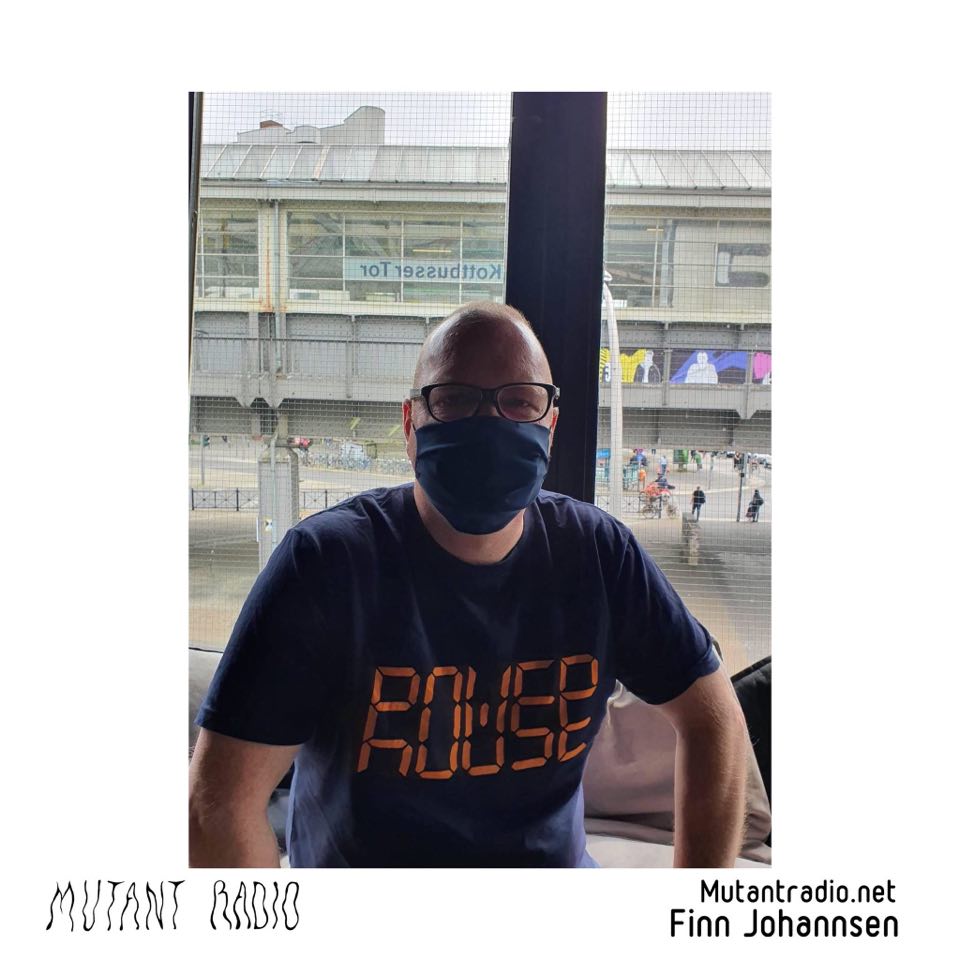
2020-05-27 Finn Johannsen – at Mutant Radio, Tbilisi

Posted: June 1st, 2020 | Author: | Filed under: Mixes | Tags: , , , , , , , , , , , , | No Comments »

D.S. Building Contractors – One For The Burglar

A Certain Ratio – Spirit Dance

Kraftwerk – Musique Non Stop

S-B-M & MC Tunes – Back To Attack

Shades Of Rhythm – Exorcist

Eric B & Rakim – Follow The Leader

Designer Imposter – Good News (Pink Alert’s Good News Remix)

Larry Heard – DNA-RNA

Electribe 101- You‘re Walking (Ambient Groove Mix) 114

Model 500 – The Passage

NSRB-11 – 685-471 2

K-S.H.E. Vs. Juzu aka Moochy – Morning Grow (K-S.H.E’s Melancholy Grow)


Finn Johannsen – Tanzdiele, Kiel, 1998

Posted: May 1st, 2012 | Author: | Filed under: Mixes | Tags: , , , , , , , , , | No Comments »


Foremost Poets – Pressin On‘
I-f – Playstation #2
Black Odyssey – Sweat
Telex – Moskow Diskow
Recloose – MYM230 (R.I.P.)
Nick Holder – Free Again
Mr. Eddie Fowlkes – Untitled
Brother Of Soul – Eyes Of Love
Glenn Underground – Jaz Love #2
Freestyle Orchestra – Twi-Lite
Eric D. Clark – Chasing Fur, Walking
Armand Van Helden Feat. Duane Harden – You Don’t Know Me
Studio 2 – Travelling Man
Kerri Chandler – Atmosphere
Kerri Chandler – Love Will Find A Way
Aquanauts – Stepping Upon Mars
N.Y. Connection – Messages
Foremost Poets – The Spy-Chiatrist
Isolée – Bleu
Random Factor – Broken Mirror
Rick Wade – 2AM Detroit
Gemini – At That Café
Jeremy – Soul Kicks
Model 500 – Be Brave
Presence Featuring Shara Nelson – Sense Of Danger
Isolée – Initiate 2
Soylent Green – After All
Orkestra Galactica – She Brings The Rain
Abstract Truth – We Had A Thing
Blue6 – Sweeter Love


Finn Johannsen – Tanzdiele, Kiel, 1996

Posted: March 1st, 2012 | Author: | Filed under: Mixes | Tags: , , , , , , , , | No Comments »


DJ Duke – Escape From N.Y.
Sensorama – Quarzzeit
Circulation – Memory
Schatrax – First Heartbeat
Kevin Yost – Natural High
DJ Sneak – Latin Seoul
GU – I Need GU
3-Play – Summer Breezz
The Ghetto Kids – Summer In The City
Sensory Productions – Houseluck
Gene Farris Presents The DEB Project – Visions Of The Future
Dave Angel – Fever
Suburban Knight – Echo Location
Trackman – Don’t Stop
Pete Conman – The Range Count
LoSoul – Open Door
Product Of Da Neighbourhood – Living In Brooklyn
Global Communication – The Way
Wamdue Kids – Memory And Forgetting
Moodymann – I Can’t Kick This Feelin When It Hits
René et Gaston – Merluche Ideale
Mood II Swing – All Night Long
Boo Williams – Home Town Chicago
Model 500 – I Wanna Be There
Jonny L – This Time
DJ Linus – Pleasure
Netto – Like Ghosts
Projekt: PM – When The Voices Come
Faze Action – In The Trees
Motorbass – Les Ondes


Rewind: Serge on “Ocean To Ocean”

Posted: July 26th, 2010 | Author: | Filed under: Interviews English | Tags: , , , , , , | No Comments »

In discussion with Serge on “Ocean To Ocean” by Model 500 (1990).

I assume you were already familiar with Juan Atkins when the “Ocean To Ocean EP” was released in 1990. He was the first of the Detroit techno originators to release a record. Was he also the first of them you heard?

I am not sure… probably yes. But it could also have been the first Transmats of Derrick May. It was around ‘87 when I heard the first techno and this came out in 1990.

What makes this record so important for you? Are there special moments and memories attached to it?

It is just one of the best records Juan Atkins did, and one of the first records where techno became techno, where it became a form of art, and not just a tool to make people dance like disco, and like what house and techno was in that period, but an expression of feelings and emotions in an creative sophisticated and highly skilled way. You also hear this on other records from that 1989 and 1990 period, but somehow this one is one of my most favourite releases.


How would you describe the music on this record? Do you like it in its entirety, or do you prefer some tracks to others?

I love all tracks and it is difficult to describe. I can only do that properly in my native language I think. “Infoworld”, “Ocean To Ocean” and “Wanderer” are tracks that are unique. It’s electronic music but not as we knew it in that period, like we knew house music, or electro and new wave. All electronic dance music was driven by rhythm and drum machines. The drive and the energy on this release come mainly from the mindblowing basslines and melodies and strings. The percussion is not the most important part of the tracks, which is rare in dance music! For me this is techno in its most vibrant and creative form. Back then (89-90) this was music from another world. This was the future! No-one ever heard anything like this before.

I think “Ocean To Ocean” and “Infoworld” are very trademark Atkins sounding, they contain a lot of elements typical for him. The pensive vocals, the delicate electro leanings, the way he establishes a feeling with fragile melodies and moody strings. Would you say this record defines his sound even more than other of his releases?How would you place it in his career?

Actually I don’t think it is very trademark Juan Atkins. You think so? “What’s The Game” and “The Chase” are maybe closest to these tracks. But I think his previous tracks are more electro orientated. I think this was more sophisticated then anything he did before. Fragile and a more dreamy atmosphere, as if you were away from the world floating in space or something It doesn’t feel so grounded and dancefloor orientated.

Juan Atkins had a few guest spots on Derrick May’s Transmat label, but this is the first release under one of his best know aliases. Do you think May wanted to pay his dues with it?

I think it completely fits on what Transmat and Derrick May where doing in that period. Techno in a more creative and expressive way. I have no idea if there are any other reasons, beside the killer tracks themselves, to release this record.

I always found it peculiar that “The Wanderer” sounds very much like May, and that there never surfaced another version of this track. Is this more of a collaboration, and there might not even exist a version which is more Atkins?

I don’t think so. It might be a collaboration, or actually it says it is a collaboration, but they all shared gear and worked together on tracks. I think “Infoworld”, and “Ocean To Ocean” are very much Derrick May. The way it builds, and how the melodies and strings are done, the drum programming. But Derrick may doesn’t get credits on those tracks I believe, only Marty Bonds. Also they don’t sound completely like Derrick May.
I actually never heard Derrick May do those melodies and sounds so loud in the mix with such a dominant arrangement. His tracks normally evolve and organically build up. Atkins used to do more of an arrangement, like electro producers. I actually never listened to the tracks like that. I always assumed that it were some kind of collaboration, like sharing studio, work on mixing together, playing a melody etc., and I just didn’t care what and how was written on the labels because that probably wasn’t correct anyway, haha.

1990 was a year in which Detroit techno seemed about to change. Derrick May fell silent, not releasing any original material under his own name since then, other producers of the first wave slowed down comparably, including Atkins, and new talent was about to enter the scene. Is this some kind of finale to the pioneering phase of the sound, or was it impossible to predict back then?

In a way you might be right. It was a small group of people up until then but I don’t think it was a finale for the pioneering phase. Those years, ‘88-’89-’90, all happened in a flash. Records from that period were not consumed as fast as people consume records nowadays, there was no internet, not 200 new records a week. So even after 6 to 12 months or even 2 years records sounded fresh. Actually I believe it was the start for the pioneering phase for many others. The period that new artists and new sorts of techno showed up was after this period. Until ‘90 it was a small group of people dominating techno music and they had their limits of what they could do on a technical and a creative level. So probably for them (Derrick May, Atkins, and Saunderson, plus a couple of others such as Marty Bonds) the pioneering phase was over. But I would say that wasn’t until ‘92 before all different styles appeared and the pioneering phase somehow ended for Detroit techno.

Was this phase of Detroit techno a sound you liked more than what followed, or was it just different?

I think all early periods of new music styles and artists are the most creative and interesting periods because of the lack of a scene and the absence of expectations. I was in the middle of that early techno period and the ending of the acid period when I discovered everything and bought most of those records right after they came out. So yes it was special because of the impact of the music and the nightlife, and also because it was in my teenage years.

There was a tradition of Dutch producers and DJs bonding and collaborating with ones from Detroit at that time. Where did that come from? Was it out of mutual respect, or a likemindedness rooted in cultural and musical parallels? How were you involved with it?

I think that was because in Holland there was a small group of record collectors, DJs and also producers who knew each other from record stores, parties etc. We had great import stores in a small country so you always ran into the same people at some point. Small fanzines where made and people could easily go to parties or stores in other cities or hook up with others collectors. Artists started to collaborate and shared info etc. Speedy J was the first European artist releasing on a Detroit label, Plus 8, and It’s Thinking aka Gerd and Dirk J Hanegraaf) were the second artist on a Detroit label, Malego Records, and they both lived in the same area south of Rotterdam. Then the connection from Eindhoven with Stefan Robbers and Planet E was made etc., and likeminded people started collaborating. There was a lively scene in Holland and club tours got organised for Detroit artists and artists got invited release records on each Dutch labels and to collaborate.

I was one of the collectors and DJs. I played in a local club on the west coast, and was visiting record stores in Rotterdam, Amsterdam and Antwerp on a regular base. In that period, the pre-internet era, there was a lively trading scene for gear and records. And that was how every one did meet. Record stores were a sort of meeting point for all the DJs.

How did this cultural exchange differ from the Detroit/Berlin axis?

I think the Berlin/Detroit connection is established with the Submerge and Jeff Mills period, the rawer techno after ‘91, while Holland and the UK had more a connection with Derrick May and Carl Craig and early Plus 8. But at the end it is about people and I’m sure that the UR thing was as big in Holland as it was in Berlin/Germany and vice versa with Transmat etc.
The fall of the Berlin wall was more of an influence and think that after that people in Berlin and East Germany had better access to import records.

In more recent years, it seemed that especially Dutch labels released records that were decidedly reinterpreting the classic Detroit sound. Was this out of a fan perspective, or was the intention to keep a certain Detroit sound up to date, instead of other, maybe lesser loved sounds from there?

I think many of the Dutch techno freaks, and also UK heads, still had a weak spot for the early 90’s Detroit techno. It is probably an attraction and a passion for that sound which doesn’t fade out very quickly. Also it is a group of people making and buying records not because they are club DJs. I guess it is a form of nostalgia for a period when things where new and had a lot of impact.

There is a lot of outside criticism claiming that most Detroit artists do little more than maintaining the city’s legacy in the history of electronic music, whereas Detroit artists are notoriously sensitive about artists beyond their scene copying their sound. Are both right? Or wrong?

I think one must understand that most artists, so also Detroit artists, are limited in what they can produce, especially with technical limitations. So their most vibrant period is the beginning of their career when they were limited. Now after 20 years they can never produce music with the same creativity, naive energy and passion as back then in their teens. You can’t blame anyone for that, it is just how it is. Manny Detroit artists are now living on the reputation they gained years ago. Some of them still try to invent new things, still are trying to make music with passion and push boundaries, others just try to make a living and play what they think people want to hear. That’s just how things go. Exactly the same thing happens with many European artists.
Of course many Europeans are influenced by what the early techno pioneers did, just like they were influenced by certain artists and records as well. Everyone has influences. Some use that only in the back of their mind, others try to copy that 1 on 1. And if they succeed in doing that, they risk being called copycats. Others don’t succeed and get praised by the unique productions they make, haha.

Was there a point in your activities where you thought it was crucial to leave this Detroit thing behind, because its quality potential seemed exploited? Was this one of the reasons why you reinvented Clone for example?

I can never leave this Detroit thing or this Chicago thing behind me. It is a essential part of my passion for music. As is disco and funk.
I didn’t reinvent the label because I wanted to leave something behind. I did that because the circle was round. I finished my circle, my musical journey in electronic dance music. I was back where I started and I was there right at the start of techno and house and went through the natural developments. But I can’t do this same journey again without losing passion, so I had to change something or quit. I mean there is a new generation. I release music of young talented guys like Space Dimension Controller, Astroposer and Kyle Hall, who where not even born when this Model 500 record came out. They are at the start of their musical journey and I needed space and freedom to work with young cats like them without being blasé.

Do you think that music like “Ocean To Ocean” will always remain valid, as long as it just reaches this artistic level?

What do you mean with music like “Ocean To Ocean”? If someone copies it? If someone makes a record as good as this it will be valid of course, but it must have a unique character and artists fingerprint on it, combined with its unique moment in time to become such classic, so it can never be “Ocean To Ocean” or “The Wanderer”.

This is a one of the records that went forward and did something new. A new step, together with several other records in that period, that represents a new development in techno music. That’s a big part of the value of the record and also part of the impact it had on me back then! For someone who grew up with techno and who went to a rave with Carl Cox or Marusha or a night at Tresor as first techno party might have a different feeling by hearing this record for the first time then. It most likely will have less impact. The discussion how good it is, and if there hasn’t been records made that are better etc is to difficult, haha.
The only thing one can do nowadays is making a record that reminds very much of this and brings more or less the same emotions. But there can only be one “Here Comes The Sun” of the Beatles, even though Oasis comes close with their songs. Their songs never can get the status of an original Beatles song.

Does it then matter how often it has been tried before by others to achieve this?

These things can not be organised. It is just a matter of being at the right place, doing the right thing, and only history can tell! You cannot try to write a classic record like this. That just happens. I mean with hard, passionate work and dedication one can achieve things. What you will achieve, or how good the record will be received one never knows until 15-20 years later. I am sure that right now, in the last months, a classic record has been released of which we don’t know yet that it is a classic record!

Will the originators from Detroit themselves be able to achieve something like this again?

No.

Sounds Like Me 07/10

Playing Favourites: Joey Negro

Posted: May 7th, 2010 | Author: | Filed under: Interviews English | Tags: , , , , , , , , , , , , , , , , , , , , , , , | No Comments »


Rinder & Lewis – Lust (Pye Records, 1977)

The first one is by Rinder and Lewis – “Lust”, which is kind of a space disco prototype so to say. For 1977 it was kind of a landmark record I guess.

For 1977, yes. I suppose Rinder and Lewis were a very prolific production team in the 70s and 80s. They made an awful lot of records, a lot of albums. That’s probably one of their most moody tracks. A lot of their stuff has got a 1920s, big band, Charleston influence to it. But I like a lot of their stuff. But some of it is unusual in its arrangement. That one’s got a slightly more mystical vibe to it.

Would you say they tried to explore their field a bit further with this record? You mentioned that a few of the other productions had certain influences, like the latin stuff for example. But this one is really something different, almost science fiction.

Yes, but that’s quite different from the rest of the “Seven Deadly Sins” album. I reckon it wasn’t a track that was made to be a hit. It was probably considered an album track. But with that weird bit in the middle with the glockenspiel, it goes into a sort of devil bit about two thirds of the way through. Which is very out of character with the rest of the record. But what I think is interesting about that is that you don’t get those sort of unexpected bits in records now. I guess when musicians are making records, it’s very different to when DJs are making records. Now, when DJs make records they just tend to have the same stuff going throughout the track, it just loops round and round. Maybe there might be some changes, but there’s nothing drastic coming in really loud. A bad DJ produced record might just be a bit boring, whereas a bad record from the 70s might have a great verse and a really terrible chorus. Or you might have something really cheesy. A lot of records now are just rhythm tracks made by DJs for mixing and whatever, whereas then you might have records that have got loads in them, maybe too much. But the reason that they’re not great is maybe because they’ve got too much in them. They might have some great musical parts, but the vocals are crap. I think I’m digressing a little bit. A lot of Rinder and Lewis stuff – have you got that album “Discognosis”?

No, I know the THP Orchestra stuff which I found really good.

Yeah, and there’s El Coco and Le Pamplemousse. I like that track. It’s always very well orchestrated, they always had a bit of money to make the records. It wasn’t done on a shoestring budget, they must have sold pretty well. I think El Coco’s “Cocomotion” is one of my favourites by them as well. Obviously a lot of the stuff on AVI was produced by them, they were putting out a lot of music. They must have lived in the studio in 76, 77, 78, 79.

This is also a really good example for what you can do if you’re a good arranger – the arrangements they did are really complex and beautiful. Is that something you miss? You talked of modern rhythm tracks and functionality – I think it’s hard to pull off these days because you don’t have budgets for studio work…

Yeah of course. I suppose you have to think, this is now and that was then. Record sales were much higher, I suppose disco was like r’n’b was 5 years ago in terms of its worldwide popularity. So there was a lot more money, obviously there weren’t downloads or people copying CDs. I don’t know what the sales figures were like of something like Rinder and Lewis, but it probably sold half a million or something like that. It’s a completely different time, in terms of being able to get a string section in for your record. I’ve paid for string sections before, but to be honest with you what I’ve found is a string section with 30-40 people is so different to a string section with 7 or 8 people. I’ve only been able to afford 6 or 7 people. It isn’t really a string section! Nowadays, with CD-ROMs and whatever you can make something that sounds pretty good – not the same – but pretty good with just samples. To really make it sound a lot better, you need a 30-40 piece, big room orchestra. People at Salsoul and a lot of them classic disco records had that big proper string arrangement. Also, paying someone to do the arrangement isn’t cheap if you get someone good. Very difficult to do that now. So yeah, I do miss it. But there’s no point missing something, it’s like saying “Oh, I wish they were still making Starsky and Hutch”.

As long as a glimpse of an orchestra won’t do, it doesn’t make sense?

I think the only it could make sense is if George Michael decides to make a disco album, or someone like that. He could afford it. Or Beyonce. Some big star. But your average dance record – I suppose Jamiroquai had some live strings on some of his stuff. But then again, he was selling a lot of records.

Doobie Brothers – What A Fool Believes (Warner Bros. Inc., 1979)

“What a Fool Believes” by the Doobie Brothers, which is a merger of rock and disco.

There’s other tracks, like the Alessi Brothers “Ghostdancer”… I suppose that just shows how popular disco music must have been at the time when people like The Doobie Brothers and Carly Simon were actually making disco records. I suppose it’s the same as nowadays people making a record with a more r’n’b type beat. Or at the beginning of house music, there were lots of pop acts making house records. I was listening to a best of ABBA a few years ago. It started off sort of glam-rock, sort of sweet, like Gary Glitter, that sort of production. And by the late seventies their stuff had got pretty disco-ey. And by 82 it was folky. So I think the disco beat was just featuring on a lot of productions by acts who just wanted to make a contemporary sounding record. That’s probably why a lot of the American rock establishment hated disco so much. It wasn’t just that it was there: their favourite acts were making disco records! They hated the fact the Rolling Stones made disco records, it just wasn’t allowed.

But the thing is, that when the disco boom ended, a lot of the rock acts who made disco records acted like they never did! They deserted it pretty quickly.

Yeah, once it became uncool they pretended they never liked it, it wasn’t their idea and all that. I tried to once do a compilation album of that sort of stuff. But it’s too difficult to license it all. They’re all on major labels, they’re all big acts, and it’s very hard to license that stuff. In fact I’d go as far as to say it’s impossible: just too difficult and expensive.

Was it just because of budget reasons, or because the acts didn’t want to be reminded of what they did in that area?

I think often those big acts have to approve every compilation album license. A lot of the time, for the people who work in the compilation album license department, it’s easier for them to say no than to write to the management of Supertramp or Queen. And often, if they do see a title that has disco in it, they will say no. And a lot of them won’t license the Rolling Stones to a comp that’s got a projected sales figure of less than half a million. There’s so many reasons why it’s problematic. You could do it, but you’d have to leave off so many tracks, there would hardly be any point doing it. I did have a chat with a major label about doing it and that was one that owned quite a lot of them. But it’s just so difficult. They want to see a big marketing budget, they want to see you spend a hundred grand on television adverts. Otherwise they just go, why are we on this compilation album?

I think it’s a shame really, there were so many good disco records done by major artists…

Yeah. I like a lot of those things. I’m doing this compilation for BBE which is maybe a similar thing, just it’s not all well known acts. People like Fleetwood Mac, they did that track “Keep On Going”, those sort of things. I guess it’s blue-eyed rocky soul. Quite danceable… it’s not all disco, but it’s not really rock either. More black music based. I always think, if you look at the back of a rock album and it’s got someone playing bongos on it, it’s worth checking out. Read the rest of this entry »


Druffmix 33 – The D.H.S. Rave Chronicles Detroit

Posted: June 19th, 2009 | Author: | Filed under: Mixes | Tags: , , , , , , , , | No Comments »

The Druffalo rave saga continues. This time round the Druffalo Hit Squad travels back to the classic sound of Motor City. No, we didn’t ask for permission.

Never On Sunday – The Journey (Retroactive)
Constant Ritual – Hard Way To Come (Network)
Psyche – Elements (Planet E)
R Tyme – R Theme (Transmat)
Mia Hesterley – Spark (Ten)
Intercity – Out Of Control (KMS)
Neal Howard – Perpetual Motion (Future Sound)
Vice – Mindmelt (430 West)
Suburban Knight – The Worlds (Transmat)
Reese – Bassline (Fragile)
H&M – Sleepchamber (Axis)
M5003MB – The Cosmic Courier (Metroplex)
Open House Feat. Placid Angles – Aquatic (Retroactive)
Octave One – Octivate (430 West)
Mayday – Nude Photo 88 (Kool Kat)
Model 500 – Electronic (Metroplex)
Blake Baxter – Forever And A Day (Ten)
Esser – Forces (KMS)
69 – My Machines (Planet E)
E Dancer – Feel The Mood (Incognito)
Octave One – I Believe (Transmat)
Underground Resistance – Hi Tech Jazz (Underground Resistance)
Pod – Vanguard (Buzz)
Inner City – Praise (Ten)
Alien FM – Art Of Illusion (430 West)
Psyche – Crackdown (Buzz)
Paris Grey – Don’t Lead Me (Network)
Never On Sunday – Urban Rains (430 West)
New Birth – Don’t Blame The Young Folks (For The Drug Society)


Playing Favourites: Shed

Posted: October 12th, 2008 | Author: | Filed under: Interviews English | Tags: , , , , , , , , , , , , , , , , , , , , , , , , | No Comments »

White Noise – Black Mass: Electric Storm In Hell

This is very early electronic music, from White Noise’s first album from 1969. They were among the first to use synthesizers in a rock context and their music became very influential later on. This particular track seems indeed way ahead of its contemporaries, and it is pretty wild.

I didn’t know that at all. I had problems listening through it, it is almost disturbing. From today’s point of view it maybe is not that overtly experimental anymore, but setting it into the time of its production, it is very cool.

There certainly was not much comparable music back then.

The sound is very good. They already had synthesizers? There is a lot of space in the production. If you would not have told me, I would never have guessed that it is so old. The arrangement and the noisy parts reminded me of destructed Amen breaks, totally distorted. Very interesting.

Quartz – Chaos

The next one is by Quartz from France . Also early synthesizer music, but within a disco context.

I was not into that at all. My calendar does not really start before 1990 or so. Even stuff like early Model 500, Cybotron, it is ok, but it’s not mine. I also can’t get into Kraftwerk. What has been called techno from 1990 on was what got me to listen to music consciously for the first time. I was never the one to check the influences on music that I like. I know Disco only from TV, Saturday Night Fever and such. I was never really interested in it.

Is that based on a basic antipathy towards the sounds of disco music?

There was a short period I found it exciting, around the time the filter and cut-up disco house arrived with DJ Sneak, all the sample stuff. But that was over pretty soon when all the records started to sound the same. So yes, it is based on principle that I don’t like the sounds too much.

So you were more interested in how a track was built on samples than where they came from?

Exactly. It was fascinating to me how all could be said in a loop that went for three minutes, if it was a cool one. Longer than that it could get boring. Of course you can’t compare that to what happens in the original disco track, there was more happening there than in house tracks, which only used bits. It was interesting that many people used the same samples and you became aware that there must some source for it. But sample based productions are not my philosophy. I never wanted to just use bits of other people’s music.

Those disco house records also did not always pay tribute to disco, they deconstructed it, and often in a not very respectful manner.

Not at all. It’s strange how American producers often deal with each other, all that stealing amongst themselves. But in the end we all benefited from that (laughs). Read the rest of this entry »


V.A. – Movement (Iridite)

Posted: March 5th, 2008 | Author: | Filed under: Rezensionen | Tags: , , , , , | No Comments »

Auch auf Iridites zweiter Veröffentlichung ein großer Wurf von Jason Brunton, diesmal mit trockenem Knister-Acid, der mit schönen tonalen Querschlägern kollidiert und sich in Richtung des seligen Armando Gallop verbeugt. Gerade hat man sich begeistert darauf eingelassen, da grätschen plötzlich von allen Seiten außer Kontrolle geratene Model 500-Basssequenzer mit Echokammeranschluss rein und stiften eine umwerfende Verwirrung, von der man sich gerne überfahren lässt. Auf der B-Seite lässt sich auch Rei Loci mit 303s ein, doch die Blubber-Basslines sind hier nur der Ausgangspunkt für eine exzellente deepe Unterwasserfahrt mit irrlichternden Dubeffekten. Alles kreist so einnehmend und intensiv umeinander, dass einem davon ganz schwummrig wird. Massive!

De:Bug 03/08


V.A. – Four Tet – DJ-Kicks (!K7 Records)

Posted: July 6th, 2006 | Author: | Filed under: Rezensionen | Tags: , , , | No Comments »

Bei Kieran Hebden mag man breit gefächerte musikalische Vorlieben bereits vermuten und die Tracklist löst gleich flächendeckend ein: Electro von Model 500, frickelige Elektronik von Akufen, düstere Breaks von Syclops, zappeliger Jazz von Heiner Stadler, unzweifelhafter Soul von Curtis Mayfield, schlauer Hip Hop von Madvillain, zickige No Wave-Disco von Julian Priester, verkopfter Indie-Kram von Quickspace Supersport, Prog Rock von Gong und noch viele smarte Einfälle mehr. Da fehlt fast nur noch der ganz käsige Hit als Kontrapunkt um das durchgehende Checkertum noch zu unterstreichen. Als Set erzählt das eine kluge Geschichte, die mit ein paar mehr gewitzten Übergängen den Vogel komplett abgeschossen hätte. Da wird er dann zuweilen zu David Mancuso.

De:Bug 07/06


Finn Johannsen – Jackin’ Planets

Posted: December 6th, 2005 | Author: | Filed under: Mixes | Tags: , , , , , | No Comments »

A guy asked me if I could provide a guest mix for his show Jackin’ Planets at a Berlin radio station called shouted.fm. Sadly I forgot his name, but he asked me very politely and I liked both the name of his show and the name of the station, so I agreed. To be honest I might have been in the mood to record a mix of some old school techno faves, and I just jumped to the occasion. Anyway, here is the result.

LFO- Freeze
Constant Ritual – Hard Way To Come
Paperclip People – Jerry Lewis (Mayday Mix)
Mark Imperial – I Can Feel The Music (Chicago Street Mix)
Eddie Flashin’ Fowlkes – Liquid Disaster
Gemini – Festival
Cybersonik – Revelation 928
Adolfo – Do I (Ivan Iaccobucci 4 A.M. Mix)
Psyance – Andromeda’s Dance
Laurent X – Drowning In A Sea Of House
KC Flightt – Planet E (Acid Drop Mix)
Chrome – My Reflection
Prince – The Future (Remix)
Octave One – Black On Black
Yazoo – Bring Your Love Down (Didn’t I)
N.Y. House ‘N’ Authority – Fort Green House
Metro – Straphanger
Urban Tribe – Eastward (Forme Remix)
Model 500 – Pick Up The Flow
ABC – The Greatest Love Of All (Mayday Mix)