Located near to its famous successor Berghain in a disused freight depot, Ostgut was open from 1998 until its lease ran out in 2003 and the location was demolished. It is telling that the name is still vital in the Berghain enterprise, and Ostgut already had a lot of key elements that are still thriving: marathon weekends with marathon DJ sets, with hard Techno played on the main floor and housier vibes on the already existing Panoramabar. And as Ostgut evolved from the male-only Snax parties, it carried the according focus on gay and fetish sex into a permanent, raw location. We asked Ostgut resident DJ André Galluzzi to guide us through the sound of the club that set the foundation for the clubbing experience Berlin became famous for in recent years.
Surgeon – Atol (Downwards, 1994)
We begin with a primetime highlight. This track guaranteed ecstasy on the floor and became a trademark for the club.
Ignacio – Virton (N.E.W.S., 1999)
It was not an unusual track, but definitely one of the naughty ones. Direct and mindblowing. I used to drop the track between 5 to 6 a.m.
Si Begg – Welcome To The Discotheque (Mosquito, 2000)
I loved to open my set with Si Begg after live acts. Because it has this incredible intro while the mood of the record was already defining for the night. This was brillant.
Down in a raw basement near Hamburg’s Berliner Tor station, Willi Prange and his partner Phillip Clarke opened the mostly gay oriented club Front in 1983. The majority of nights at Front were not played by guests, but by the main resident DJs Klaus Stockhausen and his successor Boris Dlugosch, who steered the club through the most cutting edge music the disco aftermath had to offer, until it eventually became one of the first clubs in Continental Europe to embrace house music and the styles that followed suit. The club’s intense nights were built on a wildly hedonistic and loyal crowd, a fierce quadrophonic sound system, a secluded DJ booth that seemed to antagonize the cult of personality of the years to come, and thus created a legacy that lasted well beyond the club’s closure in 1997. We asked Boris Dlugosch to guide us through the sound of the pivotal years of Front.
Shirley Lites – Heat You Up (West End, 1983)
This was one of my first lasting musical impressions at the club. Klaus Stockhausen played it nearly every Saturday then. It was more of an after hours record and it fitted perfectly.
Syncbeat – Music (Streetwave, 1984)
Klaus played this record when it came out, and when I started as a DJ in 1986 it had a small revival because I rediscovered it for myself. It was one of the most formative records for me. I did not know until then what this record was. I found it by chance in the club’s own record inventory. I loved this track very much and one day I could get a hold of it in a grab bag at Hamburg’s Tractor store for import records, where I was working at the time. Those bags were sealed and contained 10 records. I actually flicked through several other bags until I had two copies of it.
Connie – Funky Little Beat (Sunnyview, 1985)
This kind of Electro was the sound of Front from 1983 to 1984. I was not going to other clubs much, I was still too young and could not get in, but I heard this record on old tapes recorded live at the club (https://hearthis.at/front/). When I started going to Front from 1985 on this sound slowly faded away and was replaced by early house music.
Harlequin Four’s – Set it Off (Jus Born, 1985)
For me this was a quintessential Freestyle and Electro record. Klaus Stockhausen used to play it mostly as a break, often mixed with „Operattack“ by Grace Jones, or with space effects records. This and the Grace Jones album were milestones for my musical socialisation and they always worked on the floor.
Adonis – No Way Back (Trax, 1986)
This record and Farley Jackmaster Funk’s „Love Can’t Turn Around“ came out in 1986, shortly before I started playing at the club myself. At Front club changes in pace and style were elementary and the according setting was sometimes prepared over the course of hours, and sometimes just introduced by a quick break. House music brought along a different structure, and there was a steady beat for hours. At that time this was the defining new feature of the genre. Music was mixed seamlessly throughout the night at Front in all the years before, but with house music the rhythm became more homogeneous.
So what were Germans actually dancing to before Techno? Of course to as many different styles as in other countries. But a good glimpse at what was getting down in West Germany before house music happened was the club Moroco in Cologne. Located at Hohenzollernring, the club ran from 1982 to 1986, and both the club interior and its crowd were determined to look as posh as possible. In contrast to Post Punk counterculture, the materialistic 80s decade manifested itself in the culture of the “Popper”, foppish youth dressed up to display as much wealth and taste as they could. But what distinguished the Moroco from other similar clubs across the land was its status as favourite leisure and inspiration spot of the Kraftwerk members. Carol Martin, credited as CGI artist on their “Computerwelt” album, was a resident DJ at the club and guides us through the sound of the Moroco and how it was connected to the Kraftwerk canon.
James Brown – It’s Too Funky In Here (Polydor, 1979)
Be it Kraftwerk or Miles Davis, everybody seemed to be inspired by James Brown. Bootsy Collins, whom Kraftwerk also cherished, started his career with him. „Boing Boom Tschak“ is also a tribute to Bootsy’s concrete bass.
Earth,Wind and Fire – Fantasy (CBS, 1978)
Funky, emotional and wonderful to dance to until today. I went to see them with Kraftwerk by invitation of the concert promoter Fritz Rau at the Phillips-Halle in Düsseldorf. It was a magnificent show with perfect sound and effects and all of a sudden the bass player was hanging 20 metres up in the air.
The Gap Band – I Don’t Believe You Want To Get Up And Dance (Oops, Up Side Your Head) (Mercury, 1979)
Danceability was typical for Moroco, and you could play this anytime. There was a nine minute extended version of it, so the DJ could leave to „wash hands and powder the nose“ and when he returned the floor was still as packed.
If Kassel is known in Germany for another cultural contribution besides the art fair Documenta it is the legacy of the techno club Aufschwung Ost, and its renamed successor Stammheim. Both clubs were located in a former textiles factory building called Kulturfabrik Salzmann that served mainly as an art space. When Aufschwung Ost opened in 1994, it quickly established a national and international reputation that exceeded those of clubs in similarly middle-sized cities. The main resident DJs, the late Pierre Blaszczyk aka DJ Pierre and Mark Pecnik aka DJ Marky, built a dedicated local following with their state of the art techno sound, and managed to pull in every main guest DJ important in the techno scene, propelling the club to the level of famous clubs in Berlin or Frankfurt, until its lease ran out in 2002 and it had to close. We asked DJ Marky to recall some of the tunes that ruled the floor in both clubs.
.xtrak – Facc (Peacefrog, 1995)
This bleep track by Todd Sines, who regularly collaborated with Daniel Bell, was played a lot at our club. It is had a minimal sound but a maximum impact on the floor. The hi-hats coming in at the first minute are just a dream.
Jiri.Ceiver – Osiac (Vogel’s Funky Sola Mix) (Harthouse, 1995)
It is very difficult to develop an own signature style. But what Cristian Vogel and other artists such as Neil Landstrumm, Dave Tarrida, Si Begg and Justin Berkovi released in the 90s was definitely new and not existent before. This track stands for the Brighton sound and its wonderful playfulness which was very influential over the years for the resident DJs at Aufschwung Ost and Stammheim.
DJ Hyperactive – Venus (Missile, 1996)
Chicago techno at its best. A peak time banger that never failed to work on the big floor. You still hear it in the sets of well-known DJs.
Daft Punk – Rock ‘n’ Roll (Virgin, 1996)
You just could not pass by Daft Punk in 1996, but you did not want to anyway. Their „Homework“ album included this track and to this day it is still one of the best house and techno albums for me. Either the album or other terrific releases on Thomas Bangalter’s label Roulé were constantly played on both our techno and floors.
Wishmountain – Radio (Evolution), 1996
Sven Väth played this as a white label at our club, in early 1996. It was way ahead of the official release date, so the whole crowd was unfamiliar with it. The energy this track built up on the floor in just a few minutes was just incredible. It was a miracle that the whole place did not just collapse at the last break. What Matthew Herbert created with this track is unique and it is perhaps THE quintessential Aufschwung Ost/Stammheim classic.
Skull vs. ESP – Power Hour (Sounds, 1996)
A beautiful track by DJ Skull and Woody McBride. It came out on Sounds back then, which was a sub label of Communique Records, a very popular label with the resident DJs that had several legendary releases. I liked to play it in the early morning hours.
Green Velvet – Destination Unknown (Relief, 1997)
I could have picked „Flash“, „La La Land“ other Green Velvet classics as well. The Relief and Cajual labels were essential to any of our parties. You can witness its effect at Green Velvet’s legendary gig at our club in 2001 ( https://www.youtube.com/watch?v=ES0ldBe4kZA).
Coldcut & Hexstatic – Timber (Ninja Tune, 1998)
This is an absolute DJ Pierre classic. There was not only hard techno being played at Aufschwung Ost and Stammheim, and this is a wonderful example. Particularly in the morning the residents had enough time to experiment with different styles and we did just that. Electro, big beat and cuts ‘n’ breaks, everything was tried and tested. That was just as much fun for the dancers as it was for us DJs.
DJ Rolando – Knights Of The Jaguar (Underground Resistance, 1999)
A masterpiece by Rolando and Underground Resistance. This track on the big floor at 10 A.M. meant instant goosebumps for everybody. The light came through the windows, and together with the music created a magical vibe each time the track was played. It will still put a smile on those dancers today.
DJ Rush – One Two Zero (Pro-Jex, 1999)
DJ Rush and Stammheim was love at first sight. The residents loved his mad beat constructions. There was probably was not one set from us big floor DJs without at least two tracks by him. And on the other hand DJ Rush adored Stammheim, it was the best club for him back then.
Aphex Twin – Windowlicker (Warp, 1999)
Aphex Twin was formative for his time, and „Windowlicker“ is just one example. I chose it because Pierre used to end long nights by playing this as his last record. It was always astonishing how much energy it could restore for one last time. So it is a classic forever connected to Pierre.
Stefan Küchenmeister – Soda Stream (Hörspielmusik, 2000)
Stefan Küchenmeister was one of the Stammheim residents and he delivered one of the big Stammheims anthems with this track. Fortunately it was released on „Hörspielmusik“, the label I ran with Pierre, and thus we had a home-made Stammheim hit record.
Labels such as Labels wie Profan, Kompakt and Auftrieb developed the sound of Cologne, that us residents really cherished back then. This remix was also one of the big Stammheim anthems.
Vitalic – La Rock 01 (International Deejay Gigolos, 2001)
What can you still say about this track? Pure energy on the dance floor! And one of my all-time favourites.
Depeche Mode – Dream On (Dave Clarke Remix) (Mute, 2001)
Depeche Mode and Dave Clarke? That is the perfect combination that could only lead to a killer track. Dave Clarke knows how to transform an already great track into his own style, resulting in something even better, without losing any of the source’s original greatness. This is a rare gift. A big peak time number at Stammheim.
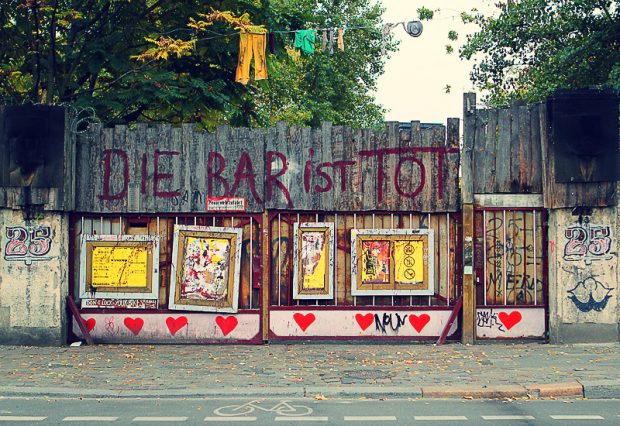
Although it closed in 2010, Bar25 still holds a very special place in Berlin clubbing history. Established in 2004, it introduced a hedonistic playground atmosphere to a scene that often preferred to appear sombre and serious. There are countless tales about what wild abandon happened between the wooden fence shielding the club from everyday life and its naturally occuring other boundary, the Spree river, where from the opposite bank or passing boats you could watch a very escapist crowd roam the vast area on marathon weekends. Its soundtrack of minimal and quirky tech house grooves that still work even when held back by a limiter is as synonymous with the Berlin party experience as are the improvised wooden interiors, psychedelic decor and joyful ideas that spawned a legion of other clubs to follow suit since its closure. Now rejuvenated as part of the Holzmarkt project in the same space, we’re taking a look back at the sounds that represented the club. To do this we enlisted someone very close to the project, who could also share some of his favorite memories from the club: Jake The Rapper, a former Bar25 resident DJ.
“This is an excellent example of original minimal, and minimal was my gateway into the whole techno scene and later Bar25. I feel like there were a lot of parallel scenes happening in the Bar at the same time, so I can’t really say this was the blueprint for the Bar25 sound, but it’s definitely the one I went deep into. When other DJs and their fans would take over right after something I was into, I’d be like, “What is this? This is totally different. I don’t get it”—which is just fine, as the place fed on variety and experimentation. There was also a whole other floor called The Circus that was dedicated exclusively to weirdness and avant-garde music. It was a very open time for music and a very open place. It certainly expanded my tastes and skills and every other part of my mind. But this track, although it came out three years before Bar25 opened, definitely laid the groundwork for the kind of vibe that was really appreciated. This was deep and trippy and softly took me to a place I really wanted to go after having been dancing, partying and socializing—sometimes for days on end.”
“This has some elements of electroclash that were really big at the time. This was the same time when Peaches, Mocky, Gonzales, Puppetmastaz and so on were some the biggest Berlin acts. It definitely influenced pop music and of course in the Bar as well, although it generally went with a more minimal sound than this. This was a big banger in comparison to what usually came before and after it. Is it a bit cheesy? Yes it is. But it’s so smooth that it inevitably got everyone deep up in there and fully involved. Plus I had a few numbers that use this same half-tone progression, and I chose this one for being the most representative of that time and also one that is still playable today.”
“I know this doesn’t even seem like a dance track at all—very mellow. But if I played this during the day between minimal tracks, people really loved it. it’s instantly recognizable without being too poppy or kitschy; it’s deep without being too melancholic—it’s really quite a piece of work. The lyrics are just single nouns in a row—“a life, a room, a house, a street.” It seems to comprise cut-up parts of a poem, and yet it expresses a mood and a scenario that’s somehow Lynchian. And then there are these minor guitar chords that go easy on ya. There’s no kick drum—or any drums per se—and yet it totally grooves and got people dancing, at least in the Ranchette at the Bar25. That may be why the place was unique, you could really DJ tracks to celebrate their spirit without having to kowtow to dance floor dynamics. There was already such a suspense and energy there, even when it was half full a little would go a long way.”
“I feel like this track, despite the fact that it became a tech house club hit nationally and internationally, nonetheless captured the sound of the Bar25. Remember that a lot of the time it was daytime, so something with a deep, warm sound made a lot more sense in bright sunlight than in a dark club. A lot of these kind of songs I think gained popularity through the surge in open-airs and daytime clubs like Bar25. This might have put everybody to sleep in the average German dance club in 2005. But when it’s around midday and you’re sitting, looking out at the Spree while a light breeze makes the straw in your gin and tonic move around so you hear the ice in your glass tinkle…you see yourself reflected in your friend’s sunglasses and you look like you’re really enjoying yourself, and then this big soothing, massaging synth surface lifts you up and you have to just stand up and go YEAHHH! …yeah, that’s a Bar25 moment for me.”Read the rest of this entry »
First thing Front club in Hamburg, what made the place magical and what made you follow Klaus Stockhausen, and his way of DJing?
There were different things falling into place then. I was always interested in club culture and music, but pre-internet you could mostly only read about legendary clubs and its resident DJs. When I first went to Front in 1987 I was 18 years old, and up to then I never heard a DJ who could really mix. Klaus Stockhausen played there since 1983, several times a week, and he had built up a very loyal crowd. The club itself was a raw basement, there was not much to distract from the music, apart from the hedonistic dancers. The place was very intense, and Stockhausen as well as his protegé and successor Boris Dlugosch were incredibly good. Of course you tend to be sentimental about times and places that intiated you into something, but I still have not experienced anything close, both in terms of clubs and DJing. Of course it also helped that those years saw very crucial developments in club music. When I started going there it was the end of that transitional period between Disco and House, which was extremely exciting. And in the following years I frequently went there that excitement persisted. Those were the blueprint years for everything we still dance to now, and I had the privilege to experience it right on the floor. And I learnt a lot of things that I still use.
How did you become part of Hard Wax, was it hard to get that job?
No. Seven years ago all my freelance activities and the according deadlines began to collide with being a father. My wife suggested some more steady work to complement and that I could ask for a job at the store, as I was a very regular customer anyway. Coincidentally Achim Brandenburg aka Prosumer quit working there at that time and they were thinking about asking me to replace him. So within a short time I sat down with the owner Mark Ernestus and the store manager Michael Hain and got the job.
I know you like to write about music, but why do you hate to write reviews?
I actually do not hate writing reviews at all. But after doing that for several years at de:bug magazine I felt I was increasingly running out of words to accurately describe the music I was given the task to review, and I think keeping a fresh perspective is mandatory in that aspect. But more importantly writing reviews does not work too well with running a label yourself, and working at Hard Wax. On the one hand I wanted to avoid allegations of being biased, on the other hand I had to keep potential implications of my writing commitments out of my other work. So I began to lay my focus on features and interviews, mostly from a historical perspective. I am not afraid of discourse and speaking my mind on certain topics if I feel it is necessary, but I am very cautious to remain objective.
Can you tell us what is Druffalo?
Druffalo is a semi-anonymous collective of six seasoned DJs and writers living in Berlin, Mannheim and Cologne, and was founded in 2007. It used to be a rather notorious web fanzine celebrating aspects of culture we felt were worth celebrating, and we were pretty merciless in pointing out aspects of culture we felt were not worth celebrating at all. The web magazine is defunct for a while now, as at some point the server we were running on mysteriously disconnected us and we thought it was a good statement to just disappear. The whole archive is backed up though, so nobody should feel too safe. Attached to it was a DJ collective called the Druffalo Hit Squad, consisting of the same six editors and likeminded guests. We did an influential mix series that is archived on Mixcloud, and we were constantly throwing parties that were pretty anarchic. Since the end of 2015 we took up a bi-monthly residency at the club Paloma Bar in Berlin, where we mostly define our idea of a modern Soul allnighter, using our vast archive of Disco, Soul and Garage House records. But there are also plans to return to the eclecticism of former years.
Do you think your Macro label is becoming a genre in itself, like RE-GRM, ECM, L.I.E.S., or Blackest Ever Black?
No, I do not think so, nor were Stefan Goldmann and me ever interested in establishing a certain trademark label sound that we have to fulfill with every release. We are more interested in working with producers that have developed their own signature sound, as long as it fits in with our own preferences. Our idea of running a label is very open, it is only determined by what we are interested in, and we are both very different individuals. We only release what we both agree on and that, combined with the consistent collaboration with our designer Hau, resulted in a certain coherence, although our back catalogue is rather diverse. We were also always aiming for the long run, and we both feel that you only can achieve that with a healthy amount of leeway and fresh ideas. Of course it is also important to have an identity, but we much prefer that to be based on reliable quality than sound aesthetics that create or reflect trends but are likely to end up as mere expectations. I do not think we are really comparable to the labels you mentioned, too. We had some archival releases, and we might have influenced some musical developments, but neither are essential to what we do.
You published your first book „Love Saves The Day“ in 2003, and although there had been plenty of literature on the topic of the classic Disco era of the 70s in New York City, it still stood out. What led you to write it?
I don’t know if that much had been written. Albert Goldman’s book „Disco“ had come out in 1979 and contains a small amount of information on David Mancuso’s private party, the Loft, and the Sanctuary, the discotheque where the pioneering Francis Grasso DJed, but it’s main focus is on the midtown discotheque Studio 54. In 1997 Anthony Haden-Guest published „The Last Party“, but that was mainly about Studio 54 and was largely concerned with celebrity culture. Both had a completely difficult reading of disco to the one I developed in “Love Saves the Day”, which focused on the influence of DJs on the rise of dance culture and what came to be known as Disco. I thought they missed the underlying dynamic of what made the culture so exciting.
Is it true that „Loves Saves The Day“ originally started out as an introductory chapter of a book about House Music?
Yes, that is true. The book about House Music was supposed to start in mid-1980s Chicago and then move on to New York City and the beginnings of UK Rave culture. I was born in 1967, so for me Disco was the music I liked when I was a kid, because the music reached its commercial peak in 1977/78. By the time I was in my 20s I was ready for something completely different and that came in the form of House Music, thus the original idea for the book. But I ended up interviewing David Mancuso early into my research, even though he was a relatively unknown figure at the time, and when he suggested that the history should begin with the Loft in 1970 I asked other interviewees, including house legends Tony Humphries, Frankie Knuckles and David Morales, if they’d heard of David and the Loft. They all replied that the Loft had been a transformational experience and so I quickly came to understand that the history of underground dance culture—a culture that ended up inspiring Disco—had yet to be narrated. Initially I thought I’d write a chapter about the 1970s but by the time I’d written 500 pages I’d only reached the end of 1979, so that turned out to be a book in itself. I just became fascinated by the way in which the communication between the person selecting the records and the dancing crowd introduced an entirely different form of musicianship to the world.
This marked the beginnings of contemporary DJ culture and it amounted to a form of democratic music-making that was firmly rooted in the counterculture, or the social forces that were unfolding in the US of that era. Before the beginning the 1970s DJs were required to “kill the dance floor” with a slow song every five or six records in order to persuade dancers to buy a drink. But when Mancuso and Grasso started playing at the beginning of 1970 they played to dancers who were rooted in the culture of gay liberation, civil rights, feminism, experimentation with LSD, and the anti-war movement. Grasso was already playing at the Sanctuary in the late 1960s and told me it was quite boring, but when the Sancutary became the first public discotheque to welcome gay men onto the dance floor at the beginning of 1970 the dancing became much more energetic and Grasso decided to try to maintain the intensity by inventing the technique of mixing two records together. Mancuso, meanwhile, started to hold dance parties in his downtown loft on Valentine’s Day 1970 and gave the party the name “Love Saves the Day”, which referenced universal love and the acid trip. Rather than mix records together, Mancuso took his dancers on a transformational journey through the juxtaposition of sound.
There is a direct lineage from the early days of The Loft through to New York dane venues such as the Paradise Garage, because the Garage owner Michael Brody and his resident DJ Larry Levan were Loft regular. The influence extends to the origins of House Music, because Robert Williams attended the Loft before he opened the Warehouse in Chicago, where he employed Frankie Knuckles to DJ, and the coinage House Music first referred to the music Knuckles would play at the Warehouse. Knuckles was also a Loft regular. So in many paths led back to the Loft. Everything seemed to be connected.
Were the interviewees in „Love Saves The Day“ waiting to tell their story?
Yes, because up to then it had not really been told, even if their cultural influence in the 70s turned out to be enormous. By the time I got home after that first interview with David Mancuso word there were five messages from people he knew and who were ready to talk on my answer machine—so it seems as though he trusted me and that there was a desire for this untold story to be told. One of the messages was from the DJ Steve D’Acquisto, who introduced me to Francis Grasso, and so things unfolded from there. This all took place in 1997, so a couple of years, I believe, before Bill Brewster and Frank Broughton started to track down David and Francis for their book „Last Night A DJ Saved My Life“.
Did you feel it was important to emphasize the political aspects of Disco?
I would say they emphasised themselves because Disco was so obviously political. The backlash against Disco peaked with the Disco Demolition night at a baseball game in Chicago’s Comiskey Park on July 12th 1979, where a local radio DJ asked the audience to bring Disco records and then blew them up in the middle of the baseball double-header. It amounted to a Mid-Western backlash against the multicultural and polysexual coalition that underpinned disco culture and I’ve argued that in many respects we can track the rise of Donald Trump (and before him Ronald Reagan) to this moment. Disco became one of the first scapegoats for the decline of industrial culture in the United States and Trump appealed to the same disenfranchised and discontented demographic. I’m always interested in the correlation between music scenes and the wider culture in which they occur. So “Love Saves the Day” was about more than Disco, even if Disco was one of its central concerns. It’s important to remember that Disco music didn’t emerge as a genre until 1974, so the first for years of the book analyse a period when the culture was fermenting but didn’t have a name or a settled sound. It’s also important to note the version of disco depicted in „Saturday Night Fever“ had very little to do with the kind of culture that was still taking place in downtown New York, and by the end of 1978 downtown DJs were also becoming tired of commercial disco. The quality of the music had declined and it was time for something new. But the downtown expression of the culture survived the backlash. Read the rest of this entry »
What was your first encounter with „The Call Is Strong“?
Alongside Daddy Gee, Carlton was featured on “Any Love”, the very first Massive Attack single which was a cover of one of my favourite songs from Rufus & Chaka Khan. I was a huge Chaka Khan fan by the way, I went to quite a few concerts. The very first time I saw her, I even waited for her at the backstage entrance because I wanted to have an autograph. Want some trivia? In the 90s, she had been living in my hometown Mannheim for a few years. Back to Carlton, I was really impressed by his crystal clear falsetto. I think “Any Love” came out roughly about the same time as the first Smith & Mighty singles, so this was the starting point of the Bristol sound. I first heard about the Bristol sound when I read about it in i-D magazine or The Face. So I already knew about Carlton when his first album dropped. I bought it at the local WOM store where I used to work back then.
1990 was a very exciting year for club music. Why did you choose this album over others? Why was and is it so important for you?
After you approached me for “Rewind”, I thought that I would have a hard time choosing “that” record. But then I stumbled across a 12” of his song “Cool With Nature” which contains killer remixes by Bobby Konders. So I remembered how much this album meant to me. When I listened to it for the first time, it blew me away. Smith & Mighty did a fantastic production job. At that time, it was very state of the art incorporating elements of Dub, contemporary US R&B, classic Soul, Reggae, electronic sounds as I knew them from House music and even some Swingbeat bits. I fell in love with the ethereal and often spliffed out vibe of the album and Carlton’s songwriting.
How do you rate Carlton as a singer? Why do you think they chose him, and could the album have been as good with another singer?
Carlton’s voice struck me instantly. I think he is a truly underrated singer and it’s a pity that the album wasn’t successful. His voice is really unique, that must be why Smith & Mighty chose him. It was his album, not a Smith & Mighty project in the first place. When you listen to him you can clearly tell that he’s coming from a Reggae background. On “The Call Is Strong” he sounds like a Reggae vocalist singing some kind of otherworldly UK version of R&B.
The album is taking quite some detours. For example „Love And Pain“ could have been a 2 Tone ballad from years earlier, while „Do You Dream“ is right on par with breakbeat pioneers like Shut Up And Dance or 4 Hero. How does „The Call Is Strong“ work as an album? How pioneering was what Smith & Mighty did?
It was very pioneering! The sparse beats, their very English way of bringing together the Jamaican sound system culture and US Hip Hop without sounding like eager copycats. And of course, as they grew up in England, they must have been in touch with 2 Tone stuff as well when they were teenagers. You’re right, you can also trace down elements that became integral with the Breakbeat scene which was already emerging at a very early stage.
I first became aware of Smith & Mighty when they appeared with their Bacharach reworks „Walk On“ and „Anyone“ two years earlier, to which „The Call Is Strong“ sounds like a continuation. I thought they sounded like nobody else at that time. Suddenly Bristol was on the map, making a difference. But could anyone predict how big that difference would be?
You could clearly hear that Smith & Mighty and Massive Attack were making a difference when their first 12”s came out. It all sounded so new and fresh. But I really had no idea how big this Bristol thing would become. Also I had no idea how misinterpreted the whole thing would get when the term Trip Hop emerged.
There were groups emerging in the late 80s that were deeply rooted in sound system culture, but why were Massive Attack and the London equivalent Soul II Soul so much more successful than Smith & Mighty? Were they less traditional and closer to pop music’s proceedings? And why do you think didn’t Carlton manage to establish himself as an ongoing fixture?
Massive Attack and Soul II Soul had the big hit singles. But not by accident, both had good labels with a staff that knew how to work their releases. Smith & Mighty signed a major deal as well – with FFRR, at that time a subsidiary of London Records/PolyGram. The first big project was Carlton’s album, which didn’t prove to be as successful as expected. Then Smith & Mighty were kind of locked in this deal. Under their own name, they only released a four track EP on FFRR. I would say they missed the right moment due to this deal. It took them years to get out of it.Read the rest of this entry »




Recent Comments