@ 3 Jahre Kunst Magazin
Posted: April 24th, 2009 | Author: Finn | Filed under: Gigs | Tags: Berlin, Gerwald Rockenschaub, Modulorhaus | No Comments »
Michael Jackson – Billie Jean
Coco Bill – Billie Jean
Lydia Murdock – Superstar
Slingshot – Do It Again
The Residents – Kaw-Liga
Losoul – Overland
Tex & Erobique – Billigjeans
Peter Kruder – The Law Of Return (Macro)
Red Sparrow – That’s The Way Of The World (United States Of Mars)
Santiago Salazar – Arcade (Stefan Goldmann Mix) (Macro)
Technose Distrikt – Untitled (Rush Hour)
Katelectro – Plug (Ultradyne Remix) (Mighty Robot Recordings)
DJ Sneak – Fear The World (Defiant)
Reggie Hall – I’ll Keep On Workin’ You (Urgent Music Works)
The Pig – Are You…? (Rush Hour)
Aaron Carl & Benjamin Hayes – The Struggle (Remix By The Plan) (Wallshaker)
DJ Sprinkles – Sloppy 42nds (Glorimar’s Deeperama) (Mule Electronic)
Raudive – Tul (Macro)
Pépé Bradock – 100% Coton (Kif Recordings)
As a respected journalist, in many ways you educate your readers. Would you say that this comes across in your DJ sets as well?
To a certain extent. In the days before the internet made all sorts of musical knowledge easily accessible it was more important, because apart from what you could gather in the print media and some specialist TV and radio programs, the DJ at the club was the one to offer the glimpse of what was going on. I have benefited a lot from the skills and taste of DJs like Klaus Stockhausen and others back then, who knew what music really mattered and who also knew how to best spread their knowledge as an intense party experience. If that works, it is the perfect way of learning about music. I was always interested in the historical context of culture and I like to connect the dots between prototypes and later developments and so in the past I felt the need to adopt that, playing a lot of records I felt missed out on the deserved recognition along better known stuff, in order to make people wonder and dance at the same time. I still do that, but now a lot of the rare records I would say are worth discovering are very likely to be discussed on specialist boards anyway, and you can easily gather the information with a few clicks that once took quite a while of digging and research. But this inevitably led to DJing with a mere collector’s approach, which often results in a showcase of rare items and not in a good party. I also don’t like when such sets are presented like the real deal and authentic, as I have been around clubs for a long time now and DJs playing whole nights of just obscure music were the absolute exception. I am very aware of the privilege of having been there when some the music people still dance to today was in early progress, and so I like to play older records like I remember them being played at the time they were introduced. And of course I use the web myself to learn how pioneering DJs played certain records in certain clubs. That is not obliging for how I choose the records for the night, but it satisfies my curiosity. I always make a few steps forward and a few steps back with what I play, and I reserve the specialist program for radio shows and mixes I make or get asked for. For gigs, the way I put my record box together has always been the same, I just pack the tracks that I would like to dance to if I was attending the club the same night, and that’s it.
Tell us a bit about Macro and the label’s plans for the future.
Macro was conceived by Stefan and me to be both a platform for his productions and other music we like, with no artistic and stylistic restrictions apart from a high quality standard. We just wanted our label releases and identity to stand out via artwork and concept from other output we deemed interchangeable and risk-free. Thankfully our ideas caught on so quickly that we got approached by other artists and producers we admire who like the idea of releasing on a label that is laying emphasis on individuality and some lasting impressions instead of just exploiting the trends of the season. You can hear some of the results in this mix. There is a track from our first release this year by Oliver Ho as Raudive, Stefan’s stunning remix of Santiago Salazar’s “Arcade”, which is about to hit the shops, and a track from the forthcoming 12″ Peter Kruder produced for us. Furthermore Stefan’s edit experiment with Stravinsky’s “Le Sacre du Printemps” is going to be released in early June and later this year we will unleash a very special album project with an accompanying series of 12″s, the preparations of which have kept us well busy and buzzing with anticipation since last year. We think it is quite a sensation.
You are known for fusing Disco and Classics in your DJ sets. What changed in your approach for the Sweatlodge set?
I still play a lot of sets where I combine Disco and other related older genres with modern electronic music, but I don’t want to do so per se. I like to treat every set as a new position, be it topical, stylistically or based on a certain purpose. This is basically an excerpt of some favourite sounds I play at the moment as a DJ representing Macro. A hopefully coherent mix of old and new. On another day it could have turned out to sound completely different, but this is how I felt it should be at the time I dropped the needle on the first record. Generally, I have a lot of records to choose from and I try to make good use of that.
Where have you played in the past that you would really want to re-visit again?
We just had our first label night at Panoramabar, and that was predictably an experience I very much look forward to repeat. I also did a nine hour plus back-to-back Disco set with Hunee last Summer at Picknick’s yard which was quite immense and shall happen again. Berlin is buzzing with great clubs, partys, DJs and devoted dancers at the moment, but I have no preferences but a good night out, and I have no doubts I will have some of that for the rest of the year. I’m also looking forward to some gigs lined up beyond Berlin, because I like to travel around and witness some other cities and the according scenes. We’re also working on taking the label out for some dates, and I happily await some fine experiences lying ahead of me with that.
Your message to the world?
Love is the message, of course!

Die Electro-Gralshüter aus Glasgow mit einer weiteren feinen EP, die sachkompetent und fanorientiert die Möglichkeiten des Genres nutzt. „Art Of Noise“ ist detroitig und scoremäßig verdüstert, „Plug“ verbindet im Original denselben Sound mit Frau/Mann-Rezitation frei nach Liaisons Dangereuses (Monologe in Tracks kriegen mich immer, besonders in französischer Sprache), der Mix von Ottomatique ist der passende Gegenpol der traditionellen italienischen Süßspeisenverlockung. Das klingt alles schon sehr gut, aber richtig sensationell wird es mit dem Mix der schon verloren geglaubten Ultradyne, die ansatzlos zum rohen Zauber ihrer frühen Warp-Veröffentlichungen zurückfinden und dunklen Techno ins Rennen schicken, in dem es an allen Ecken und Kanten rumort und pulsiert. Allerorten wird ihm wieder gehuldigt, dem altvorderen Wumms. Toll.
De:Bug 04/09

Session Victim und Quarion legen für ihr neues, gemeinsames Vinyl-Label mit dieser Split-EP einen Start nach Maß hin. Quarions „A Night At Zukunft“ ist eine liebevolle Hommage an den gleichnamigen Züricher Club und schon etwas länger die Geheimwaffe seiner Live-Auftritte. Eine Funkbombe mit einem beeindruckend dicken und originären Groove und hypnotischen Soundwirbeln am zeitgemäßen Ende von Detroit, die sich kathartisch in einem First Choice-Breakdown entladen. In einer guten und gerechten Welt sollte das flächendeckend die Tanzböden maßregeln. Extra löblich: das Ganze gibt es auch noch als Bonus Beats für DJs, die so etwas noch zu schätzen wissen. Und das sollten wahrlich wieder mehr werden. Auf der anderen Seite demonstrieren Session Victim auf der Grundlage von Billy Fraziers „Billy Who?“, wie man das leidige Thema Edits gewinnbringend angeht. Anstatt Arrangements vage historisch verpflichtet beizubehalten und Grooves mixkompatibel einzuzwängen und somit letztendlich bei einem für alle Lager unglücklichen und wackeligen Endresultat vermeintlicher Authentizität zu enden, stellen sie einfach alles auf den Kopf und setzen es anschließend zu einem beherzten House-Schwinger mit Disco-Erbe zusammen, der nichts weiter sein will als eben genau das. Spitzenplatte.
De:Bug 04/09

Session Victim alias Matthias Reiling und Hauke Freer fahren für Bear Entertainments Sublabel die im House-Revival mittlerweile etwas überstrapazierten Merkmale des Genres auf die kleinsten gemeinsamen Nenner herunter, die man für einen funktionierenden House-Track braucht: Bass, Beat und Samples. Damit ergibt sich ein Umkehrschluss zu derzeit gängigen Entwicklungen. Wo ehemalige Minimalisten ihre Tracks neuerdings mit House-Mitteln aufplustern und damit in einem stilistischen Nirgendwo landen, reduzieren Session Victim House auf den Track-Grundzustand, der per se mit minimalen Ausgangsbedingungen auskommt, aber so schon immer Bestandteil der House-Historie war. Dass die beiden sich in selbiger gut auskennen führt denn auch dazu dass dieser entschlackte Ansatz völlig ausreicht um alle vier Tracks effizient auszustatten. Reinkultur ohne Rückblick, und ein schöner Schulterschluss.
De:Bug 04/09

Eigentlich möchte man The Juan MacLean die Vergleiche zu Hercules & Love Affair ersparen, von denen sie vermutlich schon genervt waren lange bevor dieses Album überhaupt in die ersten Produktionsphasen gelang, aber es geht nicht ohne. Ähnlich wie die Konsensüberflieger der letzten Saison halten die Labelkollegen ihre Zeitmaschine bei individuell erlesenen Referenzpunkten an, sacken den jeweiligen Präferenzklang ein, und setzen ihn dann in der Gegenwart konsequent zweckoptimiert zu einem postmodernen Popentwurf mit größtmöglicher Heißigkeit zusammen, in dem sich alle schon vorher gekannt haben. Wozu Raw Silk, Armando und „Being Boiled“ auf mehrere Tracks verteilen, wenn das nicht auch schon in einem zusammengeht? Überhaupt Human League, der Call and Response-Trick von Philip mit Susanne und Jo wird hier flächendeckend von John und Nancy übernommen, und die Haltung gleich mit. Dazu House- und Technopioniertum aus Chicago, Detroit und New York, der große englische Synthiepopsiegeszug der frühen 80er, die Wave-Abteilung von Italo, die Glitzerecke von No Wave, Munich Disco, Lime, alles was schockt und blinkt, Samples in nachgespielt, sowie obendrein nicht zuletzt die ganzen zeitgenössischen Produktionsergebnisse all derer, die das in den letzten Jahren schon immer geliebt haben. Selbst die eigenen Ideen klingen, als hätte sie schon jemand anders gehabt. Tja, und wenn das Potpourri dann wieder so viel beschwert unbeschwerten Spaß macht wie hier, macht das auch alles rein gar nichts.
De:Bug 04/09

Ein neues Label aus Hamburg, betrieben von Phil Dairmount, das sich dem großen House-Erbe der Stadt verpflichtet fühlt. Allerdings nicht dem Erbe das schnell als „zu schwul“ in Form von Vocal House mit fahlem Pomp und schwachen Songs zur Zielscheibe des sich formierenden Techno-Gegenlagers wurde. Vielmehr geht es um die Zeit als alles House war, und Techno nur eine weitere Variante davon. Und nun wo die in langjähriger Abgrenzungsarbeit errichteten Kategorisierungen wieder eingerissen werden, kann man diese Haltung wohl getrost als gutes Timing bezeichnen. Für den guten Zweck ließ sich dann auch der alte Besen Austin Bascom alias Abacus reaktivieren, dessen Großtaten auf Fragile, Prescription und Guidance sich hier mit „The Answer“ gut nachempfinden lassen. In Dunkelheit grabender House mit Botschaft, der langen Anlauf nimmt und dann alle Anwesenden im Club umrennt. Auch Sasse besinnt sich auf seine alten Tage und beschwingt mit sphärischem Acid, der alte und neue Traditionen an eine üppige Tafel setzt. Den Ausklang gibt Superbads schräges „Brethren“, das sich anhört als hätte Richie Hawtin einen übergebliebenen Fuse-Track aus dem Archiv mit einer Spielzeugmelodie versehen. Interessanter Einstand.
De:Bug 04/09
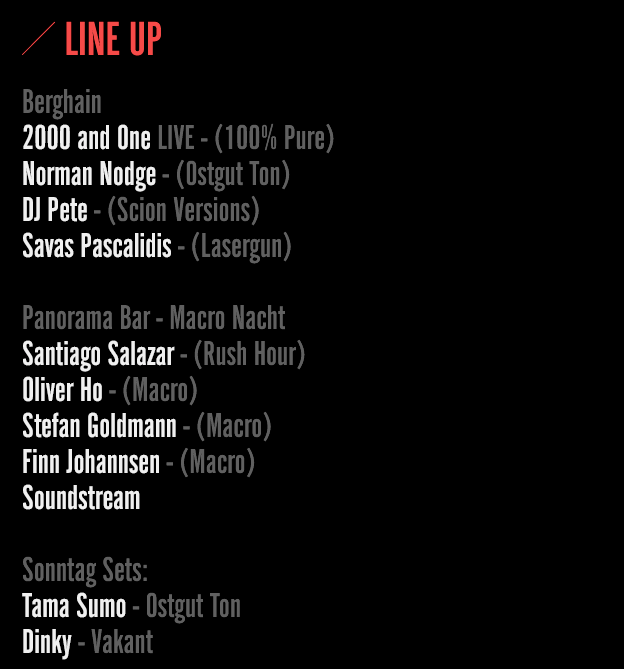
Santiago Salazar
Oliver Ho
Stefan Goldmann
Finn Johannsen
Recent Comments