Patrick Cowley & Jorge Socarras – Soon
Posted: September 7th, 2009 | Author: Finn | Filed under: Macro | Tags: Jorge Socarras, Patrick Cowley | No Comments »
MACRO M13 Patrick Cowley & Jorge Socarras – Soon
MACRO M13 Patrick Cowley & Jorge Socarras – Soon
> Love Unlimited Orchestra – Welcome Aboard (1981)
I found it interesting that this record sounded already a bit like what Metro Area were doing later on.
It is a very unusual track, especially for the time it was produced. There was not a lot then sounding like this. It almost has a housey touch, and a very beautiful atmosphere.
The track title is very telling, it is the perfect way to start a set.
Exactly, we did a show for betalounge.com once with Smith N Hack and used this as the first track.
The sound is very romantically space-like. Is this something you look for in disco? Some kind of futuristic touch?
Well, here it is a feature that definitely attracts me. I also like that it is so reduced. I like tracks that are special and unusual, like this. It is very straight, there is not too much happening in it.
Barry White kind of transformed his symphonic kitsch into something completely different with this production.
The beat almost sounds like it was sampled, very strange. I think it is a warm up bomb.
Your productions are normally not associated with sounds this mellow.
Yes, but this has this certain straightness to it, and I always like that. They hold this sequence for the whole track and just add strings and vocals, and the beat just goes on.
> El Coco – Cocomotion (1977)
This goes right back to your first Sound Stream 12”. I found it interesting that you just used a tiny weird loop, instead of its catchy bassline.
Yes, I often just get hooked on single parts and sample them. “Motion” was more like an edit. It is just a loop which then gets chopped up a bit. I like the loop because it holds the tension for so long, it’s very trippy.
But it is a very special approach to editing. You certainly were not aiming for authenticity or better DJ use.
It is kind of how it started. The first re-edits in Chicago for example. They looped bits and extended them until they developed a hypnotic quality. I think Ron Hardy initiated that. He rode a loop for several minutes and after a while it just sucked you in. This repetition also goes back to James Brown. His band played a riff for a while, then a break came on, and then it started all over again.
So you decidedly edit music to achieve a track-like quality?
Yes, definitely. With nearly all my productions I try to last long with little, and it is the same with other music I like. Simple tracks that don’t need much to hold attention for quite some time, instead of losing that after half a minute.
I remember hearing a Ron Hardy set a while ago, where he extended just the break part of Isaac Hayes “I Can’t Turn Around” for ages.
Yes, they reissued that tape edit recently. It sparked early house, like “Love Can’t Turn Around”. It is basically the same, they took the tape loop and replayed it with synthesizers, and some additional bassline and piano.
What do you think of edits that keep the arrangement of the original and just tweak the beats?
No. Something new has to be created in the process of editing. And as a DJ, I’d rather take a real drummer and fight my way through the timing. It’s funkier than a streamlined edit. That makes no sense to me. It’s okay if you have track with a wonderful part in it and then a break follows with guitars or something else you just don’t want to have. But an edit ultimately has to lead to something new.
Do you make edits for your sets?
I did a few. But they are secret. Read the rest of this entry »

> Ennio Morricone – Rodeo
This is from an old French movie soundtrack, „Le Casse“. I picked this for the string arrangement, because it puts a lot of emphasis on build-up, thus linking to the way Disco producers arranged strings for climactic dancefloor moments.
To be honest, I muss confess I don’t know Morricone’s works so well. I don’t think I have been a really big fan, partially because I don’t know it so well. My first impression of this track, which I didn’t know, was that it’s a formal composition. In my head I make a distinction between pop music, which has almost very definite rules, and people following it like Abba. It’s not formulaic, but there are very basic chord progressions that are based on Blues and Jazz that you can do in pop music and that have their own logic and their own progression. Many pop songs are actually the same song. “Good Times” by Chic is one kind of groove and twenty other songs sound exactly like it. It could be “Rapture” by Blondie or something. That’s pop music writing. And then you have soundtrack music writing and it has a different logic. It doesn’t have to follow a certain progression like in pop music, which has a reason and an impulse that keeps on pushing the song forward. When I heard this I thought it is a very good example of soundtrack music writing where you don’t really have to explain the logic of the chord progression, it just sets a mood. It makes an ambience. I think this is probably from 1967 to 71.
Good guess, it’s from 1971.
Because from 1972 on you start getting the big multi-track stuff, like Philly Disco and the more sophisticated pop, and this still sounds relatively simple. My first impression was it’s like a slightly cheaper copy of Burt Bacharach’s “Raindrops Keep Fallin’ On My Head”, but with more drama. It has some very formal devices, like it’s basically a minor key. But at some points he plays the same theme but he opens it up with a major key.
Lately all this beautifully orchestrated obscure library music back is popping up again and people scan back catalogues for songs groovy enough to suit a Disco context.
Yeah, that’s interesting, and I think there is a good reason for that. There is such a thing as real music, in the sense that there were people who did music for films, like Ennio Morricone, or Giorgio Moroder, with a more naïve use of the rules, or the very sophisticated Henry Mancini, or Alec Constandinos, or Vangelis, or Jean-Michel Jarre. All these people were obviously classically trained and they followed the rules. It doesn’t really matter if it’s a Bossa Nova, 60’s GoGo or a Disco beat, the rules of the music don’t change. I think that is why everybody is going back now to find real music. When people like Masters At Work appeared in the 90’s, people who didn’t know anything about the basic rules of music started making music. That’s why it sounds so awful, haha. A lot of the DJ produced music doesn’t have its own intrinsic logic and sense. And chords, progression and melodies have that intrinsic logic. That’s what’s been missing. So everyone of this generation who wants to find out what is really musical has to go back to the 60’s and 70’s, and there you find it everywhere actually.
> Carter Burwell – Blood Simple
This is from the soundtrack of the Coen Brothers debut film “Blood Simple”.
It’s from the 80’s I suppose.
Yes, it’s from 1987. It’s a mood piece with a synthetic feel to it.
I found the orchestration is simpler, but it’s similar to the previous song. Again, it’s not a pop song with intrinsic deep logic. Like Bach’s “Air On The G-String”, that is also some kind of pop music because it has a very definite logic. This one has a formal piano theme that sounds a bit like Erik Satie. Simple chord, simple melody, a little bit like Mozart’s “Eine kleine Nachtmusik”. It is not original, it is a formal piece, it follows a form that other people have created.
You could maybe alter its logic by just putting a beat under it, and by not adding much you would have a really moody dance track.
Yeah, actually this is the thing. To be honest, and many people are going to hate me for saying this, I’m not a big fan of Portishead. It’s very easy to make a mood piece. Anybody can do it. All you have to do is take a minor key and play some stuff over it, doesn’t really matter what. I think Portishead never even use a major key (laughs).
They don’t have to, really.
Yes. I think anybody writing good music should move between major and minor keys, that’s part of the magic. Since we now accept that some people make mood music, you can have a whole album of just melancholy. Personally, that doesn’t move me at all and I don’t find it very interesting. I think a lot of people in this generation think that this is a valid way to do music, for me it’s not enough. Salsoul records only have two or three keys but they do it so well, there are so many nuances.
I think the problem is that many people think they can only sound deep by using minor keys.
Yes, you’re right. That’s very true. If it’s not melancholy and it’s not moody then it’s not deep. Which is not true. That’s very profound what you just said. Read the rest of this entry »
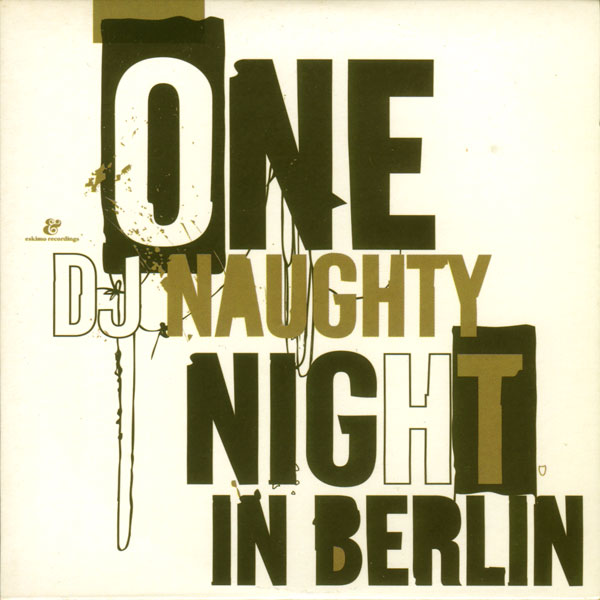
Der Alt-Gigolo mit dem schon immer etwas flexibleren Spektrum, sich der Hauptstadt im Mix annähernd. Inwiefern das jetzt repräsentativ ist, möge der interessierte Hörer im Vergleich mit dem favorisierten Club abgleichen. Laut Naughty verlangt der Anlass aufzuzeigen, wie schön sich neuerer Electro-House-Boompty der Marke Tiga, Vitalic, Ewan Pearson, M.A.N.D.Y., Thomas Anderson und ähnlichem mit ein paar originalen Perlen der elektronischen Seite von Disco und House aus der Jack-Phase verbinden lässt. Für den Sequencer in der Disco stehen hier eingangs einer von Rick James’ unbedarfteren Momenten (‚In My House’), Proto-Balihu-Space-Kitsch von Patrick Cowley (‚Sea Hunt’) und schöner Italo von Eleanor Academia, für Jack halten Bam Bam, J.M. Silk und das unverwüstliche Boller-Acapella von ‚Love Can’t Turn Around’ hin. Tatsächlich ergibt das durchaus Sinn, die Originale machen es vor und die Fortführungen berufen sich darauf. Etliche Tracks sind zudem von Naughty zweckdienlich editiert worden, Zeichen der Zeit erkannt. Unterstreicht die Auswahl der Old School-Tracks jetzt deren Zeitlosigkeit und die Auswahl der neueren Tracks deren legitime Nachfolgerschaft? Tatsächlich ist in diesem Mix die Anordnung und die Soundangleichung so weit fortgeschritten, dass ein zeitlicher Kontext keine wirkliche Rolle spielt. Auf der Basis kann man dann locker die geeigneten Eckpfeiler Disco, Synthiepop, Techno, Electro, Jack, EBM, Acid, Garage und Indierock (Chikinki in der Rolle des gewagten Ausreißers) zueinander führen ohne dass man gravierend ins Stutzen kommt. Das ist dann kohärent, funktioniert und folgt im angemessenen Umfang der gegenwärtigen diffusen Auffassung von Dancefloor-Glam. Ich weiß nicht, ob das Phuture-hafte MCing zwischendurch Naughty höchstselbst ist und ob das nur auf der Promo ist, fand ich charmant
De:Bug 10/05
Recent Comments