Berlin’s Finest Hunee schreitet auf seiner EP für W.T. auch als Produzent majestätisch die Ländereien zwischen Spezial-Disco und -House ab, die er als DJ schon seit geraumer Zeit gehörig im Griff hat. „Tour De Force“ ist ein verspulter Premium-Boogie auf Billy Frazier-Fundament, der sich mit einem beachtlichem Soundarsenal auf einen langen Weg macht, etliche Haken schlägt und dann unvermittelt in schönsten Lichtungen auftaucht. Bei „Cut Down Trees“ hüpfen die Beats und Basslines wie aufgekratzte Spatzen auf dem Telegraphenmast übereinander und werden periodisch von Abendsonne-Flächen gebändigt, und gute Freunde von Cajual und Relief grüßen im Vorbeigehen von unten herauf. Auf der anderen Seite der grandiose Tiefflieger „Rare Silk“, der sich in der Originalversion an Boo Williams, und im Remix an Chez Damier und Ron Trent anlehnt, und dabei verdammt blendend aussieht.
Orphx melden sich auf dem New Yorker Traditionslabel Sonic Groove zurück. Techno in dem es bös zur Sache geht ist zurzeit kein Feindesland mehr, es wird wieder gebollert und gefräst, wo vorher gepluckert und geklickert wurde. Im Vergleich zu der klassischen Phase in den Neunzigern sieht man es jetzt allerdings mit dem 4/4-Gebot nicht mehr so eng und hat dem Berlin-Dub-Update die Tür offen gelassen. Und so kommt er denn heraus, dieser zähe Grind, der vom unteren Drittel der Pitchleiste der Berghain-Decks aus in die Welt hinausging. Archaische Groove-Monolithen, die sich keine melodischen Kinkerlitzchen erlauben und mit strenger Methodik direkt dorthin vordringen, wohin sie wollen. Offensichtlich wissen Orphx ziemlich genau, wie man da vorgehen muss, aber sie haben sich auch noch zwei Remixer dazugeholt, die es definitiv wissen. Während Surgeon einen bratzigen Stepper bringt, neben dem brutalster Wobble-Bass wirkt wie eine wochenlang eingeweichte Lakritzschnecke, hat Pete aka Substance das Metronom angestoßen und lässt darüber metallische Geräusche in Dub rumoren, die klingen wie geisterhaft pochende Feldaufnahmen aus den Hochzeiten zerfallener Fabrikgebäude.
Peter Kruder – The Law Of Return (Macro) Red Sparrow – That’s The Way Of The World (United States Of Mars) Santiago Salazar – Arcade (Stefan Goldmann Mix) (Macro) Technose Distrikt – Untitled (Rush Hour) Katelectro – Plug (Ultradyne Remix) (Mighty Robot Recordings) DJ Sneak – Fear The World (Defiant) Reggie Hall – I’ll Keep On Workin’ You (Urgent Music Works) The Pig – Are You…? (Rush Hour) Aaron Carl & Benjamin Hayes – The Struggle (Remix By The Plan) (Wallshaker) DJ Sprinkles – Sloppy 42nds (Glorimar’s Deeperama) (Mule Electronic) Raudive – Tul (Macro) Pépé Bradock – 100% Coton (Kif Recordings)
As a respected journalist, in many ways you educate your readers. Would you say that this comes across in your DJ sets as well?
To a certain extent. In the days before the internet made all sorts of musical knowledge easily accessible it was more important, because apart from what you could gather in the print media and some specialist TV and radio programs, the DJ at the club was the one to offer the glimpse of what was going on. I have benefited a lot from the skills and taste of DJs like Klaus Stockhausen and others back then, who knew what music really mattered and who also knew how to best spread their knowledge as an intense party experience. If that works, it is the perfect way of learning about music. I was always interested in the historical context of culture and I like to connect the dots between prototypes and later developments and so in the past I felt the need to adopt that, playing a lot of records I felt missed out on the deserved recognition along better known stuff, in order to make people wonder and dance at the same time. I still do that, but now a lot of the rare records I would say are worth discovering are very likely to be discussed on specialist boards anyway, and you can easily gather the information with a few clicks that once took quite a while of digging and research. But this inevitably led to DJing with a mere collector’s approach, which often results in a showcase of rare items and not in a good party. I also don’t like when such sets are presented like the real deal and authentic, as I have been around clubs for a long time now and DJs playing whole nights of just obscure music were the absolute exception. I am very aware of the privilege of having been there when some the music people still dance to today was in early progress, and so I like to play older records like I remember them being played at the time they were introduced. And of course I use the web myself to learn how pioneering DJs played certain records in certain clubs. That is not obliging for how I choose the records for the night, but it satisfies my curiosity. I always make a few steps forward and a few steps back with what I play, and I reserve the specialist program for radio shows and mixes I make or get asked for. For gigs, the way I put my record box together has always been the same, I just pack the tracks that I would like to dance to if I was attending the club the same night, and that’s it.
Tell us a bit about Macro and the label’s plans for the future.
Macro was conceived by Stefan and me to be both a platform for his productions and other music we like, with no artistic and stylistic restrictions apart from a high quality standard. We just wanted our label releases and identity to stand out via artwork and concept from other output we deemed interchangeable and risk-free. Thankfully our ideas caught on so quickly that we got approached by other artists and producers we admire who like the idea of releasing on a label that is laying emphasis on individuality and some lasting impressions instead of just exploiting the trends of the season. You can hear some of the results in this mix. There is a track from our first release this year by Oliver Ho as Raudive, Stefan’s stunning remix of Santiago Salazar’s “Arcade”, which is about to hit the shops, and a track from the forthcoming 12″ Peter Kruder produced for us. Furthermore Stefan’s edit experiment with Stravinsky’s “Le Sacre du Printemps” is going to be released in early June and later this year we will unleash a very special album project with an accompanying series of 12″s, the preparations of which have kept us well busy and buzzing with anticipation since last year. We think it is quite a sensation.
You are known for fusing Disco and Classics in your DJ sets. What changed in your approach for the Sweatlodge set?
I still play a lot of sets where I combine Disco and other related older genres with modern electronic music, but I don’t want to do so per se. I like to treat every set as a new position, be it topical, stylistically or based on a certain purpose. This is basically an excerpt of some favourite sounds I play at the moment as a DJ representing Macro. A hopefully coherent mix of old and new. On another day it could have turned out to sound completely different, but this is how I felt it should be at the time I dropped the needle on the first record. Generally, I have a lot of records to choose from and I try to make good use of that.
Where have you played in the past that you would really want to re-visit again?
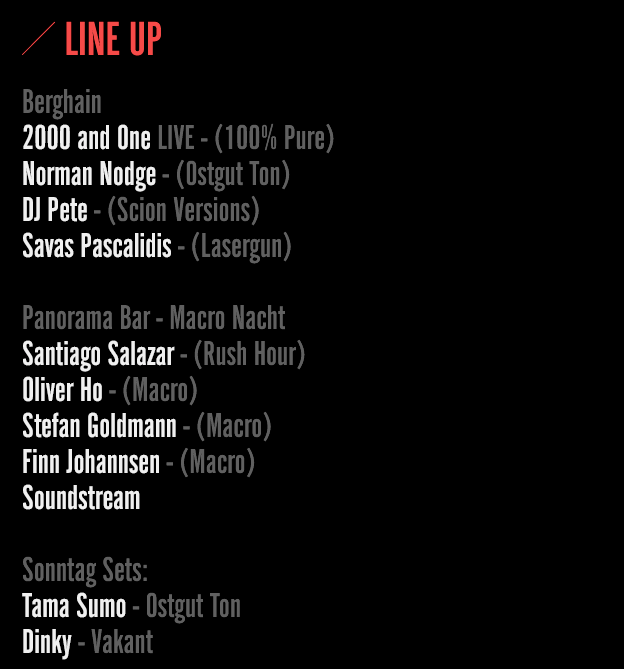
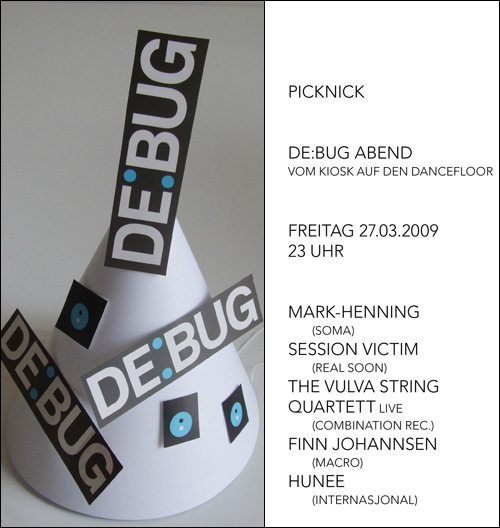
We just had our first label night at Panoramabar, and that was predictably an experience I very much look forward to repeat. I also did a nine hour plus back-to-back Disco set with Hunee last Summer at Picknick’s yard which was quite immense and shall happen again. Berlin is buzzing with great clubs, partys, DJs and devoted dancers at the moment, but I have no preferences but a good night out, and I have no doubts I will have some of that for the rest of the year. I’m also looking forward to some gigs lined up beyond Berlin, because I like to travel around and witness some other cities and the according scenes. We’re also working on taking the label out for some dates, and I happily await some fine experiences lying ahead of me with that.






Recent Comments