Posted: September 9th, 2008 | Author: Finn | Filed under: Interviews Deutsch | Tags: de:bug, Interview, Motown, Radio, Recloose | No Comments »

Du bist zurück mit einem neuen Album, und es ist randvoll mit Referenzen an 80er-Electric Funk, Prince-Rhythmuspattern, Motown-Melodien. Wie ist es dazu gekommen?
Ich glaube das war ein Nebenprodukt davon in Neuseeland zu leben und diesen Sound zu vermissen, weil er sehr präsent in Detroit war. Es gibt viele entsprechende Radioshows, Clubs wo diese Art Musik gespielt wird, Fernsehshows. Ich habe diesen Sound vermisst, weil er in Neuseeland nicht besonders groß ist. Auch älter werden und sich an die Kindheit erinnern. Es spielt auch Nostalgie mit dabei, sich hinzusetzen und zu beschließen einen Prince-Sound nachzubilden und das ganze Programm.
Den Funk zurückbringen.
Ja, genau. Der Sound hat mir gefehlt, es war ein bisschen zu meinem eigenen Vergnügen. Read the rest of this entry »
Posted: August 29th, 2008 | Author: Finn | Filed under: Interviews English | Tags: Anthems, Arthur Russell, Berghain, Berlin, Burt Bacharach, Chicago, Daniel Wang, Deep House, Ennio Morricone, Ghostly, Greg Wilson, Groove, Hamburg, Hercules & Love Affair, Interview, Jeffrey Sfire, Larry Heard, Masters At Work, Motown, ND Baumecker, Nicolette, Nicolette Larson, Patrick Cowley, Pet Shop Boys, Playing Favourites, Radio, Resident Advisor, To The Bone, Vocals | No Comments »

> Ennio Morricone – Rodeo
This is from an old French movie soundtrack, „Le Casse“. I picked this for the string arrangement, because it puts a lot of emphasis on build-up, thus linking to the way Disco producers arranged strings for climactic dancefloor moments.
To be honest, I muss confess I don’t know Morricone’s works so well. I don’t think I have been a really big fan, partially because I don’t know it so well. My first impression of this track, which I didn’t know, was that it’s a formal composition. In my head I make a distinction between pop music, which has almost very definite rules, and people following it like Abba. It’s not formulaic, but there are very basic chord progressions that are based on Blues and Jazz that you can do in pop music and that have their own logic and their own progression. Many pop songs are actually the same song. “Good Times” by Chic is one kind of groove and twenty other songs sound exactly like it. It could be “Rapture” by Blondie or something. That’s pop music writing. And then you have soundtrack music writing and it has a different logic. It doesn’t have to follow a certain progression like in pop music, which has a reason and an impulse that keeps on pushing the song forward. When I heard this I thought it is a very good example of soundtrack music writing where you don’t really have to explain the logic of the chord progression, it just sets a mood. It makes an ambience. I think this is probably from 1967 to 71.
Good guess, it’s from 1971.
Because from 1972 on you start getting the big multi-track stuff, like Philly Disco and the more sophisticated pop, and this still sounds relatively simple. My first impression was it’s like a slightly cheaper copy of Burt Bacharach’s “Raindrops Keep Fallin’ On My Head”, but with more drama. It has some very formal devices, like it’s basically a minor key. But at some points he plays the same theme but he opens it up with a major key.
Lately all this beautifully orchestrated obscure library music back is popping up again and people scan back catalogues for songs groovy enough to suit a Disco context.
Yeah, that’s interesting, and I think there is a good reason for that. There is such a thing as real music, in the sense that there were people who did music for films, like Ennio Morricone, or Giorgio Moroder, with a more naïve use of the rules, or the very sophisticated Henry Mancini, or Alec Constandinos, or Vangelis, or Jean-Michel Jarre. All these people were obviously classically trained and they followed the rules. It doesn’t really matter if it’s a Bossa Nova, 60’s GoGo or a Disco beat, the rules of the music don’t change. I think that is why everybody is going back now to find real music. When people like Masters At Work appeared in the 90’s, people who didn’t know anything about the basic rules of music started making music. That’s why it sounds so awful, haha. A lot of the DJ produced music doesn’t have its own intrinsic logic and sense. And chords, progression and melodies have that intrinsic logic. That’s what’s been missing. So everyone of this generation who wants to find out what is really musical has to go back to the 60’s and 70’s, and there you find it everywhere actually.
> Carter Burwell – Blood Simple
This is from the soundtrack of the Coen Brothers debut film “Blood Simple”.
It’s from the 80’s I suppose.
Yes, it’s from 1987. It’s a mood piece with a synthetic feel to it.
I found the orchestration is simpler, but it’s similar to the previous song. Again, it’s not a pop song with intrinsic deep logic. Like Bach’s “Air On The G-String”, that is also some kind of pop music because it has a very definite logic. This one has a formal piano theme that sounds a bit like Erik Satie. Simple chord, simple melody, a little bit like Mozart’s “Eine kleine Nachtmusik”. It is not original, it is a formal piece, it follows a form that other people have created.
You could maybe alter its logic by just putting a beat under it, and by not adding much you would have a really moody dance track.
Yeah, actually this is the thing. To be honest, and many people are going to hate me for saying this, I’m not a big fan of Portishead. It’s very easy to make a mood piece. Anybody can do it. All you have to do is take a minor key and play some stuff over it, doesn’t really matter what. I think Portishead never even use a major key (laughs).
They don’t have to, really.
Yes. I think anybody writing good music should move between major and minor keys, that’s part of the magic. Since we now accept that some people make mood music, you can have a whole album of just melancholy. Personally, that doesn’t move me at all and I don’t find it very interesting. I think a lot of people in this generation think that this is a valid way to do music, for me it’s not enough. Salsoul records only have two or three keys but they do it so well, there are so many nuances.
I think the problem is that many people think they can only sound deep by using minor keys.
Yes, you’re right. That’s very true. If it’s not melancholy and it’s not moody then it’s not deep. Which is not true. That’s very profound what you just said. Read the rest of this entry »
Posted: July 9th, 2006 | Author: Finn | Filed under: Interviews Deutsch | Tags: de:bug, Interview, Merchandise, Motown, Radio, Timmy Regisford | No Comments »
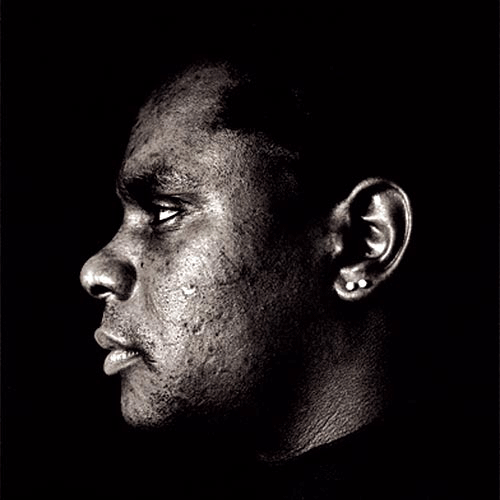
Wie fühlt es sich an, ab und zu den angestammten Platz zu verlassen? Kann man das Shelter verpflanzen?
Ich mag es, gelegentlich New York zu verlassen und woanders aufzulegen. Es gibt weltweit mittlerweile immer mehr Leute, welche die Art von Soulful Music mögen, für die das Shelter steht. Ich habe auch eine Residency in Los Angeles und regelmäßig Auftritte in Japan oder England. Ich habe zudem einen Wohnsitz in Amsterdam, weil ich die Stadt einfach liebe und auf Jamaika, wo ich ursprünglich herkomme. In Deutschland war ich bisher nur einmal mit Stevie Wonder, dass hatte sich sonst einfach nicht ergeben. Ich kann mir aber gut vorstellen, öfter hier zu sein. Mir gefällt die Idee von fixen Außenposten fernab des ursprünglichen Clubs. Das reizt mich als Herausforderung. Es wäre schön, weltweit Basen für den Shelter-Sound einzurichten, daran würde ich mich gerne beteiligen. Mal sehen, wie sich das entwickelt.
Wie unterscheiden sich dann solche internationalen Auftritte von einer Nacht im Shelter? Muss man das musikalische Programm den Trends im jeweiligen Land anpassen?
Ich muss mich eigentlich gar nicht anpassen. Ich werde als Repräsentant des Shelter gebucht und ich spiele nur Platten, die ich auch dort auflege. Ich bekomme mit, was in den Clubs anderswo läuft, aber mir ist das oft zu hart, damit kann ich nicht viel anfangen. Ich achte auch nicht auf die ganzen Kategorisierungen, für mich ist das alles Dance Music und davon interessiere ich mich nur für die Art von Musik, die Deepness, Soul und vor allem Identität hat. Aus welchem Land oder von welcher Hautfarbe ist egal, es muss nur passen. Manchmal ist ein Set nicht so wie in New York, weil ich nicht soviel Zeit habe. Übermorgen lege ich beim Southport Weekender in England auf, da habe ich einen zweistündigen Spot. Dabei brauche ich meistens drei Stunden, bevor ich mich wohl fühle. Ich werde das daher nutzen, um unveröffentlichte Sachen zu spielen, aber ich ziehe einen anderen Rahmen vor. DJing war nie mein hauptsächlicher Lebensunterhalt. Ich war deswegen auch nicht gezwungen mehr herumzureisen als ich wollte. Das Shelter ist wie mein Wohnzimmer, da ist alles so, wie ich es haben möchte. Alle meine Platten sind da, die Anlage habe ich mir zusammengestellt und so weiter. Und mir gehört der Club, ich kann machen, was ich will. Ich lege hauptsächlich Soulful Dance Music auf, aber ich kann auch afrikanische oder brasilianische Musik spielen, Jazz, Blues. Wenn ich merke, wofür die Leute bereit sind, habe ich viel Spielraum. Das Shelter hat einen familiären Vibe, es geht nicht um Drogen oder Hipness, nur um Musik. So geht das Woche für Woche. Wenn ich mal nicht da bin, so wie jetzt gerade, legt Sting International auf, sozusagen mein Protegé. Es hat ein bisschen gedauert, bis die Leute mit ihm warm geworden sind, aber jetzt geht das sehr gut. Read the rest of this entry »
Posted: November 7th, 2005 | Author: Finn | Filed under: Rezensionen | Tags: de:bug, Kenny Dope, Mixtape, Motown, Rezensionen | No Comments »

Wenn die ganzen flinken Deckchamps sowieso auf Horden von Mixtapes Beats unter die Originale schrauben und die Editierwut längst den Backkatalog erreicht hat, kann man die Aufpolierung ja auch offiziell in Auftrag geben, mit Betonung auf poliert. Wie dann zu erwarten war, haben Talkum-Soul-Traditionalisten hier wenig zu lachen, Barhocker-Soul-Nicker um so mehr. Für letztere wurde auch sichergestellt, dass nicht allzu viele Tracks aus dem gesicherten Chart-Hit-Kanon herausfallen und dass bei einigen Uptempo-Originalen die verschwitzte Energie soweit gedrosselt wird, dass nix überschwappt. Bei dieser wie auch anderen Remix-Retrospektiven liegt der Schwerpunkt auf der funkigen Seite, dass lässt sich so gut ins heutige Soundspektrum rüberholen. Übrig bleibt zumeist ausreichend sich verbeugender Vibe, aber meistens so gut abgehangen, dass man nach dem reichlichen Essen einen Kurzen haben möchte. Tagessieger erwartungsgemäß Kenny Dope gegen Gladys Knight und DJ Spinna gegen Eddie Kendricks, im breiten Mittelfeld Paul Simpson, Jazzy Jeff, ?uestlove, Z-Trip und andere. Für Deutschland überrascht DJ Friction mit einem handlichen Jackson 5-Acapella und die Marketing-Abteilung hat sich für die Weihnachtsfeier mit Turntablerocker gegen Edwin Starr einen Wunsch erfüllt.
De:Bug 11/05
Posted: August 9th, 2005 | Author: Finn | Filed under: Interviews Deutsch | Tags: de:bug, DJ Minx, Interview, Juan Atkins, Motown, Mr. V, Radio | No Comments »

Was war der Ausgangspunkt für die Enstscheidung in der Detroiter Musikszene aktiv zu werden?
Der Entschluss DJ zu werden war von meinem grundsätzlichen Interesse an Musik bestimmt, in allen Facetten. Ich begann mich für elektronische Musik zu interessieren aufgrund stilistischer Merkmale und vor allem wegen der Art, wie diese Musik die Leute berührt hat. Wo sonst bekommt man schon eine solche Bandbreite an Genres, alle zusammengefasst in einem Groove mit derartig viel Schwung? Platten wie Mr. Vs ‘I Got Rhythm’ oder Mike 303s ‘St. Sylvestre’ bleiben wohl ein Leben lang in meiner Kiste.
Du hast diverse Radiosendungen gemacht, unter anderem das weithin bekannte Format Deep Space Radio. Was für Kontakte und Einflüsse kommen aus diesem Zeitraum?
Kevin Saunderson war ein maßgeblicher Einfluss. Er hat mich immer unterstützt, zuerst gefiel ihm meine Radio-Stimme, dann respektierte er auch meine ganzen sonstigen Aktivitäten. Wenn Leute aus anderen Ländern Detroit einen Besuch abstatteten, brachten Derrick May und Juan Atkins die Zeit auf, sie für ein Treffen mit mir ins Studio zu bringen. Read the rest of this entry »
Recent Comments