In early 2004, I was occupied with the confusing and chaotic last stages of leaving my cozy and beloved seaside hometown Kiel up north for the bright lights of Berlin. My girlfriend was already there for a while, and I was more than happy to live with her again, but at the same time I was very sad to leave my family and friends behind for what was very likely to be a move for many years and a future uncertain. One of those said friends was the one who operates under the Gram moniker, a likeminded soul with whom I shared a lot of cultural interests and lasting experiences, and with whom I wholeheartedly clashed heads over what we could not agree upon in many nights of smart conversations (and more often than not far less smart amounts of drinks and cigarettes).
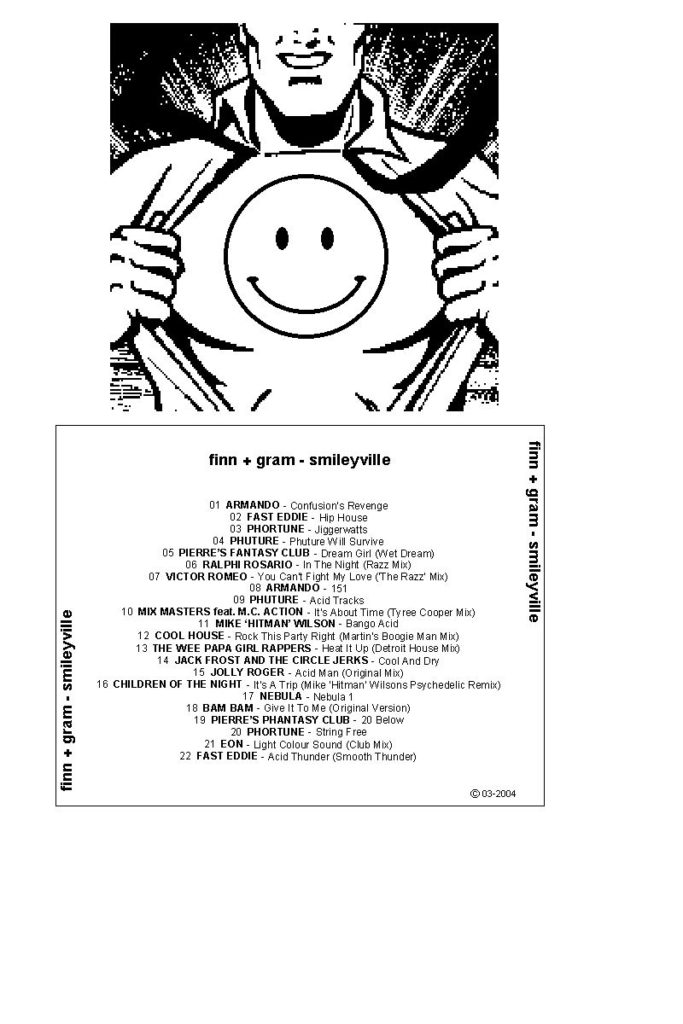
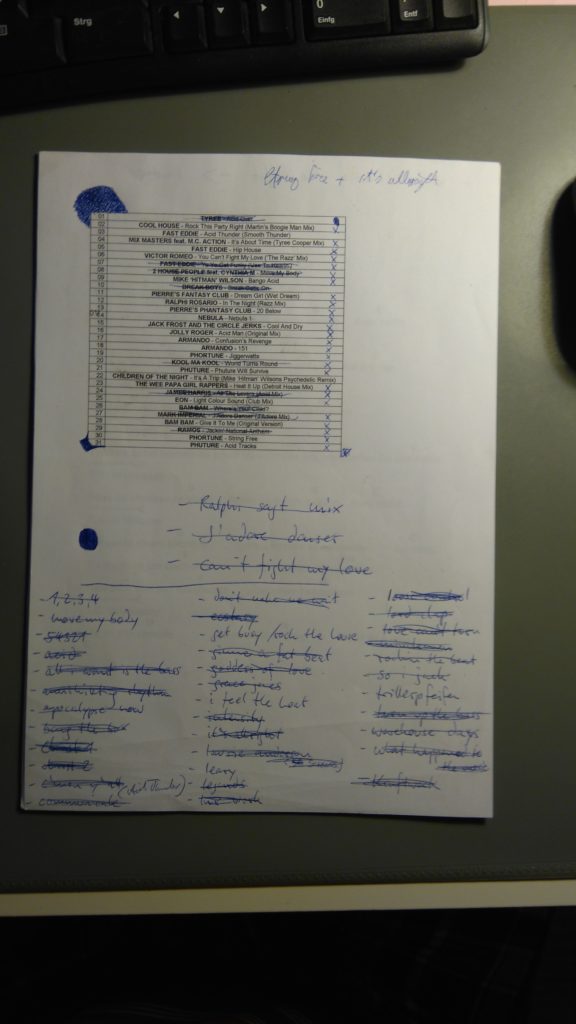
As it became clear to the both of us that we would not see each other as much again for quite a while, we were toying with the idea of recording a mix together. Some kind of final joint venture for the time being, a testament to both our friendship and music we both loved. At that point we had a few discussions about digital mixing devices, Ableton and the likes were on the upswing, and he was dabbling in a few track productions on the computer and was more open to the idea than me, as I was pretty determined to not abandon my turntables for this kind of progress. But then I felt it would be a good opportunity to try something I had not tried before, particularly instead of criticizing a method I only knew in theory. So we soon agreed to embark on the endeavour of a digital mix that should at best use what seemed to be the ultimate advantage over a setup with two turntables, meaning the use of multiple tracks and the ability to insert more sounds than you could with two records playing at once (no, I’m no turntablist). The problem was that we had no Ableton or similarly advanced mixing software at hand. Among the programs Gram knew his way around was Cakewalk, which at the time was already vintage, to say the least. We soon realized that the only way for us to do it was to combine analogue hardware with it. The idea for the source material was quickly agreed upon. I had vivid memories of the Acid House glory days, and I was miffed about how revivalists were mostly only clinging to 303 sounds whenever the genre came back into the spotlight, whereas I always experienced Acid House as template for parties that incorporated diverse styles, and not only one. So basically we wanted to use landmark records of that era with a bit of stylistic leeway left and right and play them like we felt they should be played: energetic, raw, the archetypical aural rollercoaster ride. With this in mind I browsed my record collection for the basic tracklist and also for what should be the added value of the enterprise: a whole plethora of acapellas, samples, vocal snippets from records and movies, sound detours, intros and outros, all coming from different angles. We narrowed down the selection to how much we would need to match the typical CD length, and to how much elements we could inject into a track without drowning it, and then we chose a basic record and a basic tempo (Tyree’s “Acid Over”, which strangely then did not make it to the final tracklist later on) and I pre-mixed all in sync with it on two Technics MKs and we recorded each single track and snippet onto the computer afterwards. I don’t recall how many tracks of the program we could fill with all those recordings, but for me, who rarely used more than three channels on a mixer, it sure looked impressive. What also impressed me was the hours it already took to finish this first stage of the mix. And it was only preparation still.
When we then started to structure all the single components into a whole, it took way more time. For more than one month, we met several times a week and spent hours from early evening to early morning trying to work out the best sequence for our material that we felt we were capable of. I must add that I’m hardly a perfectionist and a studio boffin even less, but my collaborator was, and that fit like a glove with my enthusiasm for the idea and my many years of DJ experience. In fact, despite barely managing to complete more than one or two track sequences in several hours of work, it felt like we were already exploring the atoms of everything we used, and then splitting it into even smaller fractions, and it felt like a strange universe on its own. Frequently, we took a break, stepped back from the monitor and listened thoroughly to what we just did, and how it worked with what we did before, like a painter studied what ended up on the canvas (I’m not getting carried away). And it was like we’ve created a monster, too. Something that spiralled out of control. Something that seemed more out of reach in terms of finishing it with every little step we took. But then again, every small step, however long it took, seemed to lead to something we had not expected. New opportunities came to mind that led to the deletion of the ones not considered as good anymore. There were setbacks, detours, fresh and false starts, bad ideas. And there were leaps of faith, open sesames, sudden solutions, good ideas (I’m not getting carried away again). For the work on something as functional and purposeful as a recorded mix, it was pretty intense. When we finally stuck the outro to the last track, and gave the whole thing a final listening, we were surprised with how fresh and accomplished it sounded, and how little of all our efforts were apparent. We conceived artwork to complement the listening experience, and we were done with it. We were ultimately satisfied with the result. Of course anyone with enough skills could have come up with something equally or more engaging in realtime, thus sparing oneself the ridiculous amount of time we spent on it. But that was not the point. The point was to spend this ridiculous amount of time on it, together. Not caring if somebody would ever appreciate what and how we did it (and also secretly hoping somebody would). Not knowing if the dam we built would hold.
But it did. Time went by, and we are still very good friends, and still living in different cities. We never recorded something together again, but we sometimes speculate what it would have sounded like if we would have. I have never recorded a digital mix again, being too impatient and feeling too uncomfortable with anything else than two turntables. Gram, however, went on to record a few other fine mixes with the same dated setup. We both are still very proud of “Smileyville”. For us, it has stood the test of time, like the music it contains.
You are a well respected music writer writing for publications like De:Bug, RA and your own blog (among others). Has music writing always been part of what you do, and what came first? The writing or the djing?
I write about music in public since the mid-90’s, and I started playing out in the late 80’s, so definitely DJing came first. My output as a writer has also been not as prolific as it turned out to be after I moved to Berlin in 2003. I knew Jan Joswig, the fashion editor at de:bug at that time, from former days in my hometown Kiel and he asked me to contribute. I started out writing reviews and then turned to features and especially interviews, some of which got quite some attention. So that eventually led to writing for other print and web publications too, like doing the “Playing Favourites” series for Resident Advisor, my “Rewind” series for sounds-like-me.com, Groove Magazine, and a lot of other media. The Website you’re referring to is not a blog in the sense that I write about everything that goes through my head, it is more like fragmentary online archive of my activities from the 90’s until now. Writings, Mixes, Gigs, the label, and a plethora of other things. It is not that I’m that vain to want everybody to know what I do and did, it is kind of a reminder for myself that others can follow if they like. Excuse the irregular updates at this point, but I slowed down all said activities a bit to have more time for my lovely wife and daughter, and I took up working at Hard Wax, too. Consider me well busy.
Can you please tell our readers what is D*ruffalo and who stands behind it?
I can’t possibly tell, at least not anymore. When D*ruffalo was unleashed 4 years ago, it was some sort of a media experiment initiated by a semi-anonymous collective of writers, producers and DJs based in several German cities, intended to be a platform to share love for what should be loved, free of any conventional restrictions. Soon some lack of love for what was deemed not as loveable showed up as well, but basically it was conceived to be the Fort Alamo of sincerity. Decidedly non-ironical, accidentally post-cool and fiercely anti-hype. At some point The D*ruffalo Hit Squad and the according Druffmix series was brought to life, to shine a light on music no light shined upon. But it totally spiralled out of control. I don’t know what it is right now, or if I am still a part of it even. But apparently D*ruffalo celebrates its sheer existence and the 50th Druffmix with a party at Berlin’s Soju Bar on February 11, and there are negotiations about a regular residency there. If the unpredictability and confusion of the D*ruffalo members allows. Which is probably unlikely, maybe. I can’t possibly tell.
You are running Macro Records together with Stefan Goldmann. How’s the process been running a label and what can we expect from Macro in 2011?
When we founded Macro we decided to only release music we find worth releasing, at the potential risk of longer stretches with no releases at all. But then the label took up so much momentum that we now have more releases lined up for this year than in the years before. March will see a new EP by the rather sensational Elektro Guzzi and Stefan’s magnificent “The Grand Hemiola” 2×12″, you can hear excerpts of both in the mix I recorded for you. We will follow that up in April with a live album by Elektro Guzzi and a compilation of the late works of the composer and conductor Friedrich Goldmann, Stefan’s father, who sadly and much too early passed away in 2009. We are also in the process of preparing several other projects for later this year, which are not yet ready to be unveiled, but well worth waiting for. We worked very hard to achieve a position in which we can do whatever we want, and as long as this strong support will stay with us, we will do just that. Expect the unexpected.
You’re known for your eclectic dj sets. What can you tell us about this set you prepared?
My sets, be it in a club or radio context, can be quite diverse, that’s true. But I don’t believe in eclecticism per se. Meaning, I don’t want to attract opposites just for the sake of it. If you neglect a certain coherence, structure and narrative you will end up sounding like a jukebox, however interesting it might be musically equipped. I like thinking of a concept when doing a mix, as subliminal or not it might be. With this one, I just intended to combine an experimental streak with a dancefloor functionality, while providing a glimpse of unreleased Macro material and tracks of artists I consistently admire, and tracks I still find as interesting as the day I first heard them. Which in the case of this playlist, was not too long ago. At any other time the set would probably have sounded differently, but this was what I then had in mind for this purpose and I hope it makes as much sense to the listeners as it made to me when I recorded it.
Stefan Goldmann – Mining The Vein / The Grand Hemiola Raime – This Foundry (Regis Version) Shackleton Vs. Kasai Allstars – Mukuba Special Theo Parrish Ft. IG Culture – Traffic Elektro Guzzi – Boom Room Margaret Dygas – Hidden (NSI Mix) Farben – Kursbuch 1&2 Son Of Sam – Nature Makes A Mistake (Âme Mix) Marco Bernardi – Klinsfrar Melode (Sprinkles Deeperama) WK7 – Higher Power (Hardcore PCK Mix) Pinch – Croydon House
Yes, almost ten years since I left England. The reason was not by my design. I was enjoying America so much that I overstayed my visa. If I was to leave, I would have not been allowed back for another five or ten years and I was planning on making my life there. And only a year and a half ago I got married and applied for my green card. And I now have the green card, and my work visa and my right to travel and re-enter the States. So here I am, back in the world. I recently completed a big tour of Japan and I’m on a major tour of Europe right now.
You got married and still it took such a while to get your green card?
Well, actually the process is a lot quicker now than it used to be. From the time I put my application in it was actually only four months until the card came through. Since 9/11 the background check is a little more stringent, but the whole process is now centralized, instead of the department in Washington, and the department in Detroit and so on. There’s one computer, and if you fit the criteria then it’s all good.
So you spent all those years of your self-imposed exile just playing in the States?
Yes, but on a regular basis. America is a big place. And I have a regular circuit. Starting on the Northeast coast, Detroit, Chicago, New York City, Philadelphia, Washington, Miami, then skipping over to the other side, San Diego, Los Angeles, San Francisco, Boulder and Seattle. And that’s not even including Hawaii. So that’s plenty of work, even if I do that once every couple of months.
But your main bases are Hawaii, Los Angeles and New York City?
Basically yes. My most regular gigs would be there.
Would you say that these are also the cities where your music fits best? Is there a better scene for what you play?
Everywhere I play people come to hear me play. I regularly play in Miami for the Winter Music Conference and Art Basel, that’s my two gigs a year mainly there. Towns like San Diego and San Francisco have a scene, too. Most of the places have a scene as such. It’s not the biggest scene, but with all the internet communication and stuff like that it’s small but healthy.
And since you are allowed to travel again, is it some kind of relief and you accept many gigs abroad?
Not really. It is nice to travel and just to have the freedom. I haven’t been around for ten years so it’s nice to pop out and go to Japan and Europe again. But I don’t plan to spend the next ten years on the road. There are a lot of opportunities, basically everywhere I ever played before plus twice as many places again.
How does it feel to get out again? Has the scene changed in the meantime?
I don’t think it has changed at all.
Is that disappointing?
No, that’s not disappointing at all. I always had a good time. There are certain focuses on particular kinds of music over the years, whether it’s Electroclash, or Minimal, or Drum ‘n’ Bass, but in general the dance music scene still goes bang bang bang between 110 and 130 bpm. And I don’t really see boundaries between the so-called genres. I play the music that I like, whether it’s a Techno record, or a Disco record, or whatever. I think more than the music has changed the people have changed. Kids that weren’t born when I was DJing in the mid 80’s are now in their mid 20’s, there’s a whole new generation of people who have come through as well as the survivors from the old school. The formula of a dance party is still very similar. I suppose communication via internet had an impact. Even though I have been away for ten years people know exactly what I have been doing. It’s not like I completely disappeared during that time. The networking has made sure that my influence via production or gossip has been maintained.
I think the internet helped to keep your status alive. All you did was thoroughly discussed on specialist websites and message boards. I guess this is quite different to how it was before.
Yeah. Scenes used to be localized, and now it’s globalized. Which is good and bad. If something fresh happens in a small area it doesn’t have time to develop, it is instantly global. Early Punk or Hip Hop had two to five years a hardcore scene as such. Whereas now, as soon as there’s a bright idea it’s everywhere in the world and everyone’s had a piece of it before it maybe manages to have a big foundation.
Nowadays it might also be easier to get influenced by another DJ, or even to imitate somebody. In pre-internet days you could maybe get your hands on some mixtape, but it was difficult. Maybe you read about DJs, but you never had the chance to hear them. And now you can download tons of sets from legendary DJs, and from legendary clubs, too.
Yeah. I think that’s good and bad, too. These days I don’t let people record my sets. I suffered from heavy bootlegging. And a lot of the time when I play it’s for that moment. Maybe you’re sitting in your car, listening to a set, but you have no idea of the atmosphere or the climate at the moment when the record was being played. The tape might sound bizarre or disjointed or strange and it might not particularly work in the car or the boutique or at home. But at the particular moment, that was the right thing to do. So I try and keep my sets for the people who were there and it’s for memory banks only.
So you think it gets watered down?
It’s a double-edged sword. Sometimes there’s a little bit too much access. Some of the mystery is gone. If you think of DJs like Ron Hardy, I’ve only see one small grainy photograph of him, and you wonder who this guy is and what his character is. If you want to find about me, just hit Wikipedia, DJ Harvey images, and you know what I look like, my style. But there is a little mystery to who or what I am and I quite enjoy that. Luckily the personal appearance still counts for something. Because they have had absolutely everything besides me physically. And here I am, in the flesh, I actually exist. I’m not just this digital entity. Read the rest of this entry »
Im Gespräch mit Marcel Dettmann über “Ich und die Wirklichkeit” von Deutsch Amerikanische Freundschaft (1981).
Die entscheidende Frage zuerst, wie bist Du zu DAF gekommen?
Ich komme aus dem Ostteil Deutschlands, und nachdem man zu DDR-Zeiten nur Depeche Mode, Madonna oder Prince hatte, die richtig dicken Pop-Acts, kam kurz nach der Wende ein ganzer Schwall von Musik, wie z. B. auch DAF, Throbbing Gristle oder Front 242, später auch Nitzer Ebb. Der Bruder eines Freundes von mir hat uns ständig mit CDs ausgerüstet, da war ich 12, und habe das erste Mal DAF gehört und fand das total verrückt.
Du hattest vorher nie von ihnen gehört?
Nein. Ich hatte vorher Ultravox, Erasure oder Depeche Mode gehört. Poppige Sachen. Und dann kamen DAF oder auch Nitzer Ebb, was ja artverwandt ist, sie waren ja quasi die englische Version von DAF. Wir hörten „Der Räuber und der Prinz“ und „Der Mussolini“ auch im Jugendclub, der von vier Uhr nachmittags bis abends um zehn offen hatte. Dort wurde in Runden gespielt, eine Runde für die Hip-Hopper, eine Runde für die Elektronikleute usw. Read the rest of this entry »
Im Gespräch mit Ralf Schmidt über “Songs Of Leonard Cohen” von Leonard Cohen (1967).
In jüngeren Jahren kannte ich Leonard Cohen weitestgehend aus dem Radio, meine Mutter hatte zwar Platten von ihm, die ich aber lange Zeit ignoriert habe. War es bei Dir auch so eine Inspiration aus der elterlichen Plattensammlung?
Definitiv, das war eine der ersten Sachen mit denen ich musikalisch in Berührung kam, schon als sehr kleines Kind. Vor allem meine Mutter hörte und hört immer noch gerne seine Musik. Diese frühe Prägung ist sicherlich einer der Gründe, weshalb mich die Musik von Leonard Cohen so berührt. Natürlich hatten meine Eltern auch noch andere Platten im Schrank stehen, die mir nicht so sehr ans Herz gewachsen sind – es gibt also noch andere Gründe, aus denen ich mich für Cohen so begeistern kann. Welche das sind – ich kann es nicht genau sagen. Ich glaube auch, wenn ich es genau wüsste, wäre die Begeisterung nicht so groß. Die wirkliche Beschäftigung mit Cohen kam auch erst, nachdem ich schon lange von zu Hause ausgezogen war. Damals gab es für mich eigentlich nur HipHop, Soul & Funk und elektronische Musik.
Auch wenn man sich anfänglich nicht für Leonard Cohen interessiert, wenn man ihn einmal gehört hat, erkennt man ihn sicherlich immer wieder. Seine Stimme, und seine Art Songs zu schreiben sind schon sehr eigen. Was macht ihn für Dich so besonders? Sind es bestimmte Einzelteile, oder ist es ein Gesamtbild?
Rein musikalisch ist es natürlich als aller erstes seine Stimme, die einen hohen Wiedererkennungswert hat – eigentlich keine im traditionellen Sinne besonders “schöne” Singstimme. Es ist oft eher eine Art Sprechgesang, nicht immer genau im Takt, manchmal fast schon brüchig. Zudem ist seine Art und Weise, mit Melodien und Harmonien umzugehen sehr eigen. Besonders in der Anfangsphase waren seine Arrangements auf den ersten Blick sehr minimalistisch, nur wenige Elemente, meist Akustikgitarre, Streicher, Frauenchöre und sparsam eingesetzte Rhythmuselemente, die jedoch in ihrem Zusammenspiel eine unheimliche Dichte erzeugen. Bei genauerem Hinhören kann man dann jedoch in beinahe jedem dieser Stücke versteckte Schichten freilegen, Effekte, leise Geräusche, teilweise sogar synthetisch anmutende Klänge. Was ihn zudem für mich einzigartig macht, ist seine Fähigkeit, seine Texte, obwohl voll von Metaphern und Bildern, dennoch sehr offen zu halten und dem Hörer die Möglichkeit zu geben, sein eigenes Leben in die Lieder hineinzulegen – ohne dabei beliebig zu wirken. Read the rest of this entry »



Recent Comments